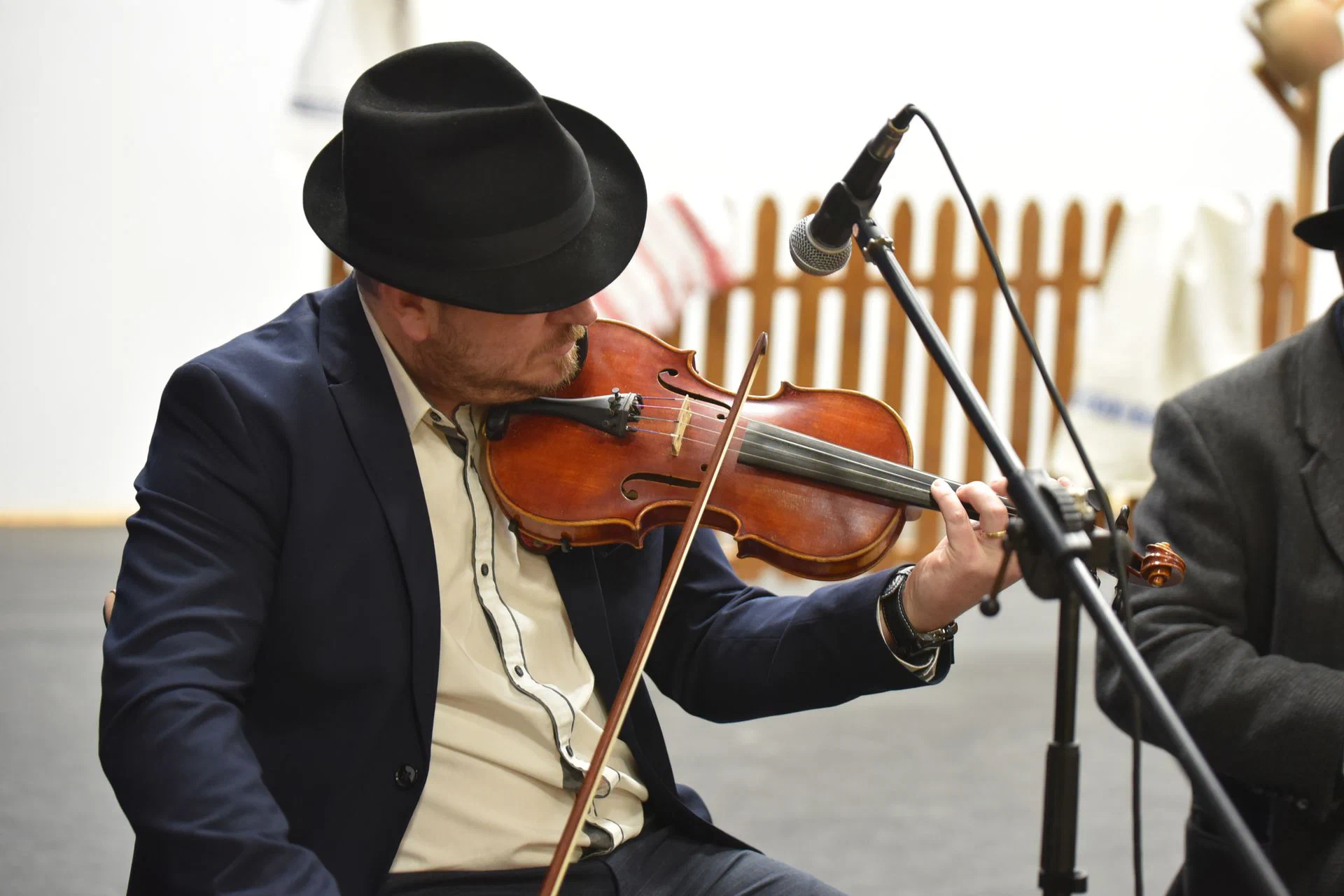
Play a minor scale, raise one note, and you are suddenly somewhere else entirely. The Hungarian minor scale is the sound people reach for when they want a violin to cry over a cimbalom, a café band in Budapest, or the dramatic slow opening of a Liszt rhapsody. It is only one note away from the harmonic minor you may already know, yet that one note gives it two exotic leaps and a strong personality of its own.
The Formula: Harmonic Minor with a Raised Fourth
Start from A harmonic minor: A, B, C, D, E, F, G♯. Raise the fourth degree from D to D♯ and you have A Hungarian minor.
| Degree | 1 | 2 | ♭3 | ♯4 | 5 | ♭6 | 7 |
|---|---|---|---|---|---|---|---|
| A Hungarian minor | A | B | C | D♯ | E | F | G♯ |
| A harmonic minor | A | B | C | D | E | F | G♯ |
The step pattern reads whole, half, augmented second, half, half, augmented second, half:
| Step | A to B | B to C | C to D♯ | D♯ to E | E to F | F to G♯ | G♯ to A |
|---|---|---|---|---|---|---|---|
| Semitones | 2 | 1 | 3 | 1 | 1 | 3 | 1 |
Notice the spelling. The fourth degree is D♯, not E♭, because each letter name appears exactly once. That matters when you read or write the scale: C to D♯ is an augmented second, a three-semitone gap written across neighbouring letters.
You can see this pattern directly in the Interactive Chord Finder. Select A as the root key and Hungarian Minor as the scale, and the step pattern shows two wide gaps separated by a run of three half steps (D♯, E, F). Press play and listen for those two leaps.
Two Augmented Seconds
Harmonic minor has one augmented second (F to G♯). Hungarian minor has two: C to D♯ and F to G♯. Those wide steps are what Western ears associate with Eastern European, Middle Eastern and Romani music. If you have read about the double harmonic scale, you will recognise the effect.
There is a second, subtler feature. The fifth degree (E) is surrounded by half steps on both sides: D♯ below it and F above it. And the root (A) has G♯ directly below it. That gives you three notes that lean by a half step into the two strongest tones of the scale:
- G♯ rises to A (the root)
- D♯ rises to E (the fifth)
- F falls to E (the fifth)
This is why melodies in Hungarian minor sound so insistent. Almost every phrase can end with a semitone sigh into A or E.
Diatonic Chords of A Hungarian Minor
Stacking thirds from each degree produces an unusual mix of chord qualities.
| Degree | Triad | Notes | Seventh chord | Notes |
|---|---|---|---|---|
| i | Am | A C E | AmMaj7 | A C E G♯ |
| II | B(♭5) | B D♯ F | B7♭5 | B D♯ F A |
| III+ | C+ | C E G♯ | Cmaj7♯5 | C E G♯ B |
| IV | D♯ (no standard name) | D♯ F A | (no standard name) | D♯ F A C |
| V | E | E G♯ B | Emaj7 | E G♯ B D♯ |
| VI | F | F A C | Fmaj7 | F A C E |
| vii | G♯m | G♯ B D♯ | G♯m6 | G♯ B D♯ F |
A few things stand out:
- The tonic is still A minor, so the scale sounds firmly minor.
- The augmented III chord (C augmented) carries over from harmonic minor. The diminished and augmented chords article explains why it sounds so unstable.
- The fourth-degree triad (D♯, F, A) is built from a diminished third and a diminished fifth. It is not a standard triad, and the Interactive Chord Finder marks it with an asterisk in the Diatonic Chords table. In practice it sounds like part of an F7 chord (F, A, E♭) and works as a colour rather than a chord to build progressions on.
- The V7 is Emaj7, not E7. The scale contains D♯ and no D, so there is no dominant seventh on E. Most music in this style simply uses E or E7 for the dominant and lets the melody adjust (more on that below).
Toggle the triad and seventh chord types in the tool to see both columns of the table update at once.
Hungarian Minor, Hungarian Gypsy and the Double Harmonic
Scale names in this family overlap and contradict each other between books, so it helps to compare the actual notes.
| Scale (as labelled in the tool) | Notes from A | Difference from Hungarian minor |
|---|---|---|
| Hungarian Minor | A B C D♯ E F G♯ | (reference) |
| Harmonic Minor | A B C D E F G♯ | Natural 4th |
| Hungarian Gypsy | A B C D♯ E F G | ♭7 instead of 7 |
| Romanian Minor | A B C D♯ E F♯ G | Natural 6th, ♭7 |
| Double Harmonic (from E) | E F G♯ A B C D♯ | Same notes, starts on E |
The last row is the important one. A Hungarian minor contains exactly the same seven notes as E double harmonic. Hungarian minor is the fourth mode of the double harmonic scale, which is why the two sound like close relatives.
The Hungarian Gypsy scale in the tool lowers the seventh to G, which removes the leading tone and gives a softer, more modal minor. Be aware that some sources use “Hungarian Gypsy” or “Gypsy minor” as another name for Hungarian minor itself, so always check the notes rather than the label.
The Romanian Minor row is worth knowing if you play klezmer. That scale (Dorian with a raised fourth) is the basis of the klezmer mode known as Mi Sheberach or altered Dorian. It shares the C to D♯ augmented second with Hungarian minor, which is a big part of why the two traditions sound related.
Where You Hear It
The scale gets its name from 19th-century Western composers who used it to evoke Hungarian music, especially the verbunkos style played by Romani bands. Franz Liszt’s Hungarian Rhapsodies are the textbook example: the raised fourth and augmented seconds colour many of their slow, rhapsodic passages. That association with Romani bands is why the scale is also called the “Gypsy minor” or “Gypsy scale” in older books.
Two caveats keep this accurate:
- Béla Bartók later showed that the old peasant music of Hungary is mostly pentatonic and modal. The Hungarian minor sound belongs to the urban, Romani-performed popular style, not to rural folk song.
- Klezmer relies more on Freygish (the tool’s Phrygian Dominant) and Mi Sheberach than on Hungarian minor itself. The shared augmented seconds give all three a family resemblance, and klezmer and Romani musicians in the same regions borrowed freely from each other.
Outside folk traditions, film composers and neoclassical metal guitarists use the scale for instant drama, usually over a pedal note or a minor vamp.
Improvising with Hungarian Minor
Start over a drone. Hold A and E (a bare fifth) on a keyboard or loop, then play the scale slowly above it. Without chord changes you can focus on the semitone pulls into A and E.
Target the leading tones. Build phrases that end G♯ to A, D♯ to E or F to E. Because E is enclosed on both sides, the figure F, D♯, E (approaching the fifth from above and below) sounds instantly idiomatic.
Use the augmented seconds as features, not obstacles. Slide or ornament across C to D♯ and F to G♯ rather than avoiding them. A turn around E (F, E, D♯, E) is a classic violin gesture.
Adapt the scale over the dominant. Over Am, play Hungarian minor freely. When the harmony moves to E or E7, switch D♯ to D natural, which turns the scale into A harmonic minor (E Phrygian Dominant from the chord’s point of view). Switch back when Am returns.
Try these progressions in the chord sequencer:
| Progression | Chords | Character |
|---|---|---|
| Lament | Am, F, E, Am | Dark, cadential |
| Verbunkos vamp | Am, B7♭5, E, Am | B7♭5 pulls into E |
| Drone | Am (held), melody only | Best for practising the scale |
The B7♭5 (B, D♯, F, A) acts like a secondary dominant of E. Its D♯ and F both squeeze toward E, the same pull you hear in the melody.
Where to Go from Here
The Hungarian minor sits at a crossroads of several scales on this site. To understand where it comes from, revisit the minor scales guide and the double harmonic scale, its parent. For another tradition that builds strong character from half steps, read about Japanese scales, and use the scales reference to compare formulas side by side. Then open the Interactive Chord Finder, set A as the root, and switch between Hungarian Minor, Hungarian Gypsy, Romanian Minor and Double Harmonic to hear exactly what each changed note does.
Practice Chords
Drill chord recognition with a metronome, MIDI support, and score tracking.
Start PracticingRelated Articles

Balinese Pelog and Gamelan Scales: Slendro, Pelog and How to Evoke Them
Oct 31, 2026 · 7 min
A Harmonic Minor Scale: Notes, Chords, and How to Play It
Apr 18, 2026 · 8 min
B Harmonic Minor Scale: Notes, Chords, and How to Play It
Apr 18, 2026 · 6 min