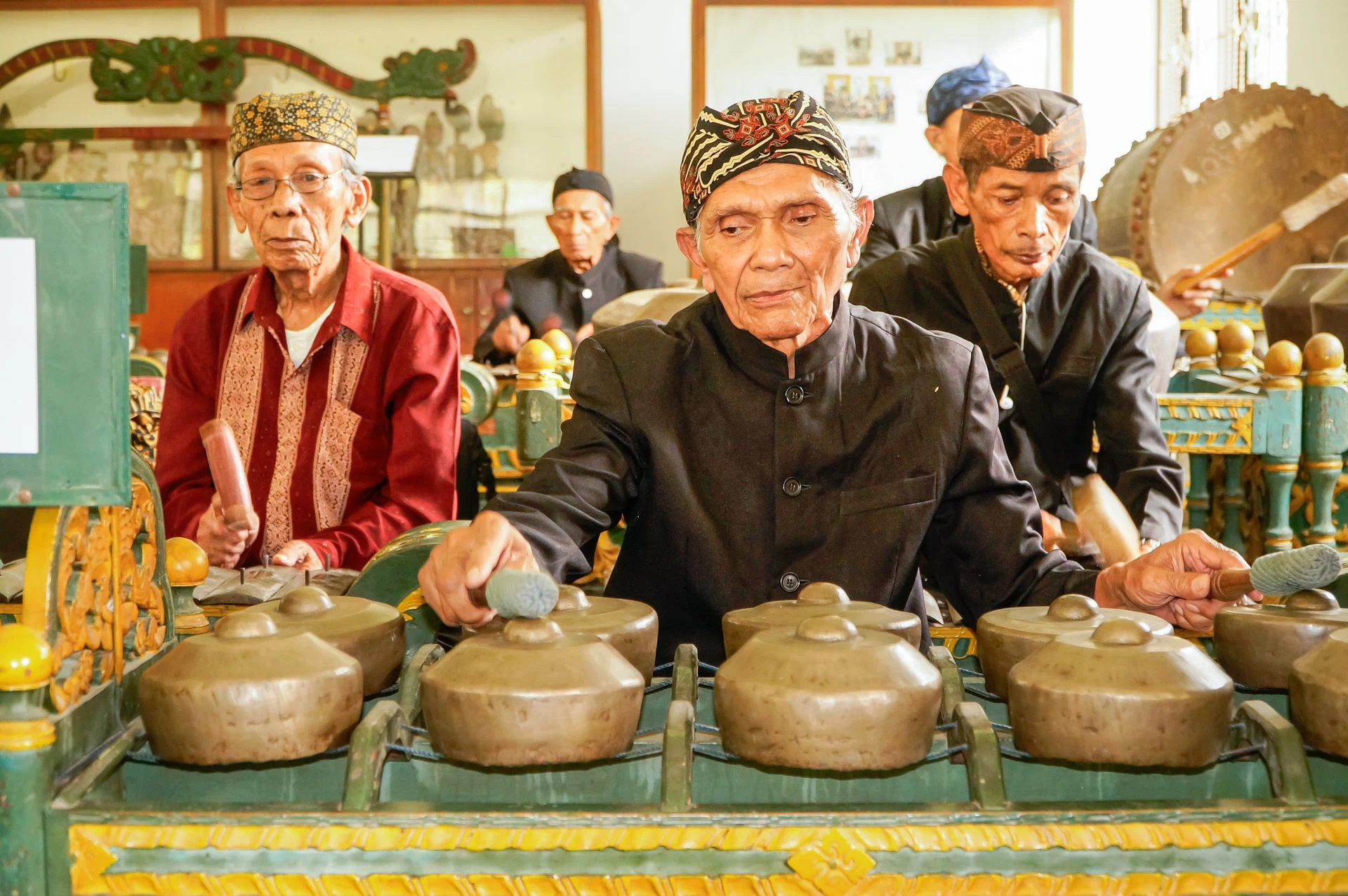
Hear a Balinese gamelan for the first time and two things stand out: the shimmer of dozens of bronze keys ringing together, and melodies that sound almost like a familiar scale but not quite. That “not quite” is the heart of the subject. Gamelan scales are not pieces of the piano keyboard. They are their own tuning systems, and understanding that is the first step to using them well in your own music.
What Gamelan Is
A gamelan is an ensemble of mostly bronze percussion instruments from Indonesia, above all Java and Bali. It includes metallophones (keyed instruments struck with mallets), sets of tuned gong-chimes, large hanging gongs, drums, and sometimes flute, bowed string and voice. The instruments are made and tuned together as one set, so a gamelan is closer to a single instrument played by a whole group than to an orchestra of separate parts.
That point matters for scales. There is no universal reference pitch like A = 440 Hz. Each ensemble has its own tuning, set by its smith, and two gamelans playing the “same” scale can differ noticeably. Any Western spelling of a gamelan scale is a convenient approximation, never the real thing.
Slendro and Pelog: The Two Tuning Systems
Gamelan music uses two tuning systems, slendro and pelog. Many Javanese ensembles own a full set of instruments in each.
| Feature | Slendro | Pelog |
|---|---|---|
| Tones per octave | 5 | 7 |
| Step sizes | Roughly equal, each between a whole step and a minor 3rd | Unequal, a mix of small and large steps |
| Rough Western comparison | Similar in feel to the major pentatonic, but with no exact match | Contains intervals close to half steps and major 3rds |
| Typical use | Five-note melodies using all tones | Five-note modes chosen from the seven tones |
Slendro divides the octave into five steps that are close to equal in size, around 240 cents each in theory (a piano half step is 100 cents). Real ensembles vary from that average, sometimes a lot. Because no step is as small as a half step, slendro sounds smooth and open, a little like the major pentatonic, yet clearly “out of tune” to a piano-trained ear.
Pelog has seven tones per octave with deliberately unequal steps: some small, close to a half step, and some large, close to a major 3rd. Musicians rarely use all seven at once. Instead, a piece draws a five-note mode from the seven tones. In Java these modal frameworks are called pathet; in Bali the most widespread five-tone pelog mode is selisir, the tuning of the popular gong kebyar ensemble.
The Tool’s Pelog and Balinese Scales
The Interactive Chord Finder uses twelve-tone equal temperament, like a piano, so it cannot reproduce real gamelan tuning. What it offers are two five-note approximations that capture the shape of pelog modes: where the small steps fall and where the big leaps are.
| Scale in the tool | Step pattern (half steps) | Degrees | Notes on E |
|---|---|---|---|
| Balinese | 1, 2, 4, 1, 4 | 1, ♭2, ♭3, 5, ♭6 | E, F, G, B, C |
| Pelog | 1, 2, 4, 3, 2 | 1, ♭2, ♭3, 5, ♭7 | E, F, G, B, D |
Both start with the same three notes: a half step, a whole step, then a major 3rd leap to the 5th. The Balinese version mirrors that small-small-large shape in its upper half (B, C, then a leap back to E), which makes it the common Western stand-in for selisir. The Pelog version replaces the ♭6 with a ♭7 and sounds a little less dark.
Choose E as the root key and Balinese as the scale, then switch to Pelog. On E, both scales use only white keys, which makes them easy to explore on a real keyboard. Press play on the step pattern and listen for the cluster of E, F and G against the open space above. Treat the Diatonic Chords table as a palette of colour rather than a set of functional chords: gamelan music is built on layered melody, not on chord progressions.
Why These Scales Sound So Distinct
Compared with the Western E minor pentatonic (E, G, A, B, D), the Balinese approximation swaps smooth whole steps and minor 3rds for a contrast of extremes. It has two half steps (E to F and B to C) and two major 3rd leaps (G to B and C to E). That alternation of tight and wide is something it shares with the Japanese scales hirajoshi and iwato, which is why the two traditions can sound related to Western ears even though their history and tuning are very different.
The half step above the root (♭2) gives both scales an exotic edge, a colour they also share with several Indian ragas such as Todi, covered in our guide to raga scales Todi, Marva and Purvi. The difference is in the texture: raga melody often unfolds slowly over a drone, while gamelan stacks many fast, interlocking layers.
Evoking Gamelan Textures
Getting the notes right is only half the effect. The texture is what makes music sound like gamelan. Four techniques do most of the work.
Interlocking patterns
In Balinese gamelan, fast figurations called kotekan are split between two players. One part (polos) and its partner (sangsih) each play only some of the notes, and together they form a continuous, rapid line that neither could play alone at that speed. Here is a simplified sketch using the Balinese scale on E, played as eight fast pulses:
| Pulse | 1 | 2 | 3 | 4 | 5 | 6 | 7 | 8 |
|---|---|---|---|---|---|---|---|---|
| Part A | E | G | F | E | ||||
| Part B | F | B | G | F | ||||
| Combined | E | F | G | B | F | G | E | F |
Program the two parts on separate tracks, pan them slightly apart, and loop them. The composite line has a jittery, glittering momentum that a single part would never have.
Gongs that mark the cycle
Gamelan pieces are built on repeating cycles, and the end of each cycle is marked by the deepest gong. Smaller gongs divide the cycle into halves and quarters. To imitate this, use a low, long-ringing sound on the root (E) once every 16 or 32 beats, and a higher gong-like sound on the 5th (B) at the halfway point. The rhythm of punctuation matters more than the exact sound.
Drones and a slow core melody
Under the busy surface sits a slower core melody, often one note per beat or slower, played on lower metallophones. Write a simple line using four or five notes of the scale, then double it an octave higher at twice the speed, then add the interlocking parts on top. You now have three time layers moving together, the essential structure of the style.
Shimmering tuning
Balinese ensembles tune instruments in pairs, one slightly higher than the other, so that when both play the same note they produce a fast beating called ombak (“wave”). In a DAW, duplicate a bell or mallet track and detune the copy by a few cents. That pulsing shimmer instantly moves the sound away from a clean piano and toward the gamelan.
Respecting the Tradition
Using pelog or slendro colours in film music, ambient tracks or game soundtracks is a long-standing practice, and composers from Debussy onward were inspired by hearing gamelan. Keep two things in mind. First, a twelve-tone approximation is a nod to the sound, not a recreation of it. Second, gamelan is a living tradition with its own repertoire, theory and teachers. If the sound grips you, listen to recordings of real Balinese and Javanese ensembles: the tuning, the dynamics and the sudden tempo shifts of gong kebyar are impossible to capture in a scale chart.
Where to Go from Here
Pelog and Balinese scales sit alongside many other five-note systems in the Interactive Chord Finder. Compare them with the pentatonic scales you already know, revisit the Japanese scales to hear another tradition built on half steps and major 3rds, and explore raga-inspired scales for a third take on the ♭2.
Then open the Interactive Chord Finder, choose E as the root key with the Balinese scale, and build your own interlocking pattern. Two simple parts, one deep gong and a little detuning are enough to transport a listener halfway around the world.
Practice Chords
Drill chord recognition with a metronome, MIDI support, and score tracking.
Start PracticingRelated Articles

Japanese Scales: Hirajoshi, Iwato, and Yo Explained
Apr 9, 2026 · 7 min
A Minor Pentatonic Scale: Notes, Shapes, and How to Play It
Apr 21, 2026 · 7 min
B Minor Pentatonic Scale: Notes, Shapes, and How to Play It
Apr 21, 2026 · 6 min