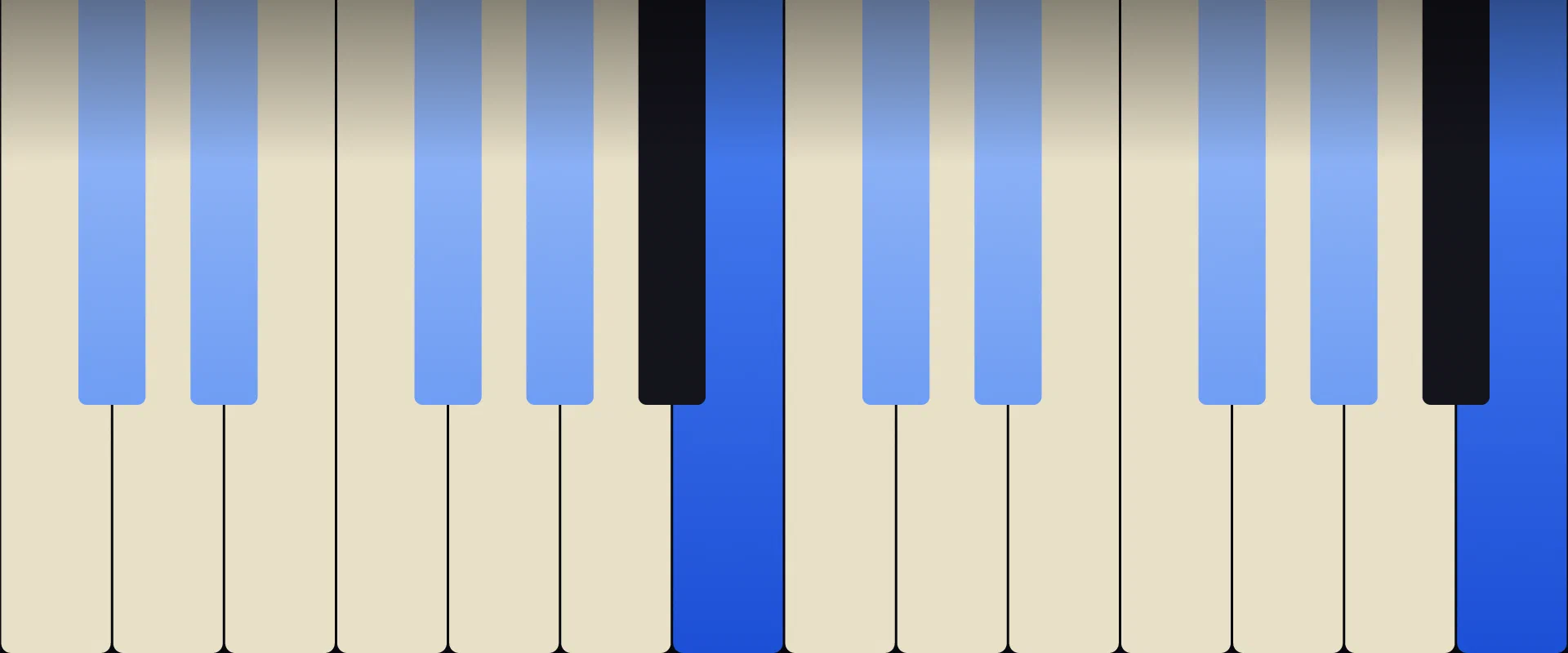
B6/9 is B, D♯, F♯, G♯ and C♯. Sort those five upward and they read B, C♯, D♯, F♯, G♯, which is B major pentatonic note for note, with nothing added and nothing left over. Play the chord and you have played the scale. Solo over it with that scale and every note you touch is already sounding underneath you.
That is the character of a six nine chord. It is a major triad with a sixth and a ninth added, not a thirteenth chord with pieces missing. There is no seventh in it anywhere, so nothing leans, nothing is owed and there is nowhere it has to go next, which is why arrangers put it in the final bar and let it ring.
Try It: B6/9 in the Chord Finder
Set the root to B and try it against B major, B lydian and B mixolydian in turn. Those three scales disagree about the fourth degree and the seventh, and this chord uses neither, so all five notes stay lit whichever is selected.
The Notes of B6/9
| Degree | Note | Interval from root | Semitones |
|---|---|---|---|
| 1 (root) | B | Perfect unison | 0 |
| 3 | D♯ | Major 3rd | 4 |
| 5 | F♯ | Perfect 5th | 7 |
| 6 | G♯ | Major 6th | 9 |
| 9 | C♯ | Major 9th | 14 |
Written out: B, D♯, F♯, G♯, C♯. The sixth is written as a sixth and kept low, near the fifth, while the ninth is written as a ninth and kept high, above the third. That placement, rather than any difference of pitch, is what separates this chord from a thirteenth.
Four of the five notes are black keys and the only white key is the root. None is a spelling trap: every sharp falls on a black key where the eye looks for it.
How B6/9 Is Built
Start with the plain B major triad, B, D♯ and F♯. Add G♯ and you have B6. Add C♯ as well and you have this chord. Both additions are pure gain, since neither displaces anything and the triad stays intact underneath.
Now look at the chord against its own key signature. B major carries five sharps, F♯, C♯, G♯, D♯ and A♯, in that order. B6/9 uses the root and the first four of them and stops. The one it does not touch is A♯, the leading note, which is precisely what would turn this into Bmaj7 and hand it an obligation. The chord is its own key with the urgency removed.
Arranged in fifths rather than thirds those same notes read B, F♯, C♯, G♯, D♯, an unbroken chain of five neighbours on the circle of fifths, with nothing in the chord closer than a whole tone to anything else in it. Hence air rather than cluster.
One more reading, and it is the strange one. Put C♯ in the bass and these five notes become C♯11, a dominant with a job to do, and the type is covered on B11. It runs both ways: the notes of B11 spell A6/9 over an A bass. The bass note alone decides whether the harmony rests or travels.
B6/9 on the Piano
Give B and D♯ to the left hand, a major third apart under fingers 5 and 3. The right hand then takes G♯, C♯ and F♯, and those three are stacked perfect fourths, five semitones and five semitones, all of them black keys. The span is ten semitones, the shape sits under 1, 2 and 5, and the hand rests back among the black keys without ever coming forward.
That fourths voicing is the sound most listeners associate with this chord. Play the same five notes closed up instead, B in the left hand and D♯, F♯, G♯, C♯ in the right, and the result is noticeably thicker: F♯ and G♯ are a whole tone apart in the middle of the hand, and the chord starts to sound like a sixth chord with something extra rather than one open sonority. Both are correct. Only one is the reason people write the symbol.
The close version also puts the thumb on a black key, which with four black keys and one white is hard to avoid. Handing the D♯ to the left hand fixes that in a single move.
B6/9 on the Guitar
x 2 1 1 2 2 is the chord complete: B, D♯, G♯, C♯ and F♯, one of each, nothing doubled. Middle finger on the fifth string at the second fret, index flat across the fourth and third strings at the first, ring finger flat across the top two at the second. Everything happens inside two frets.
It is also one finger away from a dominant. B9 in the same position is x 2 1 2 2 2, and the only difference is the third string: fret 2 gives A and a chord that must resolve, fret 1 gives G♯ and a chord that has arrived. Play the two alternately and the distinction between dominant and tonic harmony is audible under a single finger.
The cost is where those frets sit. This close to the nut the strings are tight and unforgiving, and two flattened fingers there need real pressure. Lifting the top string, x 2 1 1 2 x, drops the fifth and leaves root, third, sixth and ninth, which is easier and loses almost nothing.
Up the neck it becomes a fingerpicker’s shape rather than a strummer’s. 7 x 6 8 x 9 puts the root on the sixth string at the seventh fret and sounds B, G♯, D♯ and C♯, skipping the fifth and second strings entirely. Struck with a plectrum it is a mess of muted strings. Played with the fingers it is beautiful.
Keep the B6 barre nearby for comparison, one finger flat across the top four strings at the fourth fret. Moving between the two is the quickest way to hear what the C♯ contributes.
Inversions
| Inversion | Notes | Bass | Symbol |
|---|---|---|---|
| Root position | B D♯ F♯ G♯ C♯ | B | B6/9 |
| 1st inversion | D♯ F♯ G♯ C♯ B | D♯ | B6/9 over D♯ |
| 2nd inversion | F♯ G♯ C♯ B D♯ | F♯ | B6/9 over F♯ |
| 3rd inversion | G♯ C♯ B D♯ F♯ | G♯ | B6/9 over G♯ |
| 4th inversion | C♯ B D♯ F♯ G♯ | C♯ | B6/9 over C♯ |
This chord changes identity under inversion more readily than most, because none of its notes is committed to a role. With G♯ in the bass the five are a G♯ minor seventh with a C♯ added a fourth above its root, so the chord has become minor without a hand moving. With C♯ in the bass it is a dominant. Only root position sounds finished, which matters when sounding finished was the reason you chose it. See Chord Inversions and Voice Leading.
Voicings
Keep the sixth low and the ninth high. G♯ under C♯ is the arrangement the symbol describes, and reversing them sounds like a mistake nobody can name.
| Shape | Frets | Result |
|---|---|---|
| B6/9 | x 2 1 1 2 2 | All five notes, one each |
| B6/9 | x 2 1 1 2 x | Four notes, no 5th |
| B6/9 | 7 x 6 8 x 9 | Fingerstyle, root on 6th string |
| B9 | x 2 1 2 2 2 | One fret away, and a dominant |
| B6 | x x 4 4 4 4 | The same chord without the 9th |
Which Keys Contain B6/9
- I of B major
- I of B lydian
- I of B mixolydian
- IV of F♯ major
- V of E major
- III of G♯ natural minor
The first three rows are the point of the chord. B major, B lydian and B mixolydian disagree about the fourth degree and the seventh, the only two degrees this chord declines to use, so it is the first degree of all three at once. A tonic that will not say which major mode it belongs to is exactly what a melody that has not decided yet wants underneath it.
It appears in flat keys too, under another name. E♭ natural minor holds it on its sixth degree, where that page spells it C♭, E♭, G♭, A♭, D♭: the same five sounds, every letter different, which is what happens when a chord rooted on B has to live in a key with no B in it.
Where B6/9 Shows Up
| Progression | Chords | Context |
|---|---|---|
| Final cadence (B major) | F♯7, B6/9 | The last bar, held |
| IV I (F♯ major) | F♯6/9, B6/9 | Bossa nova, both open |
| Brightening (G♯ minor) | G♯m7, C♯m7, B6/9 | The relative major |
| Tonic vamp (B major) | Bmaj7, B6/9 | The seventh comes and goes |
The first row is the job this chord was invented for. F♯7 is B major’s dominant, full of tension, and the expected answer is a plain B triad. Answer it with B6/9 instead and the tension resolves completely while the sound stays wide open: a triad in the last bar is a full stop, and this is a door left ajar. Every arrangement that ends on a held chord rather than a stab is ending on some version of it.
The third row is where the chord earns its keep in the middle of a piece rather than at the end. In G♯ minor, B is the relative major, and arriving there on a plain B triad after two minor sevenths is a jolt. B6/9 brightens the same way without the gear change, because C♯ and G♯ both belong to the minor key the music has just left.
There is a practical reason B is a good root for this. B major is a hard key on the guitar, with no open strings to lean on and five sharps for anybody reading. The six nine chord is the exception: x 2 1 1 2 2 sits inside the first two frets, so a guitarist handed a chart in B has at least one chord that costs nothing.
Related Chords
- B Major 6th Chord, this chord without the ninth
- B Add9 Chord, this chord without the sixth
- B Major Chord, the triad both additions are resting on
- B Major 9th Chord, what happens when A♯ is allowed in
- B Dominant 13th Chord, the same G♯ over a seventh
- B Dominant 11th Chord, five notes that spell a six nine chord on A
Learn More
Practice Chords
Drill chord recognition with a metronome, MIDI support, and score tracking.
Start Practicing