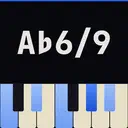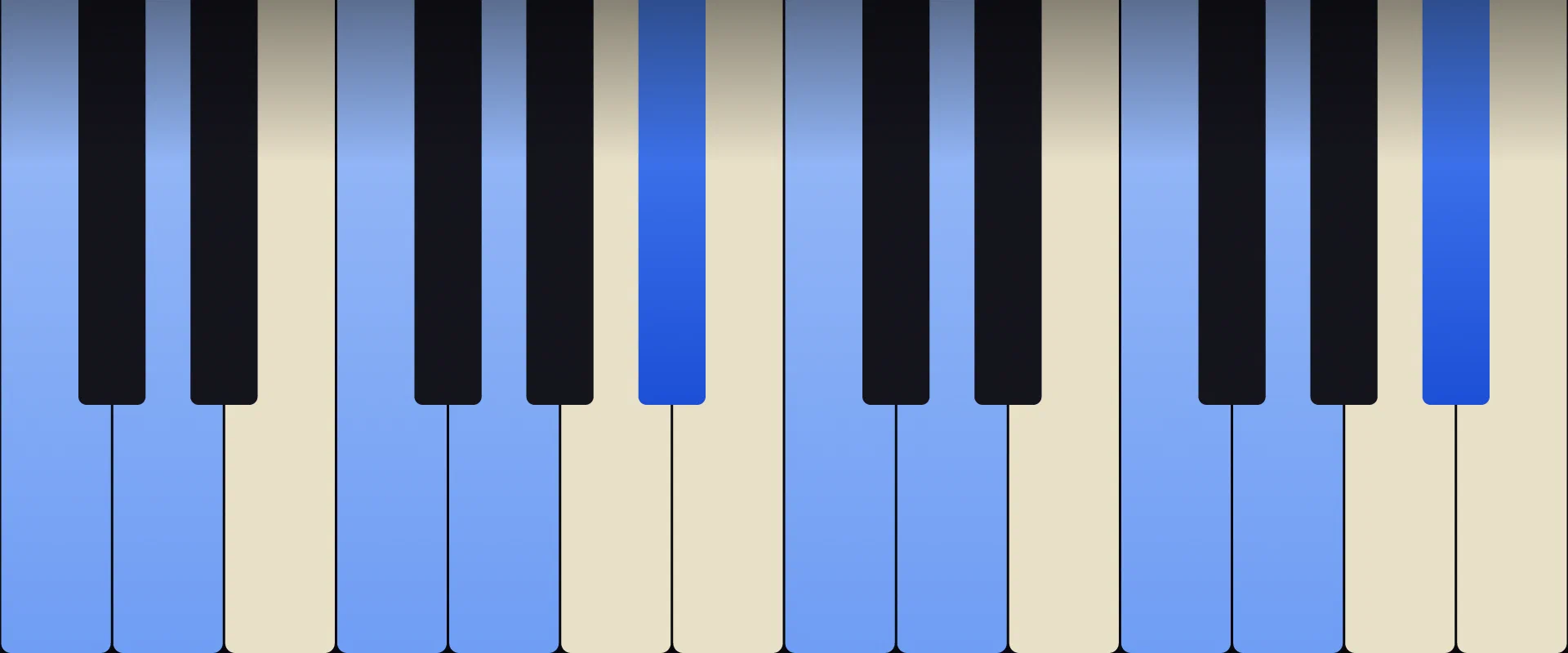
Play the B♭ major pentatonic scale, then sound all five notes at once. That is B♭6/9 exactly: B♭, C, D, F and G, rearranged as root, major third, perfect fifth, major sixth and major ninth. There is no seventh in it, and that absence is the whole design. A seventh, major or minor, promises that something else is coming. Without one, this chord has no note that wants to move and nothing left to resolve. It is what arrangers reach for when a piece has finished and needs to sound finished, and why the last chord of a big band chart is so often a 6/9 and not a triad.
Try It: B♭6/9 in the Chord Finder
Set the root to B♭ and choose B♭ major, then look at the first degree with the Sixth toggle on and the Seventh off. Switch the Seventh on and hear the chord stop being an ending.
The Notes of B♭6/9
| Degree | Note | Interval from root | Semitones |
|---|---|---|---|
| 1 (root) | B♭ | Perfect unison | 0 |
| 3 | D | Major 3rd | 4 |
| 5 | F | Perfect 5th | 7 |
| 6 | G | Major 6th | 9 |
| 9 | C | Major 9th | 14 |
Written out: B♭, D, F, G, C. The sixth stays at nine semitones while the ninth belongs an octave above the root rather than a whole tone above it, and that difference in placement keeps the two added notes from crowding each other.
How B♭6/9 Is Built
Begin with the B♭ major triad, B♭, D and F. Add the sixth, G, and you have B♭6. Add the ninth, C, and the chord is complete. Nothing is stacked in thirds above a seventh, because there is no seventh: both extra notes are added to a triad, which is why the symbol writes them as a pair rather than as one number.
That matters for reading charts. B♭13 also contains a G, but with an A♭ underneath, and that minor seventh turns the G into a thirteenth and the chord into a dominant with somewhere to go. Take the A♭ away and the same G becomes a sixth. One note is the whole difference between a chord that pushes and a chord that settles, as B♭11 shows from the other direction.
The rearrangement worth knowing is upward. Read the five notes from the C instead of the B♭ and they spell C, G, B♭, D and F, which is C11 note for note. The same pitches are a settled major chord on B♭ and an unsettled dominant on C, and only the bass decides which.
B♭6/9 on the Piano
Just one of the five notes is a black key, the B♭ itself. D, F, G and C are white, so once the left hand has found the root the right hand works on flat ground.
The classic voicing takes advantage of that. Put B♭ in the left hand and play D, G, C and F in the right. Those are three perfect fourths stacked on each other, all four notes white, under fingers 1, 2, 3 and 5 with no stretch worth mentioning. Check the arithmetic: D to G, G to C and C to F are each five semitones, and all four notes belong to the chord. Fourths sound open rather than sweet, which is how this chord ends a piece without sounding like a hymn.
The sweeter alternative keeps the triad audible. Left hand takes B♭ and F, right hand plays D, G and C, third at the bottom and ninth on top. Roll it slowly and it rings like a bell. Either way, keep the sixth and ninth apart: G and C in the same low octave is where this chord turns to mud.
B♭6/9 on the Guitar
This is the root where the guitar gets lucky. The movable fifth string 6/9 shape needs a fret below the one its root is on, which rules out the open position and makes the first fret the lowest it can ever sit. B♭ is the note on the fifth string at the first fret, so B♭ is the only root in the twelve at which this shape uses open strings.
The grip is x 1 0 0 1 1: fifth string at the first fret, fourth and third open, second and first at the first fret. It sounds B♭, D, G, C and F, which is root, third, sixth, ninth and fifth, all five notes with none doubled and none missing, and no barre in it. Middle finger on the fifth string, index laid across the top two, and the open D and G ringing between them are the chord’s own third and sixth.
Drop the top string for x 1 0 0 1 x and you have the four note version, B♭, D, G and C, ninth on top and fifth left out. That is what a comping guitarist actually uses: quiet, compact, and it stops ringing the moment the hand relaxes.
The sixth string form sits at the sixth fret: 6 8 8 7 8 8 gives B♭, F, B♭, D, G and C, all five notes with the root doubled. It is a genuine barre, and holding the eighth fret on four strings while the third string stays at the seventh asks for a second small barre from the little finger. Most players prefer the first fret shape, which is not a sentence one often gets to write about a chord rooted on B♭.
Inversions
| Inversion | Notes | Bass | Symbol |
|---|---|---|---|
| Root position | B♭ D F G C | B♭ | B♭6/9 |
| 1st inversion | D F G C B♭ | D | B♭6/9/D |
| 2nd inversion | F G C B♭ D | F | B♭6/9/F |
| 3rd inversion | G C B♭ D F | G | B♭6/9/G |
| 4th inversion | C B♭ D F G | C | B♭6/9/C |
With no seventh to argue with, this chord keeps its character under every bass note, and two rows are more useful as other chords than as inversions. With G at the bottom, G, B♭, D and F is a G minor seventh and the remaining C is its eleventh, so B♭6/9 over G is a ready made Gm11 without its ninth. With C at the bottom it is C11. Players exploit this constantly: hold the shape, give the bass player a different note, and the harmony changes without a finger moving. See Chord Inversions and Voice Leading.
Voicings
Ninth on top, or sixth on top, but not both in the middle. The two added notes are a whole tone apart, and that whole tone needs room around it.
| Shape | Frets | Result |
|---|---|---|
| B♭6/9 | x 1 0 0 1 1 | All five notes, two open strings |
| B♭6/9 | x 1 0 0 1 x | Four notes, 9th on top, no 5th |
| B♭6/9 | 6 8 8 7 8 8 | Sixth string barre form, root doubled |
| B♭6 | x 1 3 0 3 x | The chord without the ninth |
| B♭ major | x 1 3 3 3 1 | The triad underneath both added notes |
Which Keys Contain B♭6/9
- I of B♭ major
- IV of F major
- V of E♭ major
- III of G natural minor
- VI of D natural minor
- I of B♭ lydian
- I of B♭ mixolydian
The first three rows are neighbours on the circle of fifths, and that is no coincidence. A major pentatonic contains no semitones, so it fits inside any major key holding all five of its notes, and B♭, F and E♭ major are the three that do. A chord belonging equally to three keys is unusually portable, which is part of why it works as an ending: it can arrive from anywhere.
Rows six and seven make the same point. B♭ lydian and B♭ mixolydian disagree about the fourth and seventh degrees, and this chord has neither, so it is the tonic of both without adjustment.
The five notes are also the whole of the G minor pentatonic scale, what a blues guitarist plays in G.
Where B♭6/9 Shows Up
| Progression | Chords | Context |
|---|---|---|
| ii V I in B♭ major | Cm7, F13, B♭6/9 | The final chord of the chart |
| IV in F major | F, B♭6/9, F | Plagal, with nothing pulling |
| Relative major arrival | Gm7, Cm7, B♭6/9 | Minor blues resolving upward |
| Held ending | B♭6/9 over a pedal B♭ | Where the band stops together |
B♭ is a horn key, and this is the chord horns finish on. Concert bands tune to concert B♭, the trumpet, clarinet, soprano and tenor saxophone are built in it and the alto and baritone saxophone in E♭. Look at what the players see. The trumpet part is written a whole tone higher and says C6/9, which is C, E, G, A and D. The alto part is written a major sixth higher again and says G6/9, which is G, B, D, E and A. Every note in both parts is a natural: the concert chord has a flat in it and not one member of the saxophone section reads one. It is also easy to tune, having no seventh grinding against anything, and it asks nobody to resolve after the last beat.
The second row is the guitar’s favourite. In F major, B♭6/9 is the fourth chord, and the near open grip can be played softly and released cleanly in a way a barre chord cannot. Move from F to B♭6/9 and back and the motion is plagal, the amen cadence, but the added sixth and ninth stop it sounding devotional. Brazilian guitarists use exactly this, which is how the chord became a fixture in bossa nova.
The third row is the one to steal. Play a minor blues in G and end on B♭6/9 with the G still ringing in the bass rather than on Gm. Not a note has changed, since B♭6/9 over G is a G minor eleventh without its ninth, but the chord has stopped sounding minor and started sounding open.
Related Chords
- B♭ Major Chord, the triad both notes are hung on
- B♭ Major 6th Chord, the same G with no ninth beside it
- B♭ Add9 Chord, the same C with no sixth beside it
- B♭ Major 9th Chord, what a seventh does to all this
- G Minor 7th Chord, four of these notes read from the G
- B♭ Dominant 11th Chord, another chord named by its bass note
Learn More
Practice Chords
Drill chord recognition with a metronome, MIDI support, and score tracking.
Start Practicing