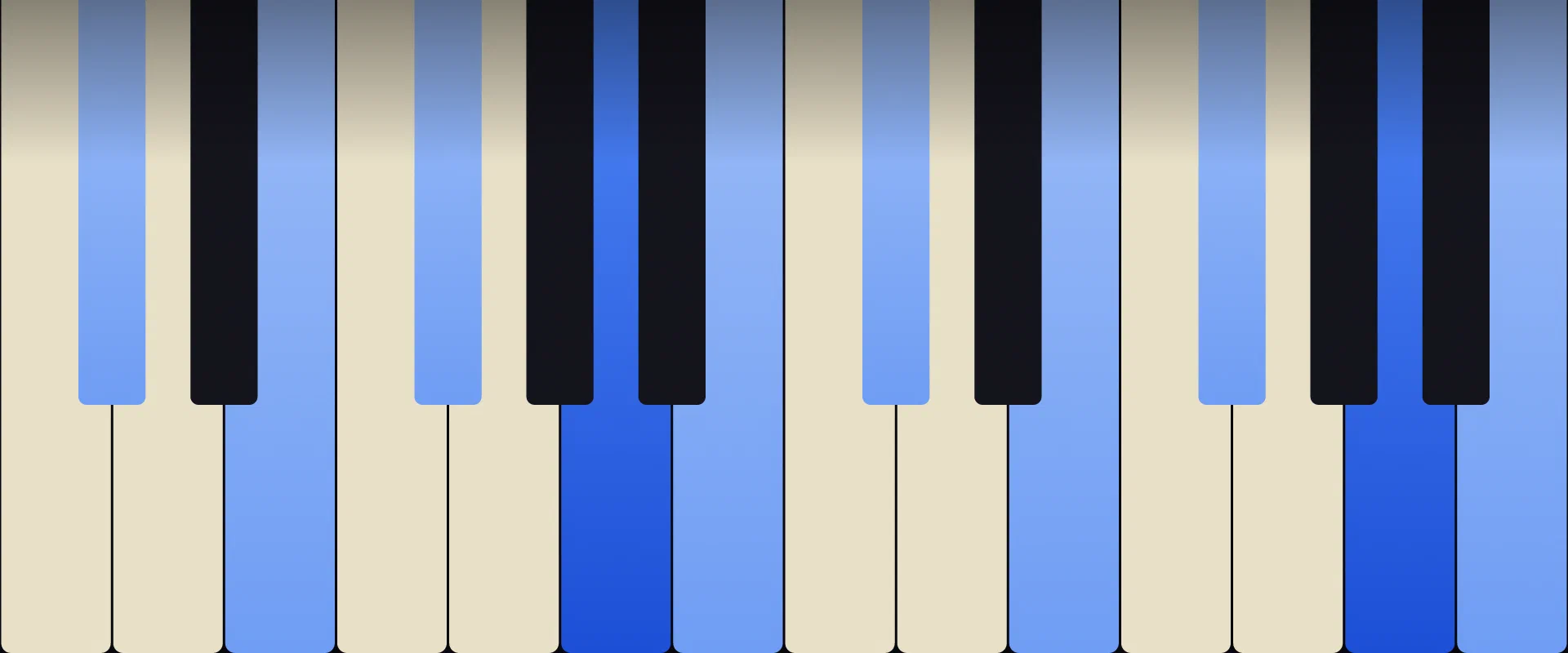
Play the A major pentatonic scale, then play all five notes together. A, B, C♯, E and F♯ is the scale; A, C♯, E, F♯ and B is A6/9, root, major third, perfect fifth, major sixth and major ninth. The same five notes. A guitarist who has soloed in A for years has been walking around inside this chord without knowing its name.
That identity explains the sound. A pentatonic scale has no semitones in it anywhere, so no two notes of A6/9 are a semitone apart and nothing in the chord grates against anything else. There is also no seventh, major or minor, so nothing leans towards a resolution. The chord is finished the moment it sounds, which is why arrangers reach for it in the last bar.
Try It: A6/9 in the Chord Finder
Set the root to A and choose A major pentatonic. The five notes the finder lights on the keyboard are this chord, note for note. Switch to A major and the two notes that appear, D and G♯, are the ones this chord leaves out.
The Notes of A6/9
| Degree | Note | Interval from root | Semitones |
|---|---|---|---|
| 1 (root) | A | Perfect unison | 0 |
| 3 | C♯ | Major 3rd | 4 |
| 5 | E | Perfect 5th | 7 |
| 6 | F♯ | Major 6th | 9 |
| 9 | B | Major 9th | 14 |
Written out: A, C♯, E, F♯, B. Two black keys, C♯ and F♯, and three white ones. The B is written as a ninth rather than a second because it belongs an octave above the root, which is not a technical detail: play it down beside the A and the whole open quality collapses.
How A6/9 Is Built
Start with the A major triad, A, C♯ and E. Add the sixth, F♯, and the ninth, B. That is the whole construction, and what matters is what never happens: no seventh is added. This is not a thirteenth chord with notes missing. Set it beside A13, which is A, C♯, E, G, B and F♯, and the difference is one note, the G, and that G is the whole argument. With it the chord is a dominant and has somewhere to go. Without it the chord has arrived.
Spread the notes from the bottom and they come out as A, E, B, F♯, C♯: four perfect fifths stacked one on another with nothing else in the pile. The fifth is the widest interval that still sounds consonant, which is why this chord stays transparent at a size where most turn muddy.
Read the same notes from B and they are B11, a dominant eleventh, complete. That is the relationship A11 has with G6/9, turned around.
A6/9 on the Piano
The two black keys sit either side of the hand’s resting position, so the shape is comfortable in a way the note count does not suggest. Give the A to the left hand and the right takes C♯, E, F♯ and B under thumb, index, middle and little finger, with no stretch worth mentioning.
The better sound splits it differently. Left hand plays A and the E above, an open fifth, and the right hand plays C♯, F♯ and B, which is a fourth and another fourth stacked. That quartal shape is the sound of a 6/9 chord in every piano record that ever used one. The fifth below and the fourths above keep the whole thing wide and hollow, which is what is wanted at an ending where a dense chord would sound like an apology.
One warning: slide the right hand’s B down to the A beside it and the seconds close up, turning the sound from open to cluttered in one movement. The ninth has to stay a ninth.
A6/9 on the Guitar
There is an open form and it is good: x 0 4 4 2 0. It sounds A on the open fifth string, F♯ on the fourth at the 4th fret, B on the third at the 4th, C♯ on the second at the 2nd and E on the open first: all five notes with none doubled and none added. Two open strings carry the outer voices, root at the bottom and fifth at the top, and the fretted notes sit in the middle. Ring and little finger take the pair at the 4th fret, index takes the 2nd, and nothing is barred.
Check any 6/9 grip you are handed, because the shapes near this one are not this chord. x 0 2 1 2 0 looks similar and is the open A major seventh: it contains a G♯. This chord has no seventh at all, so any grip for A6/9 that sounds a G or a G♯ is a different chord wearing the wrong label.
Two variations earn their place. x 0 4 4 2 2 puts F♯ on the top string instead of E, dropping the fifth to double the sixth, which is thinner and sweeter and suits a band with a bass player in it. Higher up, the E shape barred at the 5th fret gives 5 7 7 6 7 7, sounding A, E, A, C♯, F♯ and B: all five notes with the root doubled, index barred at the 5th and the little finger holding two strings at the 7th. It is not easy, but it is the only way up the neck without losing a note.
One finger separates the open form from a chord you know. Open Aadd9 is x 0 2 4 2 0, and moving the fourth string from the 2nd fret to the 4th turns its E into F♯.
Inversions
| Inversion | Notes | Bass | Symbol |
|---|---|---|---|
| Root position | A C♯ E F♯ B | A | A6/9 |
| 1st inversion | C♯ E F♯ B A | C♯ | A6/9/C♯ |
| 2nd inversion | E F♯ B A C♯ | E | A6/9/E |
| 3rd inversion | F♯ B A C♯ E | F♯ | A6/9/F♯ |
| 4th inversion | B A C♯ E F♯ | B | A6/9/B |
A chord with no seventh and no leading note is unusually tolerant of its own inversions, and three of these have separate lives. Over F♯ the notes are an F♯ minor seventh with an eleventh added, the relative minor’s version of the same colour and just as final. Over B the chord is B11 in root position, a dominant, which is a change of function bought by moving one bass note. Over E it becomes a suspended chord with a ninth and a sixth and no third, which hangs beautifully and then wants the root back. See Chord Inversions and Voice Leading.
Voicings
| Shape | Frets | Result |
|---|---|---|
| A6/9 | x 0 4 4 2 0 | Open form, all five notes |
| A6/9 | x 0 4 4 2 2 | Sixth on top, no fifth |
| A6/9 | 5 7 7 6 7 7 | E shape barred at the 5th |
| A6 | x 0 2 2 2 2 | This chord without its ninth |
| Aadd9 | x 0 2 4 2 0 | This chord without its sixth |
| Amaj7 | x 0 2 1 2 0 | Not this chord: it has a G♯ |
Which Keys Contain A6/9
- I of A major
- V of D major
- IV of E major
- VI of C♯ natural minor
- III of F♯ natural minor
- I of A lydian
- I of A mixolydian
The three major keys, D, A and E, sit next to each other on the circle of fifths, and the chord is tonic in one, dominant in another and subdominant in the third. One grip, three jobs.
Three of the rows are modes rooted on A, and they matter more than they look. A major, A lydian and A mixolydian disagree about exactly two notes, D against D♯ and G♯ against G, and A6/9 uses none of the four. The chord is neutral between them: it will sit under a melody that raises the fourth degree or one that lowers the seventh and contradict neither. Film writers use it for that as much as for its sound, because it commits to a tonic without committing to a mode.
Where A6/9 Shows Up
| Progression | Chords | Context |
|---|---|---|
| Final cadence (A major) | Bm7, E9, A6/9 | Nothing left to resolve |
| Tonic vamp | A6/9 held | Melody chooses the mode |
| Turnaround (A major) | A6/9, F♯m7, Bm7, E9 | I vi ii V, softened |
The first row is the classic use. Bm7 and E9 set up an arrival, and where a plain A triad would land with a thud and an Amaj7 would leave a G♯ still shimmering, A6/9 simply stops. Bossa nova ends this way almost by definition, as do jazz standards, country instrumentals and surf records: strum x 0 4 4 2 0, let the open strings ring, and the piece is over.
The second row is the one to steal. Hold the chord under a solo and any A pentatonic phrase is playing chord tones, since the scale and the chord are the same five notes. A guitarist can hammer between the fretted notes and the open strings without ever sounding a note outside the harmony, which is why this chord turns up in fingerstyle arrangements and in the quiet stretches of soul records.
The last row shows what changes when the tonic stops resolving. In a standard I vi ii V, the I feels like a stopping point that is then dragged onwards. Make it A6/9 and the phrase circles instead of stepping, because the chord that should have released the tension never built any. Sessions transpose into A for guitar reasons, the open form among them, and this ending comes free. In E♭ it means a barre at the 6th fret.
Related Chords
- A Major 6th Chord, this chord without its ninth
- A Add9 Chord, this chord without its sixth
- A Major 7th Chord, the G♯ this chord refuses to take
- A13 Chord, the same F♯ with a G underneath it
- A11 Chord, the same trick between two other roots
- F♯ Minor 7th Chord, four of these notes read from F♯
Learn More
Practice Chords
Drill chord recognition with a metronome, MIDI support, and score tracking.
Start Practicing