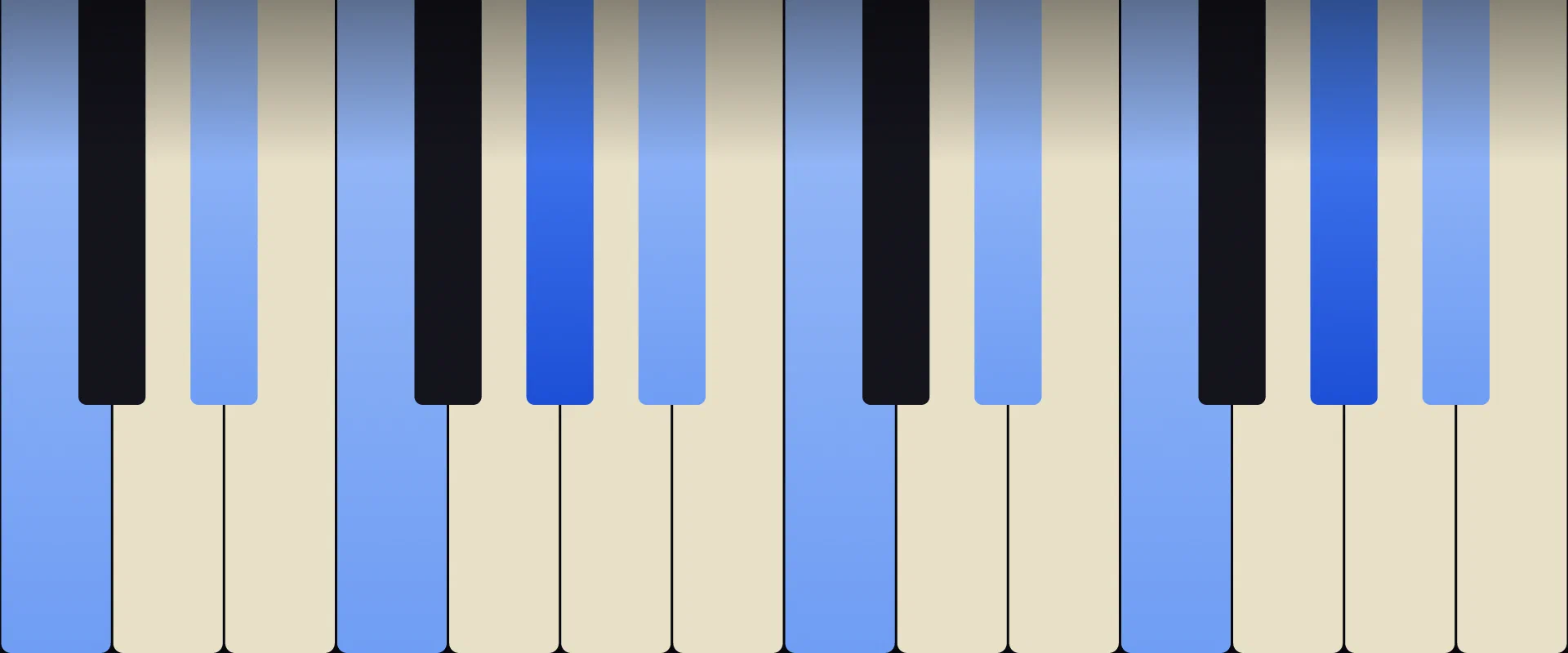
Play the A♭ major pentatonic scale as a chord instead of a line. That is A♭6/9, exactly: A♭, C, E♭, F and B♭, the same five notes a beginner is handed for soloing, stacked rather than strung out. Nothing in it is a semitone away from anything else in it. The closest two notes come is a whole tone, and that single fact explains the chord’s whole reputation.
A chord with no semitone inside it has no note leaning on another, so nothing needs to resolve and no melody note played over it can be wrong. That is why arrangements end here. Finish on a plain A♭ major triad and the last bar sounds abrupt. Finish on A♭maj7 and the G in it sits one semitone below the root, still pulling. Finish on A♭6/9 and the music has genuinely stopped.
Try It: A♭6/9 in the Chord Finder
Set the root to A♭ and choose major pentatonic. The five notes the tool highlights on the keyboard are this chord and nothing else. Switch to A♭ major, then A♭ lydian, then A♭ mixolydian, and watch those five stay put while the other two change underneath them.
The Notes of A♭6/9
| Degree | Note | Interval from root | Semitones |
|---|---|---|---|
| 1 (root) | A♭ | Perfect unison | 0 |
| 3 | C | Major 3rd | 4 |
| 5 | E♭ | Perfect 5th | 7 |
| 6 | F | Major 6th | 9 |
| 9 | B♭ | Major 9th | 14 |
Written out: A♭, C, E♭, F, B♭. Three black keys and two white ones, and no accidental lands anywhere surprising. The slash in the symbol is not a bass note. It simply says both extras are present: a sixth and a ninth, added to a major triad, with no seventh between them.
How A♭6/9 Is Built
Start with the A♭ major triad, A♭, C and E♭. Add F and you have A♭6. Add B♭ instead and you have A♭add9. Add both and the chord is A♭6/9. That is the whole construction, and the order matters less than what is absent: there is no seventh of any kind, so this is not a thirteenth chord with notes missing. It is a triad with two guests.
Put the same five notes in fifths and they form an unbroken run: A♭ to E♭ to B♭ to F to C. Five consecutive perfect fifths with the root at the bottom of the chain, which is why every interval inside the chord is wide and open. A♭11 is built from a run of five fifths as well, but with its root in the middle instead of at the end, and that one difference turns an open major sound into a suspended dominant.
Adding a minor seventh changes everything again. Put G♭ into A♭6/9 and the F is no longer a sixth, it is a thirteenth, and the chord becomes A♭13 with somewhere it has to go.
A♭6/9 on the Piano
This is one of the rare five note chords that fits comfortably under one hand. A♭ to B♭ is fourteen semitones, a stretch most players have, and the three notes inside it fall exactly where fingers two, three and four want to be. Thumb on A♭, index on C, middle on E♭, ring on F, little finger on B♭.
Feel what that sequence does. Black, white, black, white, black, alternating the whole way up. The thumb and the little finger are deep on the keyboard among the black keys while the index and ring sit forward on the white ones, so the hand settles into a natural diagonal rather than fighting for a straight line. Very few five note grips in any key arrange themselves so tidily.
The other voicing worth owning drops the root and stacks what is left in fourths: C, F, B♭, E♭. Each step is a perfect fourth, the sound is hollow and modern rather than sweet, and it leaves the bass free. Play that in the right hand over A♭ in the left and you have the standard jazz piano ending of the last seventy years.
A♭6/9 on the Guitar
The guitar likes this chord more than it likes most things in A♭, and the reason is that the fourths voicing a pianist builds by hand is already sitting on the fretboard as a shape.
x 11 10 10 11 11 sounds A♭, C, F, B♭ and E♭: all five notes, no doubling, inside two frets. Middle finger on the fifth string at the eleventh, index flat across the fourth and third strings at the tenth, ring and little finger on the second and first at the eleventh. Nothing stretches, and up there the frets are close enough that a small hand has an easier time than at the nut.
The shape rooted on the sixth string is 4 6 6 5 6 6, giving A♭, E♭, A♭, C, F and B♭. Index takes the sixth string at the fourth fret, middle the third string at the fifth, ring covers the fifth and fourth strings at the sixth and the little finger covers the top two. Four fingers, six strings sounding. It is worth comparing that with plain A♭6 in the same position, which needs the top string back at the fourth fret and therefore a fifth finger nobody has. The chord with more notes in it is the easier one to play.
With a capo at the first fret the open G6/9 shape 3 2 0 2 0 0 sounds A♭, C, E♭, B♭, C and F. Every note of the chord, three strings ringing open behind the capo, and a grip most players already use as a folk voicing without knowing what to call it. For a final chord that ring is the whole point, so this is the version to reach for when the arrangement stops.
Inversions
| Inversion | Notes | Bass | Symbol |
|---|---|---|---|
| Root position | A♭ C E♭ F B♭ | A♭ | A♭6/9 |
| 1st inversion | C E♭ F B♭ A♭ | C | A♭6/9/C |
| 2nd inversion | E♭ F B♭ A♭ C | E♭ | A♭6/9/E♭ |
| 3rd inversion | F B♭ A♭ C E♭ | F | A♭6/9/F |
| 4th inversion | B♭ A♭ C E♭ F | B♭ | A♭6/9/B♭ |
Because nothing in the chord is a semitone from anything else, the bass note has an unusually free hand, and two of these rows are simply different chords. With F underneath, F, A♭, B♭, C and E♭ is an F minor seventh with an eleventh on it. With B♭ underneath, the same pitches are a dominant eleventh on B♭, note for note. Let the bass walk from A♭ to F to B♭ and a tonic becomes a minor chord and then a dominant with no hand moving above it. See Chord Inversions and Voice Leading.
Voicings
| Shape | Frets | Result |
|---|---|---|
| A♭6/9 | x 11 10 10 11 11 | All five notes inside two frets |
| A♭6/9 | 4 6 6 5 6 6 | E form, six strings, four fingers |
| A♭6/9 | capo 1, 3 2 0 2 0 0 | G6/9 shape, three strings ringing |
| A♭6/9 | x x 10 10 11 11 | Top four only, no root |
| A♭6 | x 11 13 13 13 13 | The same chord without B♭ |
| A♭add9 | x x 6 5 4 6 | The same chord without F |
Which Keys Contain A♭6/9
- I of A♭ major
- I of A♭ lydian
- I of A♭ mixolydian
- IV of E♭ major
- V of D♭ major
- VI of C natural minor
- III of F natural minor
- rooted on degree 1 of, and entirely contained in, A♭ major pentatonic
The first three rows are the point. A♭ major, A♭ lydian and A♭ mixolydian disagree with each other about exactly two notes, the fourth degree and the seventh, and A♭6/9 contains neither of them. The chord therefore refuses to say which mode it belongs to, and a soloist can treat D or D♭, G or G♭, as an open question and answer it differently each chorus.
That neutrality is also why the list of keys runs so long. A chord that commits to almost nothing fits almost everywhere, which is a strength when you want colour and a weakness when you want the harmony to point somewhere.
Where A♭6/9 Shows Up
| Progression | Chords | Context |
|---|---|---|
| Final cadence (A♭ major) | D♭maj7, E♭13, A♭6/9 | The last bar of the chart |
| ii V I (A♭ major) | B♭m9, E♭13, A♭6/9 | Standard jazz ending |
| IV in E♭ major | E♭, A♭6/9, B♭ | Gospel and soul |
| Over a moving bass | A♭6/9, then B♭ in the bass | Turns into a dominant |
The first two rows are the same job. Bring a piece in A♭ major to a close here and it stops without sounding either plain or unfinished. A guitarist then has to choose between the capo and the fretboard: the barre shapes above are correct and completely dry, while the capo shape rings for as long as you let it. Last chords are held, so the capo usually wins.
The third row is where the chord earns its keep in the middle of a song rather than at the end. In E♭ major the fourth degree is A♭, and gospel and soul players almost never leave that chord as a bare triad. A♭6/9 sits under a vocal without dictating a melody note, because whichever of the five the singer lands on is already in the chord.
The last row is the trick worth stealing. Hold the grip, move the bass to B♭, and the five pitches become B♭11, a suspended dominant that wants to go to E♭. One player changes one note and a resting chord turns into a departure.
Related Chords
- A♭ Major 6th Chord, the same chord with B♭ taken out
- A♭ Add9 Chord, the same chord with F taken out
- A♭ Major Chord, the triad holding both of them up
- A♭ Dominant 13th Chord, these five notes plus G♭, and an obligation with it
- A♭ Major 9th Chord, the version with a seventh in it, and a semitone
- A♭ Dominant 11th Chord, which is a six nine chord read from a different root
Learn More
Practice Chords
Drill chord recognition with a metronome, MIDI support, and score tracking.
Start Practicing