Put one finger on the sixth string at the third fret and strum all six strings. That is the entire chord, correctly voiced, nothing muted and nothing missing. G6/9 is G, B, D, E and A, and those five pitches are exactly the five distinct notes a guitar in standard tuning already sounds when nobody is touching it. Of the twelve roots, G is the only one this works for, because the open strings spell one six-nine chord and only one.
The chord is a major triad with a sixth and a ninth added and no seventh anywhere. That absence is the whole character. Line the notes up as G, A, B, D, E and no two of them are a semitone apart, so there is no avoid note in it, no tritone, and nothing that wants to move. Play it and the music can stop.
Try It: G6/9 in the Chord Finder
Set the root to G and switch the Sixth and Ninth toggles on together. Then choose G major pentatonic and look at what the scale contains: the same five notes, in the same order.
The Notes of G6/9
| Degree | Note | Interval from root | Semitones |
|---|---|---|---|
| 1 (root) | G | Perfect unison | 0 |
| 3 | B | Major 3rd | 4 |
| 5 | D | Perfect 5th | 7 |
| 6 | E | Major 6th | 9 |
| 9 | A | Major 9th | 14 |
Written out: G, B, D, E, A, five white keys and no accidental to argue about. The slash in the symbol is not a bass note. It separates two added degrees, so G6/9 means a G chord carrying both a sixth and a ninth, and some charts write G6add9 instead. The sixth is numbered 6 rather than 13 because a thirteenth is a degree stacked above a seventh, and this chord has no seventh.
How G6/9 Is Built
Take G major, which is G, B and D, and add the E to make G6. Then add the A. Coming the other way, Gadd9 is G, A, B and D, and the E completes it. Either route arrives at a triad with two extra colours and its seventh degree untouched.
It is worth saying what this chord is not. It is not G13 with notes left out. G13 contains F, and that F makes a tritone with the B and turns the chord into a dominant with somewhere to go. Remove the F and the function goes with it.
Two other identities are more useful than the theory. Read the five notes from the E and they are E, G, B, D with an A added: an Em7 carrying an eleventh. Read them as a scale and they are G major pentatonic note for note, the same collection as E minor pentatonic. The chord and the scale played over it are not merely compatible. They are one thing.
G6/9 on the Piano
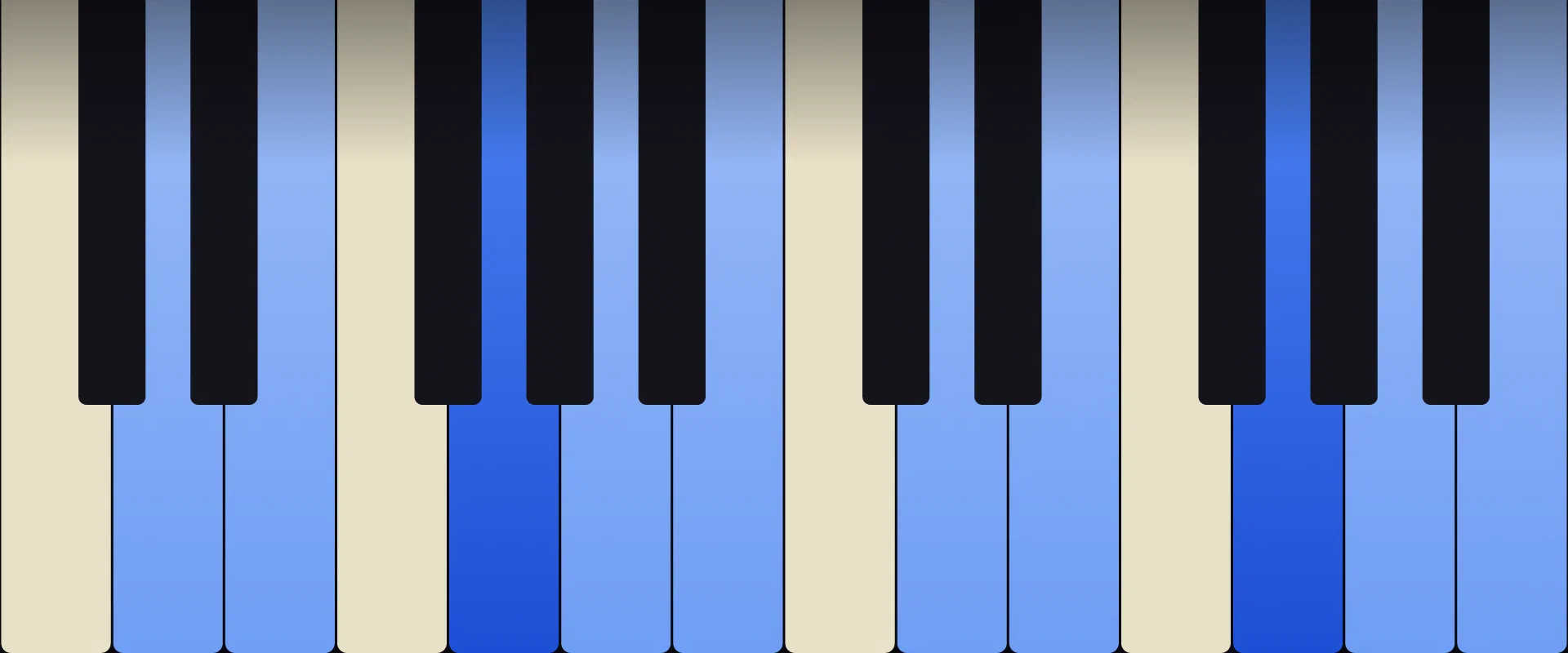
All white, no black, and a span of fourteen semitones from G up to A, so give the root to the left hand and keep the right hand clear.
The voicing to learn puts G and D in the left hand as an open fifth and B, E and A in the right. Look at what the right hand is holding: B up to E is a perfect fourth, E up to A is a perfect fourth, two fourths stacked, under thumb, middle and little finger. That is why this chord sounds modern rather than sugary. The third is present, but it sits at the bottom of a quartal stack instead of leaning on the root, and the ear reads the whole thing as open rather than sweet.
The alternative is G alone in the left hand and B, D, E, A in the right, under thumb, index, middle and little finger. What to avoid is putting the A next to the G low down, where a whole tone in the bass turns the ninth into mud. Every good voicing sends the A well above the root, and the fourths shape does it without being asked.
G6/9 on the Guitar
3 0 0 0 0 0. One finger. It sounds G, A, D, G, B and E from the bottom, all five notes of the chord, six strings ringing. Two other roots get close. C6/9 is 8 0 0 0 x 0 and D6/9 is 2 0 0 x 0 0, each one fretted string with one string muted. What no other root has is this: a complete six-nine chord with nothing muted, nothing doubled wrongly and every open string earning its place.
Watch it arrive. Open G major is 3 2 0 0 0 3, and the two fretted notes above the bass are both doubling something. Lift the finger from the first string and the doubled G falls to the open E: that is G6, the shape the chord books print as 3 2 0 0 0 0. Now lift the finger from the fifth string as well. The B it was holding drops to the open A, the ninth arrives, and the third is not lost with it, because the second string has been sounding B all along.
Strum the guitar with no fingers at all and E, A, D, G, B and E is the same five notes with the E underneath, which is that Em7 with an eleventh again. Alternate the sixth string between the 3rd fret and open and you have the tonic and the relative minor of G major, with a single finger doing all the work.
Movable shapes are a step down, but worth having. 3 2 2 2 3 x holds all five: ring finger on the sixth string at the 3rd fret, index barred across the fifth, fourth and third strings at the 2nd, middle finger on the second string at the 3rd. On the fifth string, x 10 9 9 10 x gives G, B, E and A, dropping the fifth, with narrow frets that far up. The six string form barred at the 3rd fret, 3 5 5 4 5 5, is complete and genuinely awkward, and on this root there is no reason to bother with it.
| Form | Frets | Notes sounded |
|---|---|---|
| Open, one finger | 3 0 0 0 0 0 | G A D G B E |
| Open, no doubled root | 3 0 0 x 0 0 | G A D B E |
| All open strings | 0 0 0 0 0 0 | E A D G B E |
| Sixth string root | 3 2 2 2 3 x | G B E A D |
| Fifth string root | x 10 9 9 10 x | G B E A |
| Barre, all six | 3 5 5 4 5 5 | G D G B E A |
| G6 it grows from | 3 2 0 0 0 0 | G B D G B E |
Inversions
| Inversion | Notes | Bass | Symbol |
|---|---|---|---|
| Root position | G B D E A | G | G6/9 |
| 1st inversion | B D E A G | B | G6/9/B |
| 2nd inversion | D E A G B | D | G6/9/D |
| 3rd inversion | E A G B D | E | G6/9/E |
| 4th inversion | A G B D E | A | G6/9/A |
Two of these rows have names of their own. With E in the bass the chord is Em7 with an eleventh, which is what six open strings sound. With A in the bass, read the notes from A and they are root, minor seventh, ninth, eleventh and fifth: that is A11, the chord type covered on G Dominant 11th Chord, with no third in it and nothing to say about major or minor. One handful of notes, three functions, and only the bass player moves. See Chord Inversions and Voice Leading.
Voicings
Spread it. Nothing in this chord clashes, so the only way to spoil it is to crowd the bottom: keep the A and the E above the D rather than below it, and let the root sit on its own. If a note has to go, drop the fifth. The sixth and the ninth are the two the symbol is named for.
Which Keys Contain G6/9
- I of G major
- I of G lydian
- V of C major
- IV of D major
- III of E natural minor
- VI of B natural minor
- VII of A natural minor
Three major keys and three minor ones plus a mode, because a five note chord fits inside more seven note scales than a six note one does. The first two rows are the useful pair. G major has a C in it, G lydian has a C♯, and that one note is what separates them. G6/9 contains no fourth degree of any kind, so it is the tonic chord of both without choosing, and a soloist can move between the two scales over a chord that contradicts neither.
Where G6/9 Shows Up
| Progression | Chords | Context |
|---|---|---|
| Final bar in G | D7, G6/9 | Where the piece stops |
| Bossa nova tonic | G6/9, Am7, D7, G6/9 | The chord the vamp returns to |
| Turnaround in G | G6/9, Em7, Am7, D7 | Two chords, one finger apart |
| IV in D major | D, G6/9, A7 | Colour on the subdominant |
The first row is what this chord exists for. A seventh chord at the end of a piece leaves a question in the air and a plain triad sounds like the end of an exercise, while G6/9 sounds like a decision. Nothing in it is a semitone from anything else, so no interval is left pointing anywhere, and big band arrangers, bossa nova guitarists and gospel pianists all end on it for that one reason.
The third row costs almost nothing on a guitar. G6/9 is 3 0 0 0 0 0, Em7 is 0 2 0 0 0 0, and the single finger simply moves from the sixth string at the 3rd fret to the fifth string at the 2nd. That is a tonic going to its relative minor with the top four strings never changing, which is why the pair turns up under so many fingerpicked parts in G.
The soloist’s side of it is simpler still. The five notes of this chord are the five notes of the G major pentatonic scale, so over a held G6/9 every note in that box is a chord tone and there is nothing to avoid. It is the same box a guitarist first learns as E minor pentatonic. See Pentatonic Scales for Improvisation.
Related Chords
- G Major 6th Chord, the same chord without the ninth
- G Add9 Chord, the same chord without the sixth
- G Major Chord, the triad underneath both additions
- E Minor 7th Chord, four of the five notes, read from the sixth
- G Major 9th Chord, the other way to colour the triad, with F♯ in place of E
- G Dominant 13th Chord, what happens when an F joins the party
Learn More
Practice Chords
Drill chord recognition with a metronome, MIDI support, and score tracking.
Start Practicing