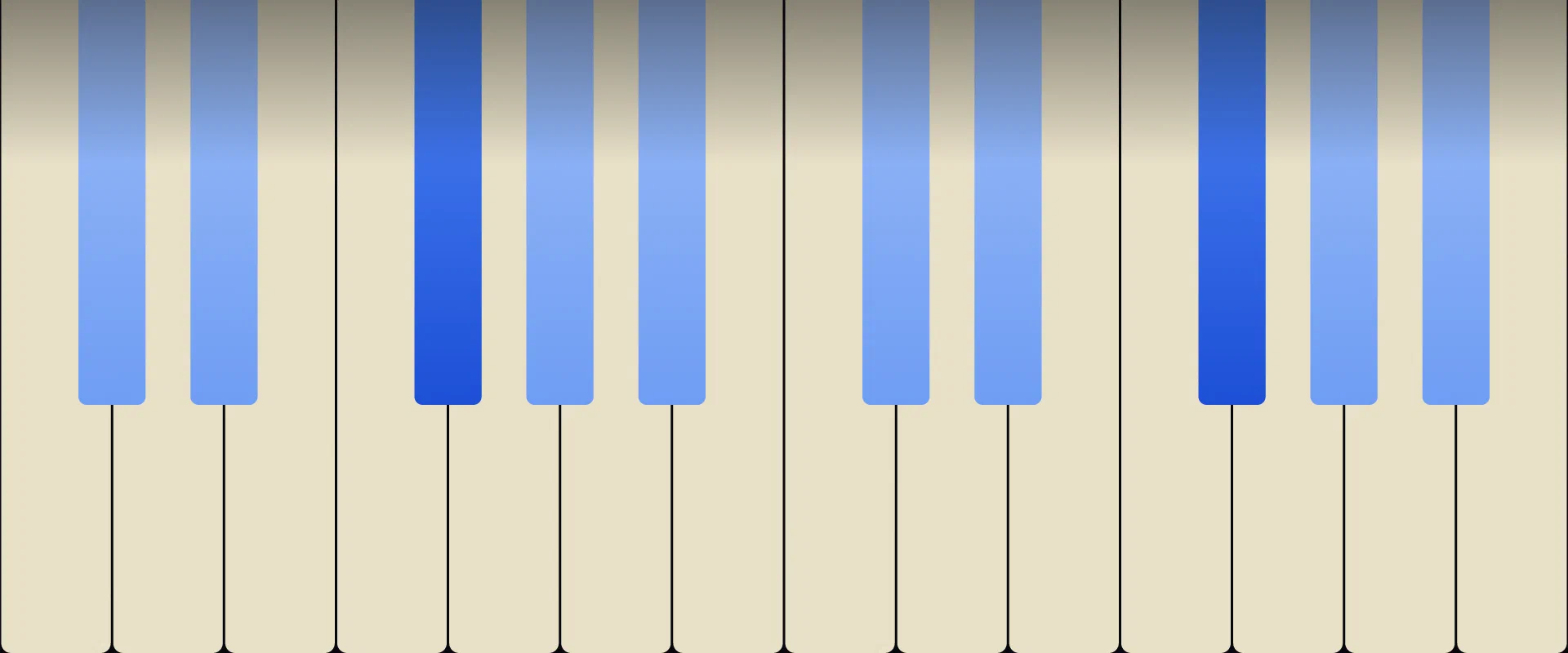
Hold down all five black keys. You are playing this chord. F♯6/9 is F♯, A♯, C♯, D♯ and G♯, which is the black keys exactly, none left over and no white key involved. Work through the other eleven roots and no other six-nine chord manages it, because a six-nine chord is a major pentatonic scale sounded at once and the black keys are the F♯ major pentatonic. Written in flats the same five keys are G♭6/9.
There is no seventh anywhere in it, and that is the character of the chord rather than an omission. No seventh means no tritone, no leading note, nothing pulling anywhere and no wrong note to avoid. A major triad with a sixth and a ninth added does not want to go anywhere, which is why arrangers put it at the end.
Try It: F♯6/9 in the Chord Finder
Set the root to F♯ and look at the first degree of F♯ major, then at the fifth degree of B major: the same five notes doing a different job.
The Notes of F♯6/9
| Degree | Note | Interval from root | Semitones |
|---|---|---|---|
| 1 (root) | F♯ | Perfect unison | 0 |
| 3 | A♯ | Major 3rd | 4 |
| 5 | C♯ | Perfect 5th | 7 |
| 6 | D♯ | Major 6th | 9 |
| 9 | G♯ | Major 9th | 14 |
Written out: F♯, A♯, C♯, D♯, G♯. The sixth is a sixth and not a thirteenth on purpose. A thirteenth implies a seventh below it, and there is no seventh here, so D♯ may sit inside the octave. The ninth is the opposite case: G♯ is a nine rather than a two because it belongs above the octave, clear of the F♯ a tone below and the A♯ a tone above.
Add one note, E, and this becomes F♯13. That is the whole difference between the most restful chord in the family and one of the most restless.
How F♯6/9 Is Built
Begin with the F♯ major triad, F♯, A♯ and C♯. Add D♯ and the chord is F♯6. Add G♯ instead and it is F♯add9. Add both and you have this chord, which is why the symbol keeps both numbers and the slash between them. It is a triad with two guests, not a stack of thirds.
Stack the same five notes in fourths instead: D♯, G♯, C♯, F♯, A♯. Three perfect fourths in a row with a major third on top, and the whole chord accounted for. That is the voicing jazz pianists use, and it sounds so unlike a stack of thirds that most listeners cannot find the root in it.
Four of the five notes spell something else again. D♯, F♯, A♯ and C♯ is a D♯ minor seventh, so this chord is that with G♯ added, and the same collection over a G♯ bass reads as root, ninth, eleventh, fifth and seventh: an eleventh chord on G♯. Every six-nine chord is the eleventh chord of the root a whole tone below, and F♯11 is in turn the six-nine chord of E. Extended Chords and Jazz Harmony has more on chords that answer to several names.
F♯6/9 on the Piano
Five notes, five black keys, no white key anywhere, and that changes how the hand works. Every finger sits on the raised plane at the back of the keyboard, so nothing drops forward between two black keys, and the usual warning about keeping the thumb off the black keys has to be ignored since there is nowhere else for it to go. Beginners find this chord by accident, which is how the black keys earned their reputation.
The practical arrangement is the fourths voicing. Left hand takes F♯ low down, right hand takes D♯, G♯, C♯, F♯ and A♯ going up, thumb on D♯ and the little finger out on the A♯. It spans a thirteenth, so a smaller hand drops the A♯ and keeps the fourths. That loses the third of the chord and does no harm: with no seventh present it stays open and consonant either way.
For a closer sound, keep F♯ in the left hand and play A♯, C♯, D♯ and G♯ in the right. C♯ and D♯ are neighbours, so that voicing has a gentle rub in the middle, which is the sound of a film cue holding its last chord.
Chopin’s Étude Op. 10 No. 5 is in G♭ major and its right hand plays nothing but black keys from beginning to end, so every chord it lands on is drawn from these five notes.
F♯6/9 on the Guitar
Not one open string is a chord tone. The guitar offers E, A, D, G and B and this chord holds none of them, so every F♯6/9 is fully fretted and the nut is no help at all. That mirrors the keyboard: no white key on the piano, no open string on the guitar.
The sixth-string form is the one to learn. 2 x x 3 4 4: index on the sixth string at the second fret for F♯, middle on the third string at the third for A♯, ring and little fingers on the second and first strings at the fourth for D♯ and G♯. The fifth and fourth strings are muted by the index and middle fingers leaning back on them. Four notes, root, third, sixth and ninth, no fifth, which is the least informative note in any extended chord.
The C♯ can be brought back on the fifth string at the fourth fret, giving 2 4 x 3 4 4 with all five notes, but that finger has to reach past the one on the third string at the third fret and few players bother.
The fifth-string form lands at the ninth fret: x 9 8 8 9 9. Middle finger on the fifth string at the ninth, index laid across the fourth and third strings at the eighth, ring finger flattened across the second and first at the ninth. That sounds F♯, A♯, D♯, G♯ and C♯, all five notes, and the two small barres make it easier than the numbers imply.
One warning about that form. The sixth sits on the third string one fret below the root’s fret. Put it one fret above, at the tenth, and the note is F, which is E♯, the major seventh of F♯. One fret turns a chord with no tension in it into a major seventh chord and destroys the point of it. If a printed six-nine grip contains a major seventh, the grip is wrong. Guitar Chord Shapes: The CAGED System explains how both forms move.
Inversions
| Inversion | Notes | Bass | Symbol |
|---|---|---|---|
| Root position | F♯ A♯ C♯ D♯ G♯ | F♯ | F♯6/9 |
| 1st inversion | A♯ C♯ D♯ G♯ F♯ | A♯ | F♯6/9/A♯ |
| 2nd inversion | C♯ D♯ G♯ F♯ A♯ | C♯ | F♯6/9/C♯ |
| 3rd inversion | D♯ G♯ F♯ A♯ C♯ | D♯ | F♯6/9/D♯ |
| 4th inversion | G♯ F♯ A♯ C♯ D♯ | G♯ | F♯6/9/G♯ |
The bass note matters more here than in most chords, because no seventh is anchoring the identity. Over D♯ the chord is a D♯ minor seventh with its eleventh added and will pass for the minor tonic of a piece in D♯ minor. Over G♯ it is an eleventh chord, restless where the root position is settled. Only the F♯ in the bass makes it sound like an ending, which is worth remembering when a band is trying to finish together. Chord Inversions and Voice Leading goes further into this.
Voicings
| Shape | Frets | Result |
|---|---|---|
| F♯6/9 | 2 x x 3 4 4 | Root, 3rd, 6th, 9th |
| F♯6/9 | x 9 8 8 9 9 | All five notes |
| F♯6/9 | 2 4 x 3 4 4 | All five, awkward reach |
| F♯6 | 2 4 4 3 4 x | The chord without the 9th |
| F♯ major | 2 4 4 3 2 2 | The triad underneath |
| F♯add9 | 2 x x 3 2 4 | The other single addition |
Which Keys Contain F♯6/9
- degree 1 (I) of F♯ major
- degree 5 (V) of B major
- degree 1 (I) of F♯ mixolydian
- degree 2 (II) of E lydian
- degree 4 (IV) of C♯ mixolydian
- degree 7 (VII) of G♯ natural minor
- degree 4 (IV) of D♭ major
The last row needs a word. That page spells this chord G♭, B♭, D♭, E♭ and A♭, because a scale with five flats cannot be asked to produce sharps. Same five keys under the piano lid, different names on the page, and the key signature makes the choice.
The chord also fills F♯ major pentatonic exactly. Not contained in it, identical to it, which keeps the improvising instruction short: play the pentatonic, hit anything.
Where F♯6/9 Shows Up
| Progression | Chords | Context |
|---|---|---|
| ii V I in F♯ major | G♯m7, C♯7, F♯6/9 | The final bar |
| V that does not push | Bmaj7, F♯6/9, Bmaj7 | Soft dominant |
| IV in C♯ mixolydian | C♯7, F♯6/9 | Modal vamp |
| Blues ending in F♯ | F♯9, B9, F♯6/9 | The last stab |
The first row is the job this chord was hired for. G♯m7 and C♯7 set up an arrival, and a plain F♯ major triad answers it too bluntly while F♯maj7 answers it with an E♯ still humming against the F♯. F♯6/9 has neither problem. It is fuller than the triad and quieter than the major seventh, and with no note needing resolution it can be held until the reverb runs out.
The second row is the same chord asked to be a dominant. In B major, F♯ is the fifth degree and this is the chord on it, but with no E there is no tritone and no obligation, so it colours the bar without demanding anything. Songwriters use that when a verse should drift rather than turn a corner.
The last row is guitar territory. F♯ suits guitarists, since the sixth-string form of every chord in it sits at or near the second fret. A blues in F♯ can run on ninth chords for eleven bars and then stop dead on this shape, which is why a six-nine chord is the last thing heard on so many recordings that spent three minutes refusing to settle. Horn led bands respell it as G♭6/9 and play the identical sound.
Related Chords
- F♯ Major 6th Chord, the same chord without the ninth
- F♯ Add9 Chord, the same chord without the sixth
- F♯ Major Chord, the triad both of them decorate
- F♯ Major 9th Chord, what happens if a seventh is added instead
- F♯ Dominant 13th Chord, this chord plus one E
- F♯ Dominant 11th Chord, which is the six-nine chord of E renamed
Learn More
Practice Chords
Drill chord recognition with a metronome, MIDI support, and score tracking.
Start Practicing