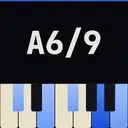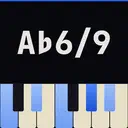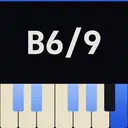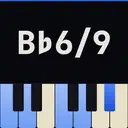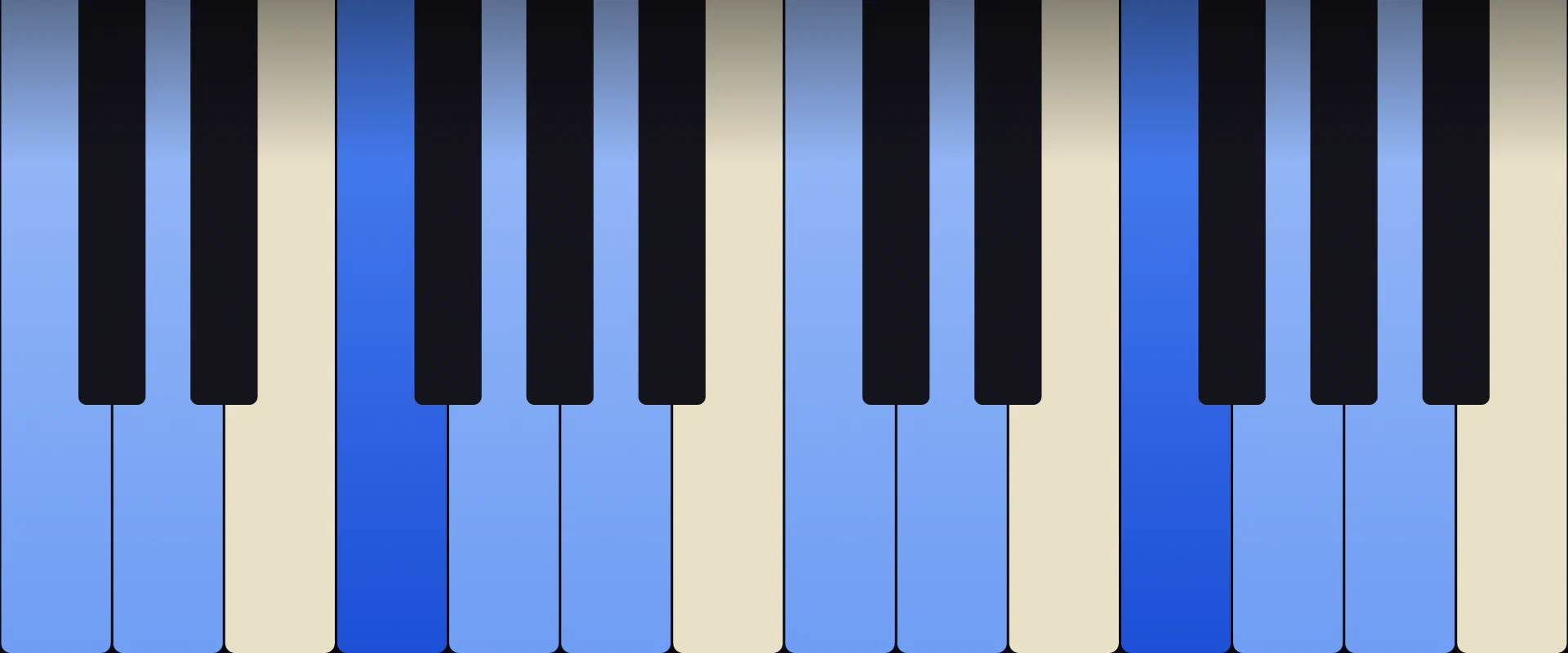
F, A, C, D and G, and the hand never leaves the white keys. F6/9 is a major triad with a 6th and a 9th added and no 7th of any kind, and of the twelve roots only three produce it without an accidental: C, F and G. Every other 6/9 chord on the keyboard needs at least one black key.
Two things follow from having no 7th. No two notes are a semitone apart, F to G and C to D being the closest pairs at a whole tone each, so there is no avoid note anywhere. And nothing in the chord owes anybody a resolution, so it can be held as long as the arranger likes and still sound finished. That is why it turns up at the end of arrangements more than in the middle.
Be clear about what it is not. This is a triad with two notes added, not a 13th chord with pieces missing. There is no E♭ in it and no E either, so it is neither a dominant nor a major 7th chord, and the D is a 6th rather than a 13th because there is no 7th under it.
Try It: F6/9 in the Chord Finder
Set the root to F and compare the first degree of F major, F lydian and F mixolydian. The chord is identical in all three, which is the whole point of it and is explained further down.
The Notes of F6/9
| Degree | Note | Interval from root | Semitones |
|---|---|---|---|
| 1 (root) | F | Perfect unison | 0 |
| 3 | A | Major 3rd | 4 |
| 5 | C | Perfect 5th | 7 |
| 6 | D | Major 6th | 9 |
| 9 | G | Major 9th | 14 |
Written out: F, A, C, D, G. The last column is where this chord parts company with a 13th chord. In F13 the same D measures 21 semitones, because there it belongs above a ♭7. Here it measures 9 and belongs in the body of the chord, close to the C. The G goes the other way: a 9th rather than a 2nd, because it wants to be above the triad rather than squashed against the F at the bottom.
How F6/9 Is Built
Start from F major, F, A and C. Add the 6th, D, and the 9th, G. There is no subtraction step. Either side works as a starting point: F6 is F, A, C, D and needs the G, while Fadd9 is F, A, C, G and needs the D.
The five notes are also a scale. F, G, A, C, D is F major pentatonic exactly, so the chord and the notes you would improvise over it are the same five things, and nothing from that scale can be a wrong note against it.
Rotate the set and it changes name without changing content. Read from D, the notes D, F, A and C are Dm7 with the G added as an 11th. Read from G they spell G11 precisely: root, 9th, 11th, 5th and ♭7, with no 3rd anywhere. That mirrors F11, whose five notes read from their ♭7 spell E♭6/9. Every pentatonic set is a 6/9 chord on one root and an 11th chord on another, and the bass alone decides which one you hear.
F6/9 on the Piano
Five notes, five white keys, no accidental to find and no enharmonic argument to have. Beginners produce this chord by accident all the time, because it is what an F major triad becomes when a couple of neighbouring white notes get caught under the hand.
The voicing worth learning splits it. Left hand takes F and C, the root and the 5th. Right hand takes A, D and G, the 3rd, the 6th and the 9th, two perfect 4ths that lie flat under thumb, middle and little finger. Five notes, no doubling, and the D and G that name the chord are up where they can be heard.
Keep that right hand and change the left from F and C to F and E♭, and the chord becomes F13. One note in the left hand is the whole difference between a chord that has arrived and a chord still travelling, which is worth having under the fingers when a tune ends.
F6/9 on the Guitar
The chord books carry no open F6/9, and on this root they are leaving one on the table. Standard tuning gives three of these notes away for nothing: the open A string is the 3rd, the open D string is the 6th and the open G string is the 9th, which happen to be the three notes that make F6/9 what it is. Only the root and the 5th need fretting, and both sit at the first fret, on the sixth string and the second.
1 0 0 0 1 1 sounds F, A, D, G, C and F. Root, 3rd, 6th, 9th, 5th, root, every note of the chord and nothing that is not in it, across six ringing strings. The fingering is easier than it looks: index on the sixth string at the first fret, ring and little fingers on the second and first strings at the first, and the three in the middle left completely alone. Drop the top string and 1 0 0 0 1 x is the same five notes for two fingers.
The movable form is the one every bossa nova record uses. x 8 7 7 8 x sounds F, A, D and G, root, 3rd, 6th and 9th, with the 5th left out. Index across the fourth and third strings at the seventh fret, middle finger on the fifth string at the eighth, ring finger on the second at the eighth. Compact, no open strings, and it goes anywhere on the neck.
There is a sixth string version at the first fret too, 1 x 3 2 3 3, sounding F, F, A, D and G, but it doubles the root and puts four fingers to work for a chord the open form gives you for two. F is not usually a generous key at the nut, so it is worth noticing when it is. Shapes that travel are in the CAGED system.
Inversions
| Inversion | Notes | Bass | Symbol |
|---|---|---|---|
| Root position | F A C D G | F | F6/9 |
| 1st inversion | A C D G F | A | F6/9/A |
| 2nd inversion | C D G F A | C | F6/9/C |
| 3rd inversion | D G F A C | D | F6/9/D |
| 4th inversion | G F A C D | G | F6/9/G |
Rotating a pentatonic set never produces a wrong chord, only a different name for the same five notes. Two rows have names of their own. Over D the chord is Dm7 with an 11th on top, and over G it is G11 exactly. Hold the five notes still and let a bass player walk F, D, G, and you have passed through the first, sixth and second chords of F major without lifting a finger. That G is not literally Gm7, which is what F major puts on the degree, but with no 3rd to contradict it, it sits in the slot happily. See Chord Inversions and Voice Leading.
Voicings
| Shape | Frets | Result |
|---|---|---|
| F6/9 | 1 0 0 0 1 1 | Open form, all five notes |
| F6/9 | 1 0 0 0 1 x | The same five, two fingers |
| F6/9 | x 8 7 7 8 x | Root, 3rd, 6th, 9th |
| F6/9 | 1 x 3 2 3 3 | Sixth string root, crowded |
| F6 | 1 3 3 2 3 1 | The same chord without the 9th |
| Dm7 | x x 0 2 1 1 | Four of the five notes |
Which Keys Contain F6/9
- I of F major
- IV of C major
- V of B♭ major
- degree 1 of F lydian
- degree 1 of F mixolydian
- degree 3 of D natural minor
- degree 6 of A natural minor
- entirely contained in F major pentatonic and in D minor pentatonic
Read rows one, four and five together. F major is F G A B♭ C D E. F lydian is the same seven with B natural instead of B♭, F mixolydian the same seven with E♭ instead of E. The 4th and the 7th degrees are the only two separating the three scales, and those are exactly the two F6/9 does not contain. The chord cannot tell you which of the three you are in, and nothing holding a 7th or a 4th could manage that.
The same absence explains the length of the list. The full set of scales on this site containing these five notes runs past twenty, far more than any chord with a semitone in it manages, because a chord with no semitone has almost nothing to collide with. Row three is worth a second look. In B♭ major the chord built on F is F7, and F6/9 fits the key without being that chord at all: it has a 6th where the dominant wants a ♭7, so it sits on the fifth degree and refuses to pull anywhere.
Where F6/9 Shows Up
| Progression | Chords | Context |
|---|---|---|
| ii V I (F major) | Gm7, C7, F6/9 | The last bar of the tune |
| Turnaround (F major) | F6/9, Dm7, Gm7, C7 | Two chords, one shape |
| Blues in F | F7, B♭7, F6/9 | Settled at last |
| Bossa vamp (F major) | F6/9, Gm7, F6/9 | Nothing needs resolving |
The first row is the job this chord was made for. End on Fmaj7 and the E in it sits one semitone under the root, a lovely colour and also a faint rub that never quite goes away. End on F6/9 and there is no semitone anywhere, so it is as still as a plain triad while carrying twice the colour. Big band charts, film cues and bossa records all end this way and hold the chord for four bars, because there is nothing in it to get tired of.
The second row is the inversions table in practice. Every note of Dm7 is already inside F6/9, so a pianist plays the first two chords of the turnaround without moving and lets the bass do the work. A guitarist gets most of the same economy: go from 1 0 0 0 1 1 to x x 0 2 1 1 and the open fourth string and the top two never move.
The blues row is about where F sits for a band. Concert F reads as G on a trumpet or a tenor saxophone, so horn players are at home in the key and guitarists usually are not, since F offers nothing at the nut. This chord is the exception. It is the one F chord a guitarist can play with two fingers and three open strings, which is a reasonable argument for ending the tune on it.
Related Chords
- F Major Chord, the triad these two notes are added to
- F Major 6th Chord, the same chord without the 9th
- F Add9 Chord, the same chord without the 6th
- F Major 7th Chord, the other way to colour the triad, semitone included
- F Dominant 13th Chord, where the same D goes once a ♭7 arrives
- F Dominant 11th Chord, the same pentatonic idea read from another root
Learn More
Practice Chords
Drill chord recognition with a metronome, MIDI support, and score tracking.
Start Practicing