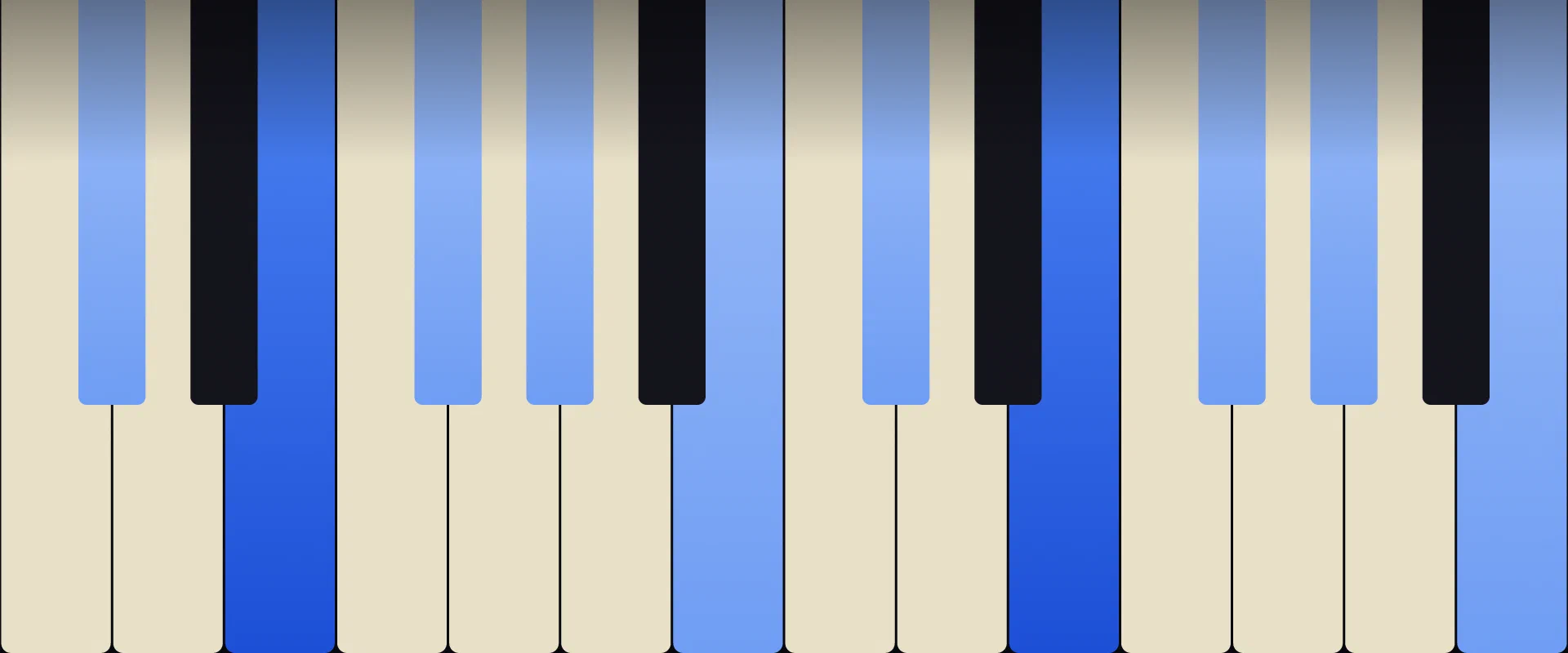
E6/9 is an E major triad that has been given two extra notes and no obligations: E, G♯, B, C♯ and F♯. The C♯ is the 6th, the F♯ is the 9th, and there is no 7th of any kind, which is the whole point. A major 7th would put a D♯ a semitone under the root. A minor 7th would put a D against the G♯ and make a tritone. Either way something in the chord starts pulling. Leave the 7th out and nothing is left leaning.
Write the five notes in pitch order and you get E, F♯, G♯, B, C♯, which is the E major pentatonic scale exactly. That is why arrangers reach for this chord in a final bar: it is as coloured as a jazz voicing and as settled as a triad, and it asks the listener nothing on the way out.
Try It: E6/9 in the Chord Finder
Set the root to E and compare degree 1 in E major, E lydian and E mixolydian. The chord is the same in all three, and the reason is in the notes it does not use.
The Notes of E6/9
| Degree | Note | Interval from root | Semitones |
|---|---|---|---|
| 1 (root) | E | Perfect unison | 0 |
| 3 | G♯ | Major 3rd | 4 |
| 5 | B | Perfect 5th | 7 |
| 6 | C♯ | Major 6th | 9 |
| 9 | F♯ | Major 9th | 14 |
Written out: E, G♯, B, C♯, F♯. Three sharps, each on a black key, so the spelling is straightforward. The 6th is written as 6 and not as 13 deliberately: 13 would imply a 7th below it, and this chord has none.
How E6/9 Is Built
Start from the E major triad, E, G♯ and B. Add C♯ a whole tone above the B and you have E6. Add F♯ a whole tone above the root, an octave up, and you have Eadd9. Do both and you have this chord. Nothing was stacked in thirds and nothing was omitted, which is why the symbol carries a slash rather than a number: it is a triad with two additions, not a tall chord with holes in it.
The gaps between neighbouring notes run two, two, three, two and three semitones. No two notes in the chord are a semitone apart, and no two of them form a tritone either, so there is no pair anywhere in it that wants to move. That is what people mean by saying it has no avoid note: a soloist can hold any of the five indefinitely and a singer can land on any of them.
Take the F♯ away and the four notes left, E, G♯, B and C♯, are also C♯ minor 7th read from the other end. Put the F♯ back and the whole set, read from F♯, spells F♯11. One collection of notes, three usable names, and the bass decides which applies.
E6/9 on the Piano
Three black keys and two white ones, which is an unusually black chord for five notes, and it makes the hand position easy to feel. E and B are white and they are the two the left hand takes, a bare fifth, thumb and little finger. G♯, C♯ and F♯ are black, and every one of them lives in the right hand.
Give the right hand G♯, B, C♯ and F♯. That is ten semitones from bottom to top and sits under thumb, index, middle and little finger, with the index dropping onto the white B between two black keys. The thumb starts on black and the only white key in the hand is the second note, which makes the shape quick to find without looking down.
The three note version is prettier still: left hand E and B, right hand G♯, C♯ and F♯. Those three are perfect fourths stacked on black keys, so the hand slides the whole shape without changing its span, and nothing is doubled.
It will not go in one hand. E up to F♯ is fourteen semitones with three notes standing inside, so a one hand version has to give up either the 5th or the 9th. Give up the 5th: E, G♯, C♯, F♯ spans an octave and a whole tone and loses the least.
E6/9 on the Guitar
The everyday grip has its root on the fifth string. x 7 6 6 7 7 sounds E, G♯, C♯, F♯ and B, all five notes, one each. The index lies across the fourth and third strings at the 6th fret, the middle takes the fifth string at the 7th, and the ring and little fingers cover the second and first strings at the 7th. Guitarists learn it as a shape rather than as a chord, because it moves anywhere and never needs a full barre.
Open position is possible and it is a fight. Take open E, 0 2 2 1 0 0, and push the top two strings up two frets: 0 2 2 1 2 2 sounds E, B, E, G♯, C♯ and F♯, the complete chord across all six strings. The trouble is geometry. The index has to stay on the third string at the 1st fret while three other fingers work at the 2nd, and one of them has to cover two strings at once. It rings gloriously if you can hold it.
Most players take the four string version instead. x x 2 1 2 2 sounds E, G♯, C♯ and F♯: root, 3rd, 6th and 9th, no 5th, one finger per string, no stretch at all. Let the low open E ring under it, 0 x 2 1 2 2, and the bass is covered for free.
One comparison is better made with the hands. Hold E13 in open position, 0 2 0 1 2 2, then press the fourth string down at the 2nd fret. That one finger turns the open D, the minor 7th, into an E, and the chord becomes E6/9. The C♯ never moved. The difference between a chord that has to resolve and a chord that can end a record is a single finger on a single string.
Inversions
| Inversion | Notes | Bass | Symbol |
|---|---|---|---|
| Root position | E G♯ B C♯ F♯ | E | E6/9 |
| 1st inversion | G♯ B C♯ F♯ E | G♯ | E6/9/G♯ |
| 2nd inversion | B C♯ F♯ E G♯ | B | E6/9/B |
| 3rd inversion | C♯ F♯ E G♯ B | C♯ | E6/9/C♯ |
| 4th inversion | F♯ E G♯ B C♯ | F♯ | E6/9/F♯ |
Because nothing in the chord is a semitone from anything else, the rotations stay consonant in a way inverted 7th chords do not, and each is really a rename. Over C♯ the notes read as a root, minor 3rd, 5th, minor 7th and 11th, a C♯ minor 7th with an added 11th. Over F♯ they are a root, 5th, minor 7th, 9th and 11th, which is F♯11. Over B they make a suspended B chord with a 6th and a 9th. Four symbols, one hand shape, which is worth knowing before a bass player moves under a held chord. See Chord Inversions and Voice Leading.
Voicings
| Shape | Frets | Result |
|---|---|---|
| E6/9 | x 7 6 6 7 7 | All five notes, movable shape |
| E6/9 | 0 2 2 1 2 2 | Open position, complete, demanding |
| E6/9 | x x 2 1 2 2 | Four notes, no 5th, very easy |
| E6/9 | 0 x 2 1 2 2 | The same with a low open E under it |
| E6 | 0 2 2 1 2 0 | The chord without its 9th |
| E | 0 2 2 1 0 0 | The triad it grows from |
Keep the F♯ above the C♯ where you can. The 9th is the note that separates this chord from a plain 6th, and it does its work at the top of the voicing.
Which Keys Contain E6/9
- I of E major
- I of E lydian
- I of E mixolydian
- V of A major
- IV of B major
- III of C♯ natural minor
- VI of G♯ natural minor
- inside E major pentatonic and C♯ minor pentatonic entirely
The first three rows explain themselves once you list what those scales disagree about. Major, lydian and mixolydian on the same root differ only at the 4th degree and the 7th, A against A♯ and D♯ against D, and this chord contains neither degree, so it fits all three untouched. That is worth remembering when a solo section changes mode underneath a held pad.
The C♯ minor rows matter to improvisers. The five notes are also C♯ minor pentatonic, so a guitarist running that box over this chord is playing the chord itself, note for note.
Where E6/9 Shows Up
| Progression | Chords | Context |
|---|---|---|
| V I (E major) | B13, E6/9 | Only the tritone moves |
| ii V I (E major) | F♯m9, B13, E6/9 | Jazz and bossa ending |
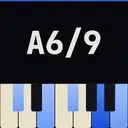
| I IV (E major) | E6/9, A6/9 | Same shape, five frets up |
| III in C♯ minor | C♯m9, E6/9 | Relative major, coloured |
The first row is a cadence with almost no motion in it. B13 is B, D♯, F♯, A, C♯ and G♯. Four of those, B, F♯, C♯ and G♯, are already in E6/9 and simply hold. The two that move are the tritone, D♯ rising a semitone to E and A falling a semitone to G♯. Everything else sustains, so the arrival sounds inevitable rather than announced, which is exactly what a final chord in a ballad wants.
The third row is a guitarist’s argument for the key of E. The movable shape at the 7th fret goes up five frets, to x 12 11 11 12 12, and becomes A6/9 with nothing changed in the hand, so a whole tune’s worth of I and IV takes one grip and a shift. Bossa nova comping and the closing bars of a great many standards are built out of that motion.
The last row is songwriting sleight of hand. In C♯ minor the third degree is the relative major, and dropping E6/9 there instead of a plain E gives the passage a lift without changing key. It works because every note of the chord is in C♯ natural minor already, so nothing sounds borrowed. That is one reason the chord turns up at the end of songs that are otherwise in a minor key.
Related Chords
- E Major Chord, the triad both additions are hung on
- E Major 6th Chord, the same C♯ with no 9th above it
- E Add9 Chord, the same F♯ with no 6th below it
- E Major 9th Chord, a major 7th in place of the 6th, and a semitone with it
- E13 Chord, one added note away, and a completely different job
- C♯ Minor 7th Chord, four of these five notes read from the other end
Learn More
Practice Chords
Drill chord recognition with a metronome, MIDI support, and score tracking.
Start Practicing