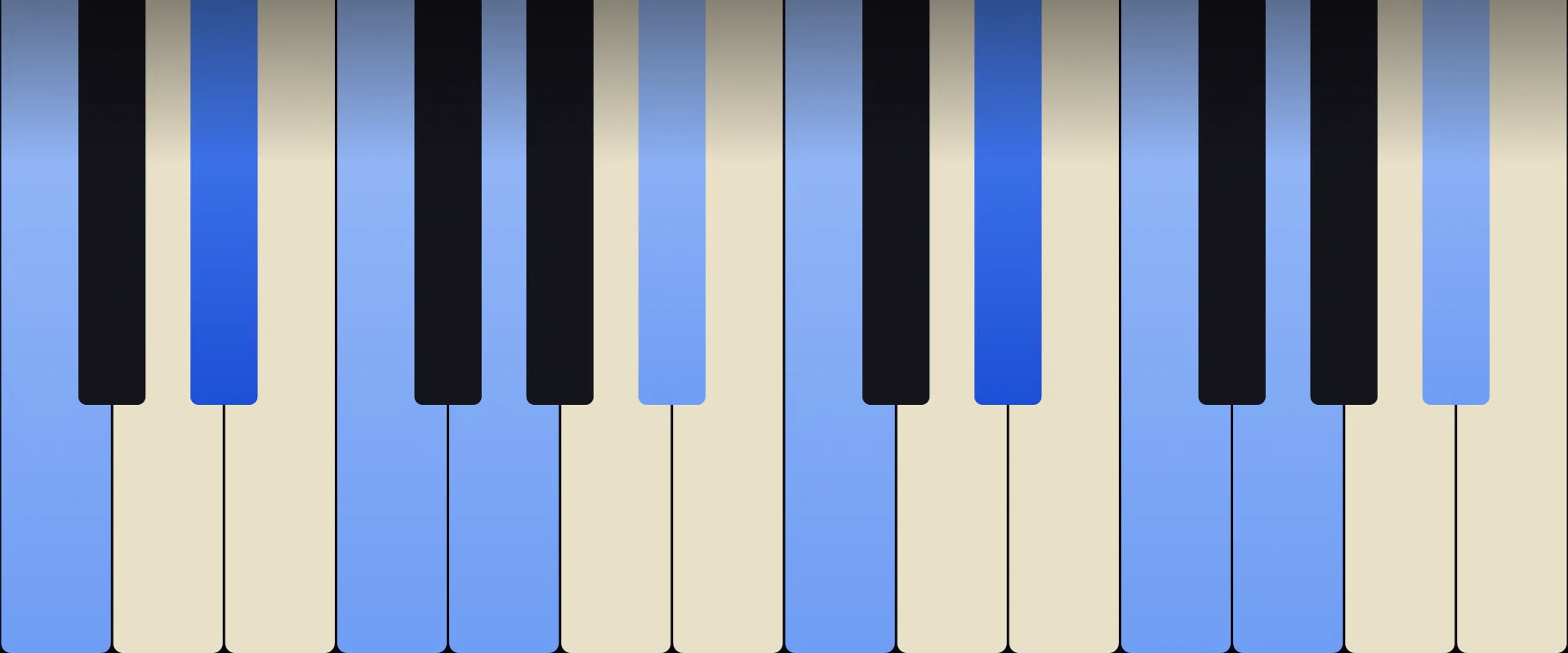
Most chords with five notes in them are going somewhere. This one has arrived. E♭6/9 is E♭, G, B♭, C and F, an E♭ major triad with a sixth and a ninth added and no seventh of any kind, so there is no semitone clash anywhere in it and nothing that wants to move. Stack the notes in fifths and they run in an unbroken line, E♭ to B♭ to F to C to G, which is to say you are hearing E♭ major pentatonic all at once. That is why arrangers reach for it as the last chord of a piece.
Try It: E♭6/9 in the Chord Finder
Set the root to E♭ and compare this chord with E♭maj9 on the same degree. One note differs, C against D, and it changes everything.
The Notes of E♭6/9
The chord contains five notes: E♭, G, B♭, C and F.
| Degree | Note | Interval from root | Semitones |
|---|---|---|---|
| 1 | E♭ | Root | 0 |
| 3 | G | Major 3rd | 4 |
| 5 | B♭ | Perfect 5th | 7 |
| 6 | C | Major 6th | 9 |
| 9 | F | Major 9th | 14 |
The slash is not a bass note instruction. E♭6/9 means a sixth and a ninth together, and some publishers write E♭69 to avoid the confusion. The F is a ninth rather than a second because it belongs an octave up, at the top of the chord, not crushed against the E♭.
How E♭6/9 Is Built
Begin with an E♭ major triad, E♭ G B♭. Add C and you have E♭6; add F and you have E♭add9; add both and this is the result. No seventh appears at any stage, which is the point. The chord never becomes a dominant and never becomes a major seventh, so it inherits the obligations of neither.
Test it for avoid notes and none appear. The closest any two come is the whole tone between B♭ and C, which is a colour rather than a collision. Compare E♭maj9, which puts D where the C is: that D sits a semitone under the root and leans on it, exactly the tension this chord declines. Add a D♭ instead and the five notes become E♭13, which pulls hard towards A♭. One seventh, either kind, is all that separates rest from motion.
E♭6/9 on the Piano
The chord divides cleanly on this root. E♭ and B♭ are black keys, G, C and F are white, so the two black keys go in the left hand and the three white ones in the right. Left hand E♭ and B♭ as a plain fifth, fingered 5 and 1. Right hand G, C and F, fingered 1, 2 and 5.
That right hand is the sound of the chord. G to C is a perfect fourth and C to F is another, so the third, the sixth and the ninth arrive as two stacked fourths. Fourths refuse to cluster, and that openness is most of what a listener registers when a piece ends here rather than on a triad.
Keep the C above the B♭. Put C at the bottom instead and the same five sounds, C, E♭, F, G and B♭, read as a C minor seventh with an added fourth, and the ear stops hearing E♭ as the root. The bass note does more work here than in almost any other chord this size.
E♭6/9 on the Guitar
There is no barre chord version of this shape, and the reason is worth following, because it is not the one you would expect. A straight barre gives a root, a fourth, a seventh, a ninth and a fifth, which spells an eleventh chord on whatever note the fifth string is stopping, as the E♭11 page sets out.
That does not rule out our five notes, though. An eleventh chord and the six-nine chord a whole tone below it contain exactly the same five pitches, so the barre at the eighth fret, which reads as F11, sounds E♭, G, B♭, C and F. Those are the notes of E♭6/9 and nothing else.
What it will not do is sound them as E♭6/9. The lowest note of that barre is C, and the F above it is the loudest thing in the voicing, so the ear hears an F chord. Run the arithmetic across all twelve frets and no barre ever puts E♭ in the bass of this collection. The notes are reachable in one finger; the chord is not.
Down at the nut there is a good form that uses the open third string, a G and therefore the major third of this chord. x x 1 0 1 1 sounds E♭, G, C and F: root, third, sixth and ninth ascending, with only the fifth missing. Index across the first and second strings at the first fret, middle finger on the fourth string at the first, third string ringing open between them. Two fingers, and the top three notes are the piano voicing exactly.
The standard movable grip lives at the sixth fret: x 6 5 5 6 6, sounding E♭, G, C, F and B♭. All five notes, root in the bass, the same fourth heavy spacing again. Middle finger on the fifth string at the sixth fret, index flat across the fourth and third at the fifth, ring finger flat across the top two at the sixth. It moves anywhere, and it is the most useful jazz and bossa shape on the instrument. For a sixth string root instead, 11 x 10 12 13 13 gives E♭, C, G, C and F, wide open and with no fifth: middle finger on the sixth string at the eleventh fret, index on the fourth string at the tenth, ring on the third at the twelfth, little finger across the top two at the thirteenth. See Guitar Chord Shapes: The CAGED System.
Inversions
| Inversion | Notes | Lowest note |
|---|---|---|
| Root position | E♭ G B♭ C F | E♭ |
| 1st inversion | G B♭ C F E♭ | G |
| 2nd inversion | B♭ C F E♭ G | B♭ |
| 3rd inversion | C F E♭ G B♭ | C |
| 4th inversion | F E♭ G B♭ C | F |
Every row is a rotation of the same pentatonic scale, and two of them are ordinary chords under another name. With C at the bottom the notes read as a C minor seventh with a fourth added, which is why this chord doubles as the tonic of C minor. With F at the bottom they give a root, a fifth, a flat seventh, a ninth and an eleventh, which is F11 exactly: the fourth inversion of E♭6/9 and the root position of F11 are the same five sounds, and the bass line alone decides the name. Second inversion is the odd one, with no third above its bass at all: useful as a suspension, useless as an ending. See Chord Inversions and Voice Leading.
Voicings
| Shape | Frets | Result |
|---|---|---|
| E♭6/9 | x x 1 0 1 1 | Four notes at the nut, no 5th |
| E♭6/9 | x 1 1 0 1 1 | All five, fifth in the bass |
| E♭6/9 | x 6 5 5 6 6 | The standard movable grip |
| E♭6/9 | 11 x 10 12 13 13 | Sixth string root, no 5th |
| E♭6 | x 6 5 5 4 3 | The same chord, ninth removed |
The fifth is the first note to go, as in any extended chord, and after that you stop. Drop the C and it is E♭add9; drop the F and it is E♭6. Four notes, E♭, G, C and F, are the minimum that still deserves the symbol.
Spacing matters more than in a chord with a seventh, because no dissonance is carrying the interest. Fourths between the upper voices and the chord glows; B♭, C and E♭ clustered in the middle and it turns muddy. See Extended Chords and Jazz Harmony.
Which Keys Contain E♭6/9
- I of E♭ major
- IV of B♭ major
- V of A♭ major
- III of C natural minor
- VI of G natural minor
- I of E♭ lydian
- I of E♭ mixolydian
- degree 1 of, and entirely inside, E♭ major pentatonic
- degree 2 of, and entirely inside, C minor pentatonic
Three of those rows are one observation. E♭ major, E♭ lydian and E♭ mixolydian differ only in their fourth and seventh degrees, and this chord has neither a fourth nor a seventh, so it is the tonic of all three without adjustment. A soloist can choose the mode after the chord has been struck rather than before it.
The C minor pentatonic entry is those same five pitches read from C, so playing E♭6/9 in C minor is literally sounding that scale as a chord. See Pentatonic Scales for Improvisation.
Where E♭6/9 Shows Up
Fm7, B♭7, E♭6/9. The ii V I in E♭ major with a tonic that sounds finished rather than merely correct. F runs through all three chords, as the root of the first, the fifth of the second and the ninth of the third, so one voice holds a single note across the whole cadence.
E♭6/9, A♭6/9, E♭6/9. I to IV and back, both chords voiced the same way. On guitar it is one shape at the sixth fret and the same shape at the eleventh, and it is the whole harmonic content of a great many bossa nova bars. Nothing resolves because nothing needs to.
Cm7, F9, B♭7, E♭6/9. A turnaround in E♭ major with a deliberately soft arrival. Cm7 is C, E♭, G and B♭, four of the five notes of the final chord, so the ear is inside the tonic four bars before it gets there.
E♭6/9 under a C minor melody. Written III in that key, and used as a wash of colour rather than a chord change. Soul keyboard players hold it and let the singer supply the root.
E♭ is a natural home for all of this. It is a flat key, which puts it in the hands of horn players, and the shape at the sixth fret sits in the widest part of the neck. What the guitar cannot do is ring this chord on open strings the way it can in C or G, which is most of why rock in E♭ is rare and jazz, gospel and Brazilian music in E♭ is not.
Related Chords
- E♭ Major 6th Chord, the same chord without the F
- E♭ Add9 Chord, the same chord without the C
- E♭ Major Chord, the triad underneath both additions
- E♭ Major 9th Chord, D in place of C, and a leaning note with it
- E♭13 Chord, these five notes with a flat seventh underneath
- C Minor 7th Chord, four of these five notes, read from C
Learn More
Practice Chords
Drill chord recognition with a metronome, MIDI support, and score tracking.
Start Practicing