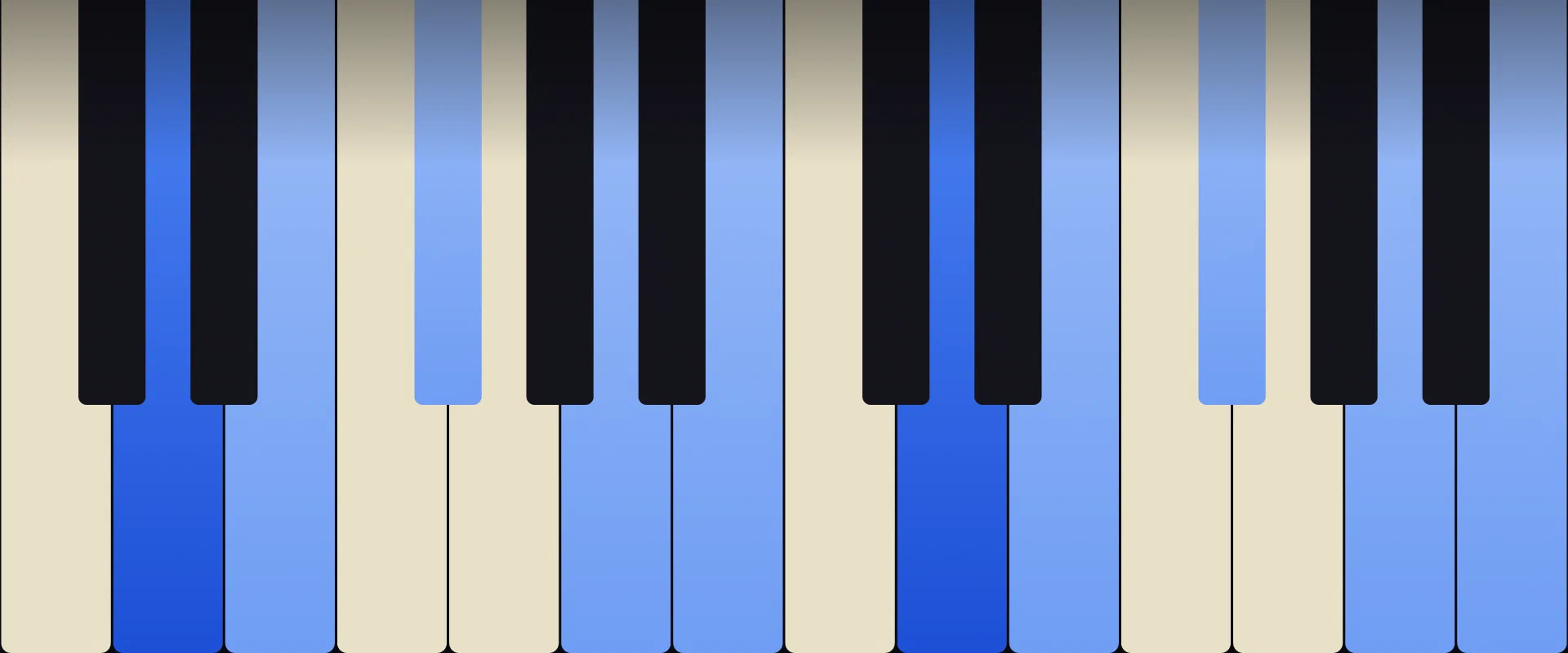
This is the chord arrangements end on. D6/9 is D, F♯, A, B and E: a D major triad with a sixth and a ninth laid on top and no seventh anywhere. That absence is the whole point. With no seventh there is no tritone, nothing leaning on a neighbour, nothing that has to move next, so the chord can sit still for as long as the player likes. Line the five notes up inside one octave and they read D, E, F♯, A, B, which is the D major pentatonic scale exactly. The chord and that scale are the same five notes, which is why no note a soloist plays over it can be wrong.
Try It: D6/9 in the Chord Finder
There is no six-nine toggle, so come at it from the scale side. Set the root to D and choose Major Pentatonic: the five notes lit on the keyboard are this chord. Then switch to Major and look at the chord on the first degree. D6/9 is that triad with the second and sixth degrees of the same scale added to it.
The Notes of D6/9
| Degree | Note | Interval from root | Semitones |
|---|---|---|---|
| 1 (root) | D | Perfect unison | 0 |
| 3 | F♯ | Major 3rd | 4 |
| 5 | A | Perfect 5th | 7 |
| 6 | B | Major 6th | 9 |
| 9 | E | Major 9th | 14 |
Written out: D, F♯, A, B, E. The sixth stays at nine semitones while the ninth is written above the octave, and the missing seventh is the reason. A thirteenth is a sixth that has climbed over a seventh to get out of its way; here there is nothing to climb over, so the B stays put. Sorted into one octave, the five notes are never closer than a whole tone, so the chord holds no semitone at all.
How D6/9 Is Built
Take the D major triad, D, F♯ and A, and add two notes from the same scale: B, the sixth, and E, the ninth. That is the entire construction. It is not a thirteenth chord with pieces missing, which is the usual misreading. A thirteenth needs the minor seventh underneath, and there is no C here of any kind.
It is easier to see as two familiar chords at once. D6 is D, F♯, A and B. Dadd9 is D, F♯, A and E. Play both at the same time and you have this chord, which is why the symbol is written with a slash: it is a six chord and an add nine chord sharing a triad.
Read the same five notes from the B and something useful appears. B, D, F♯ and A are Bm7, and the E on top is that chord’s eleventh, so D6/9 is Bm7 with an added fourth over a D bass. Read them from the E instead and they spell E11, the suspended dominant. One handful, three names, all of them true.
D6/9 on the Piano
One black key, F♯, and four white ones. D up to E is fourteen semitones, a major ninth, which a large hand can just span but not with three notes standing inside it, so this is a two hand chord in practice.
The classic layout gives D to the left hand, or D and A as a bare fifth, and puts F♯, A, B, E in the right. That right hand spans a minor seventh and falls under thumb, index, middle and little finger. The awkward part is the thumb on F♯: black keys sit further in, so let the hand travel forward half an inch rather than reaching backwards for the E.
The alternative is to gather the top four notes into a cluster. E, F♯, A, B covers only seven semitones, sits easily under one hand, and puts the ninth at the bottom, where it belongs to the chord rather than decorating it. Low D in the left hand, that compact group in the right, and you have the sound of a record ending. Because there is no semitone in the chord, no spacing you pick will muddy it and any of the five notes can be doubled on top.
D6/9 on the Guitar
The chord books print no open form for D6/9, and the fretboard says otherwise. Five of the six open strings belong to this chord: E is the ninth, A the fifth, D the root, B the sixth and the top E the ninth again. Only the third string, G, is a stranger, and it is a real one, a semitone above the F♯ that gives the chord its quality.
Here is the form worth learning. x 5 4 2 0 0 sounds D, F♯, A, B and E, all five notes, in order, root in the bass and the sixth and ninth ringing open on top. Ring finger on the fifth string at the fifth fret, middle on the fourth string at the fourth, index on the third string at the second, and the last two strings look after themselves. It is easier than an open F and it is the best sounding D6/9 on the instrument.
Two small changes show what the chord is made of. Fret the second string at the third fret and the B becomes a D: x 5 4 2 3 0 is Dadd9. Fret the first string at the second fret instead and the E becomes an F♯: x 5 4 2 0 2 is D6. The chord you want is the one where you leave both strings alone.
The movable form is the shape guitarists know from C6/9, moved up two frets: x 5 4 4 5 5 sounds D, F♯, B, E and A, fifth on top. The sixth string version, 10 12 12 11 12 12, wants a barre at the twelfth fret with the third string pulled back behind it and the root two frets lower still. Few players bother with it.
Inversions
| Inversion | Notes | Bass | Symbol |
|---|---|---|---|
| Root position | D F♯ A B E | D | D6/9 |
| 1st inversion | F♯ A B E D | F♯ | D6/9/F♯ |
| 2nd inversion | A B E D F♯ | A | D6/9/A |
| 3rd inversion | B E D F♯ A | B | D6/9/B |
| 4th inversion | E D F♯ A B | E | D6/9/E |
The bottom two rows are the ones to know, because they are not really inversions at all. Over B the five notes are Bm7 with an eleventh, the vi chord of D major. Over E they are E11, which functions as the ii chord of the same key. So a pianist can hold one right hand while the bass walks D, B, E and produce I, vi and ii of D major without moving a finger. That is a trick worth having in a fade out. See Chord Inversions and Voice Leading.
Voicings
Give the sixth and the ninth some air. Crowded into the middle of the chord they sound like an accident, and spread across the top they sound like the ending of a record.
| Shape | Frets | Result |
|---|---|---|
| D6/9 | x 5 4 2 0 0 | Open form, all five notes |
| D6/9 | x 5 4 4 5 5 | Movable, fifth string root |
| D6 | x 5 4 2 0 2 | The 9th traded for the 3rd |
| Dadd9 | x 5 4 2 3 0 | The 6th traded for the root |
| D | x x 0 2 3 2 | The triad underneath both |
| D6/9 | 10 12 12 11 12 12 | E form at the 10th fret, hard |
Which Keys Contain D6/9
- I of D major
- V of G major
- IV of A major
- I of D lydian
- I of D mixolydian
- III of B natural minor
- rooted on degree 1 of, and entirely inside, D major pentatonic
The three major keys at the top are neighbours on the circle of fifths, and the chord belongs to all three, which tells you how little it commits to. D lydian and D mixolydian are the more revealing pair. Lydian raises the fourth degree, mixolydian lowers the seventh, and this chord contains neither a fourth nor a seventh. The two degrees those modes argue about are the two D6/9 declines to have an opinion on, so both modes take it as their tonic chord without alteration.
Where D6/9 Shows Up
| Progression | Chords | Context |
|---|---|---|
| Final chord (D major) | Em7, A7, D6/9 | Nothing left to resolve |
| I vi ii V (D major) | D6/9, Bm7, Em9, A13 | The bass does the work |
| Bossa nova (D major) | D6/9, Bm7, Em7, A7 | The tonic never settles flat |
| Country ending | A, G, D6/9 | The Nashville full stop |
The first row is the chord’s whole career. Land on a plain D triad and the ear hears a full stop, but a bare one, three notes and nothing to listen to while the sound decays. Land on Dmaj7 and the C♯ leans hard on the D above it, so the chord glows but keeps asking. D6/9 does neither. It is rich enough to hold attention for four bars and contains nothing that wants to go anywhere, so the piece simply stops.
The second and third rows are the same idea moving. Because the chord already contains Bm7, a hand holding D6/9 can stay put while the bass drops to B, and the harmony changes from one to six without a voice crossing. Bossa nova players do this constantly, and it is the reason a bossa tonic never sounds like an arrival even when it is one.
For guitarists the chord is a gift in D specifically. Two open strings, the B and the top E, supply exactly the sixth and the ninth, so a fingerpicked piece in D major can end on x 5 4 2 0 0 with those strings ringing on after the fretting hand lets go. Most keys cannot do that without a barre. It is why the sound turns up wherever guitarists write: country endings, slack key, folk, and any pop record whose last chord rings out rather than stopping.
Related Chords
- D Major 6th Chord, this chord without the ninth
- D Add9 Chord, this chord without the sixth
- D Major Chord, the triad underneath both of them
- B Minor 7th Chord, four of these five notes, one bass note away
- D Major 9th Chord, the version that keeps a C♯ and its tension
- D Dominant 11th Chord, where an eleventh chord turns out to be a six-nine chord on another root
Learn More
Practice Chords
Drill chord recognition with a metronome, MIDI support, and score tracking.
Start Practicing