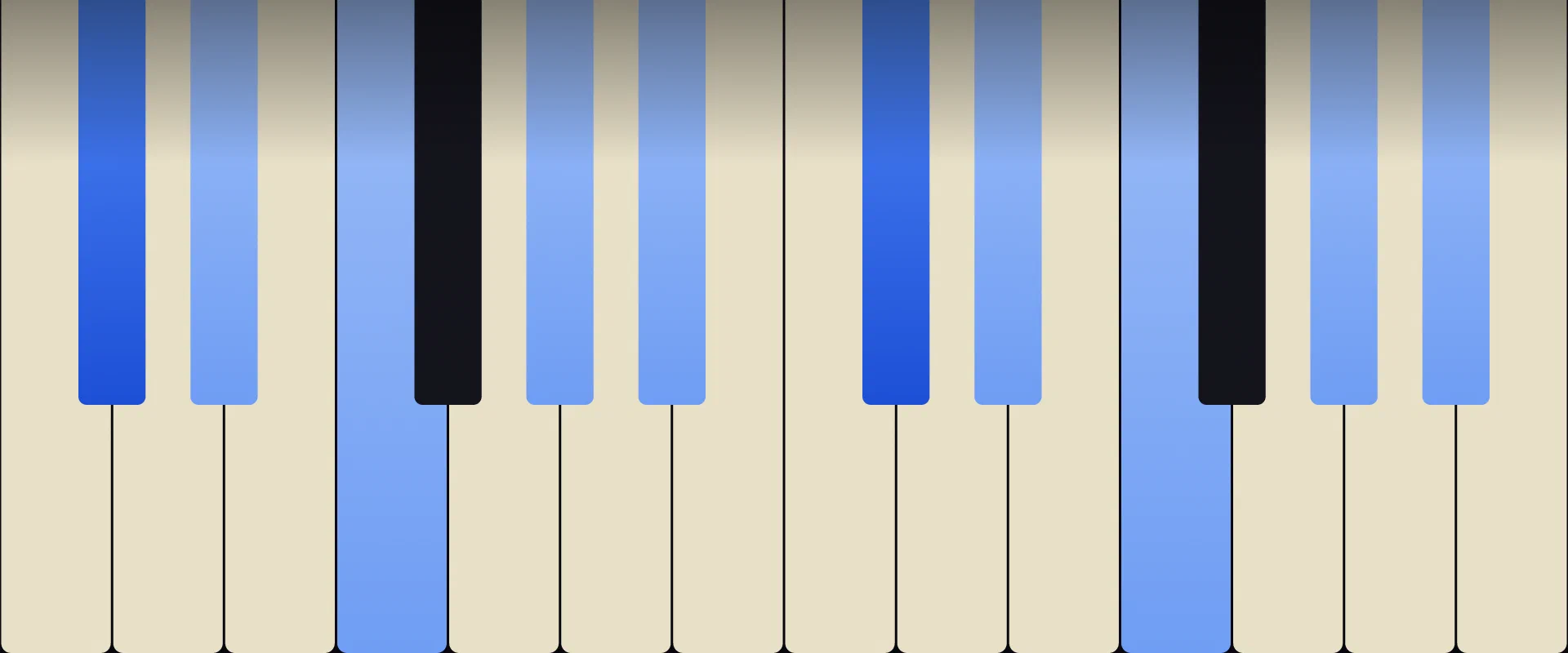
Stack perfect fifths from C♯ and stop after five notes. You get C♯, G♯, D♯, A♯ and E♯, and those five notes are this chord. Squeeze them into one octave and they become C♯, E♯, G♯, A♯ and D♯: a major triad with a sixth and a ninth added and nothing else. There is no seventh anywhere, so there is no interval in the chord that wants to go somewhere, which is why arrangers park on C♯6/9 at the end of a piece and let it ring.
Try It: C♯6/9 in the Chord Finder
Set the root to C♯ and choose Major Pentatonic. The five notes the tool highlights on the keyboard are exactly the five notes of this chord, a match worth understanding rather than memorising.
The Notes of C♯6/9
| Degree | Note | Interval from root | Semitones |
|---|---|---|---|
| 1 (root) | C♯ | Perfect unison | 0 |
| 3 | E♯ | Major 3rd | 4 |
| 5 | G♯ | Perfect 5th | 7 |
| 6 | A♯ | Major 6th | 9 |
| 9 | D♯ | Major 9th | 14 |
Written out: C♯, E♯, G♯, A♯, D♯. Four black keys and one white one, and the white one is the note that makes readers doubt the page.
E♯ is played on the white key F. Nothing sits between E and F on a keyboard, so raising E by a semitone arrives at a key that already has another name. The spelling is not optional. A chord built on C♯ uses every second letter going up, C, E, G, so its third has to be some kind of E, and calling it F would make the interval look like a fourth and turn this into a suspended chord on paper. Every other note behaves normally: C♯, G♯, A♯ and D♯ are black keys, exactly where their names suggest. The 14 in the last row is a placement instruction, since D♯ belongs an octave above the root, where it is a ninth rather than a second.
How C♯6/9 Is Built
Begin with C♯ major, which is C♯, E♯ and G♯. Add A♯ and you have C♯6. Add D♯ as well and the chord is complete. Nothing was removed and no seventh was ever involved, so this is not a thirteenth chord with pieces missing: a C♯13 has B in it and this does not.
That absent B is the entire character of the chord. With no minor seventh there is no tritone, no leading note and no pull, so any of the five notes can be the melody note and none of them has to move next. Compare C♯9, where the B forces a resolution whether the arranger wants one or not.
Now count the fifths again. C♯ up to G♯, G♯ up to D♯, D♯ up to A♯, A♯ up to E♯: four perfect fifths and nothing else in the chain. Chords built out of fifths sound wide and unhurried at any spacing, which is why a six nine can be voiced almost carelessly and still sound professional. See Extended Chords and Jazz Harmony.
C♯6/9 on the Piano
Play C♯, D♯, F, G♯, A♯ upwards and look at the keys: black, black, white, black, black. The five notes of this chord, in ascending order, make a shape that is almost symmetrical under the hand, with the single white key sitting in the gap between the two black key groups.
That is also the fingering. The two note black group gives C♯ and D♯, the thumb steps down to F for the third, and the three note group supplies G♯ and A♯. Any pianist who has practised C♯ major pentatonic already has this hand position, and stacking those five notes is the whole trick.
The neighbouring chord is worth knowing about. F♯6/9 is F♯, A♯, C♯, D♯ and G♯, five black keys and not one white. C♯6/9 is that chord with a single key shifted down to the white level, which is why it feels almost as easy and never quite as smooth.
In practice, split it. Left hand takes C♯, or C♯ and G♯. Right hand takes E♯, G♯, A♯ and D♯, a span of nine semitones. Keeping A♯ and D♯ on top matters most, since those are the two notes a listener has not already heard in a plain C♯ major triad.
C♯6/9 on the Guitar
C♯6/9 shares no note at all with any open string. Check them: E, A, D, G and B are none of them C♯, E♯, G♯, A♯ or D♯. That settles the question of an open form, since there is nothing at the nut to hang one on, and every voicing below is fretted on every string it sounds.
The grip to learn is x 4 3 3 4 4, which gives C♯, E♯, A♯, D♯ and G♯: all five notes, one of each and no doubling. The middle finger takes the fifth string at the 4th fret, the index lies across the fourth and third strings at the 3rd, and the ring finger covers the second and first strings at the 4th. It is the standard C6/9 shape, x 3 2 2 3 3, moved up a single fret, and since that shape uses no open strings the move costs nothing. Down here the frets are wide and the two small barres have room to sit cleanly.
Rooted on the sixth string there is a thinner option at the 9th fret: 9 x x 10 11 11 sounds C♯, E♯, A♯ and D♯, root, third, sixth and ninth, with the fifth left out and the two middle strings muted. Index on the sixth string at the 9th fret, middle on the third at the 10th, ring and little finger on the top two at the 11th. The gap in the middle is the point: four notes spread wide sound more like a six nine than five crammed together. More on these forms in Guitar Chord Shapes: The CAGED System.
Inversions
| Inversion | Notes | Bass | Symbol |
|---|---|---|---|
| Root position | C♯ E♯ G♯ A♯ D♯ | C♯ | C♯6/9 |
| 1st inversion | E♯ G♯ A♯ D♯ C♯ | E♯ | C♯6/9/E♯ |
| 2nd inversion | G♯ A♯ D♯ C♯ E♯ | G♯ | C♯6/9/G♯ |
| 3rd inversion | A♯ D♯ C♯ E♯ G♯ | A♯ | A♯m7 add 11 |
| 4th inversion | D♯ C♯ E♯ G♯ A♯ | D♯ | D♯11 |
The bottom two rows are not really inversions at all, they are other chords. Put A♯ in the bass and A♯, C♯, E♯ and G♯ spell A♯m7 outright, with the D♯ above it reading as an eleventh. Put D♯ in the bass and the five pitches become a root, a fifth, a minor seventh, a ninth and an eleventh, which is the dominant eleventh built on D♯. A chain of fifths is a six nine read from the bottom and an eleventh read from the middle, and the bass decides which. See Chord Inversions and Voice Leading.
Voicings
Spread it. This chord tolerates almost any spacing and rewards wide ones, so put a gap in the middle and let the fifths breathe.
| Shape | Frets | Result |
|---|---|---|
| C♯6/9 | x 4 3 3 4 4 | All five notes, no doubling |
| C♯6/9 | 9 x x 10 11 11 | Wide, no 5th |
| C♯6/9 | x 4 3 3 4 x | Four notes, no 5th |
| C♯6 | x 4 6 6 6 6 | The same chord without the 9th |
| C♯add9 | x 4 3 x 4 4 | The same chord without the 6th |
Which Keys Contain C♯6/9
- degree 5 (V) of F♯ major
- degree 1 (I) of C♯ mixolydian
- degree 2 (II) of B lydian
- degree 4 (IV) of G♯ melodic minor
- rooted on degree 1 of, and entirely contained in, D♭ major pentatonic
The last row is an identity rather than a containment. A major pentatonic scale is degrees 1, 2, 3, 5 and 6 of the major scale, and a six nine chord is degrees 1, 3, 5, 6 and 9, the same five notes with the second moved up an octave. This chord is the pentatonic scale played all at once. The site spells that page in flats, as D♭, E♭, F, A♭ and B♭, but the pitches are identical.
The chord’s most useful home is spelled in flats too. As D♭6/9 it is the tonic of D♭ major, written D♭, F, A♭, B♭ and E♭, and that is where most of the music using it lives, since composers who reach for this sound write for horns and singers rather than for open guitar strings.
Where C♯6/9 Shows Up
| Progression | Chords | Context |
|---|---|---|
| ii V I (C♯ major) | D♯m7, G♯7, C♯6/9 | The final bar of a standard |
| I IV I (D♭ major) | D♭6/9, G♭maj7, D♭6/9 | Bossa nova, same pitches |
| V that refuses (F♯) | C♯6/9, F♯maj7 | A dominant with no seventh |
| Fade out (C♯) | C♯6/9 held | Nothing left to resolve |
The first row is the classic, and the reason this chord is in every jazz pianist’s hands. A tune ends on its tonic, and a plain C♯ major triad ends it too abruptly while C♯maj7 leaves a B♯ leaning on the root from a semitone below. C♯6/9 ends it with colour and no leaning at all, which is what a last chord is for. See The ii V I Progression.
The third row is the odd one and worth trying. Every note of C♯6/9 belongs to F♯ major, so it can sit on the fifth degree of that key looking like a dominant, except that it has no B in it and so no tritone and no obligation. Move to F♯maj7 and the arrival feels like a door opening rather than a resolution, because nothing was ever pushing. Composers use this where a normal V would be too emphatic: over a fade, under dialogue, at the end of a verse that is not really over.
For a soloist the news is unusually good. The chord is a pentatonic scale, so every note in it can be leant on for as long as you like and the question becomes phrasing rather than which notes work. See Pentatonic Scales for Improvisation.
Related Chords
- C♯ Major 6th Chord, this chord with the 9th taken off
- C♯ Add9 Chord, this chord with the 6th taken off
- C♯ Major Chord, the triad underneath both additions
- C♯ Dominant 13th Chord, the same A♯ with a B underneath it
- C♯ Major 9th Chord, the other way to end a piece in C♯
- Extended Chords and Jazz Harmony for why a chord with no 7th has no avoid note
Learn More
Practice Chords
Drill chord recognition with a metronome, MIDI support, and score tracking.
Start Practicing