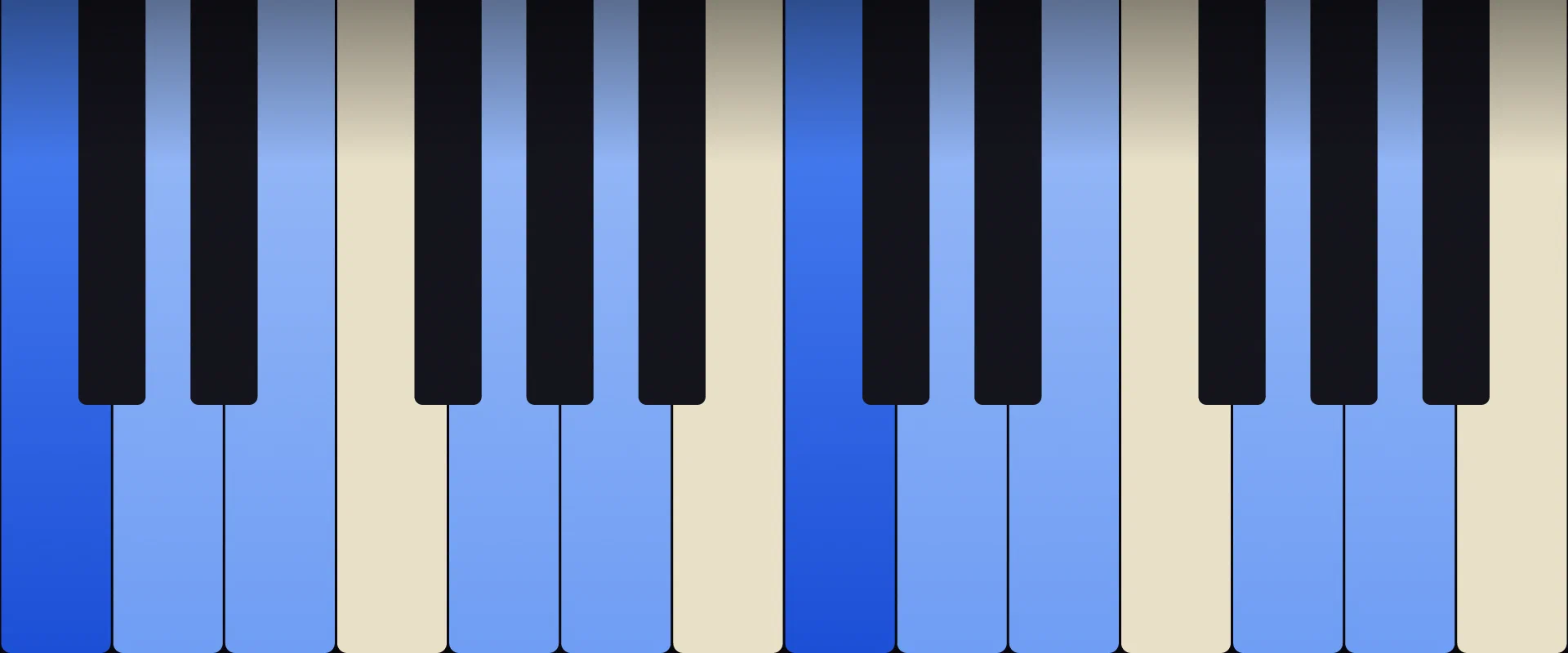
C6/9 has no seventh in it, and that absence is what the chord is for. Its five notes are C, E, G, A and D, a plain C major triad with a sixth and a ninth added, so there is no major seventh grinding against the root and no minor seventh setting up a tritone. Nothing here wants to go anywhere, which is why arrangers reach for it when a piece has to stop.
No two of the five notes are closer than a whole tone, and there is no tritone anywhere inside. Sorted into one octave they read C, D, E, G, A, which is the C major pentatonic scale complete. This chord is that scale sounded at once, so it has no avoid note and no wrong melody note. A singer can land on any of the five.
Try It: C6/9 in the Chord Finder
Set the root to C and compare the chord on the first degree of C lydian with the one on the first degree of C mixolydian. Those two scales disagree about two notes, and this chord contains neither, so it appears identically in both.
The Notes of C6/9
| Degree | Note | Interval from root | Semitones |
|---|---|---|---|
| 1 (root) | C | Perfect unison | 0 |
| 3 | E | Major 3rd | 4 |
| 5 | G | Perfect 5th | 7 |
| 6 | A | Major 6th | 9 |
| 9 | D | Major 9th | 14 |
Written out: C, E, G, A, D. Every one is a white key and there is not a single accidental to consider. That is true of only three of the twelve roots: C, F and G give an all white 6/9 chord, and the other nine need at least one black key.
Notice the last two rows. The sixth is written as 6 and stays inside the octave, while the ninth is written as 9 and belongs above it. That asymmetry is the whole notation: if the A were written as a 13 the chord would be claiming a seventh it does not have.
How C6/9 Is Built
Start with C major, C, E and G. Add the A and you have C6. Add the D instead and you have Cadd9. Add both and you have this chord. No stack of thirds is involved and no seventh was skipped, which is the thing most often got wrong about it: C6/9 is a triad with two notes added, not a thirteenth chord with pieces missing.
The distinction is audible. C13 holds the same A, but with a B♭ underneath it, and that B♭ turns a resting place into a departure. Take the seventh away and the A stops being a tension and becomes furniture.
One smaller chord lives inside. A, C, E and G are an A minor 7th chord, so C6/9 is Am7 with a D added, the same five notes read from A instead of C. This is a five note set with several names, and the bass note picks which one is in force.
C6/9 on the Piano
Five white keys, no accidental, no black key reached for at any point. This is the first chord past the triad that a beginner can play correctly on the first attempt.
The full shape does not fit one hand: C up to D is fourteen semitones with three notes inside it. Give C to the left hand and the right takes E, G, A and D, spanning ten semitones under thumb, index, ring and little finger. That is what most players do at first.
The better voicing gives up a note. Left hand plays C and G, right hand plays E, A and D. Those three are two perfect fourths stacked, E up to A and A up to D, and a hand holding stacked fourths sounds nothing like a hand holding thirds: open, slightly anonymous, impossible to date. Thumb, middle and little finger, no stretch, and it is the most recognisable piano sound in bossa nova and in the last bar of a jazz ballad.
A third arrangement is worth knowing for its tightness. Right hand D, E, G, A spans only seven semitones and can be held while the left plays a bass line. The D against the E is a whole tone, close enough to shimmer and wide enough never to clash.
C6/9 on the Guitar
The grip is x 3 2 2 3 3 and it sounds C, E, A, D and G. All five notes are present, none is doubled, and no barre is required: middle finger on the fifth string at the 3rd fret, index flat across the fourth and third at the 2nd, ring finger and little finger on the second and first at the 3rd. It is the shape a rhythm guitarist in a bossa nova band plays for hours at a time.
Be precise about what that grip is, though. Nothing rings open in it. It sits in open position, at the second and third frets, which is what makes it feel like an open chord, but it is really the movable A shape at its lowest useful fret. Slide the same fingering up five frets and it is F6/9.
Where the guitar genuinely is generous is overhead. Five of the six open strings are chord tones. Play x 0 0 0 1 0, one finger on the second string at the 1st fret, and the strings sound A, D, G, C and E, every note of the chord. The bass ruins the reading: with A underneath, the ear hears an A minor 7th chord with an added eleventh. The five notes are free on this instrument, and the root in the bass is what you pay for.
Two more are worth learning. x x 10 9 10 10 sounds C, E, A and D, the chord without its fifth, compact enough to sit between a horn line and a bass. Around the eighth fret the complete chord is 8 7 7 7 8 x, sounding C, E, A, D and G, index barring the seventh across the fifth, fourth and third strings. That one puts the root in the bass where it belongs.
Inversions
| Inversion | Notes | Bass | Symbol |
|---|---|---|---|
| Root position | C E G A D | C | C6/9 |
| 1st inversion | E G A D C | E | C6/9/E |
| 2nd inversion | G A D C E | G | C6/9/G |
| 3rd inversion | A D C E G | A | C6/9/A |
| 4th inversion | D C E G A | D | C6/9/D, or D11 |
The last two rows are the useful ones, and they are not really inversions but other chords. With A in the bass the notes are Am7 with an eleventh added, the open string voicing above. With D in the bass they are D, A, C, E and G: root, fifth, minor seventh, ninth and eleventh, a D dominant eleventh chord with no third, built the way C11 is built on C.
The pairing holds for every root, because a six nine chord and the eleventh chord a whole tone above it are the same major pentatonic scale. C6/9 and D11 share one set, C11 and B♭6/9 share another. So a bass player turns a resting chord into a dominant by walking up a whole tone while the hands above hold still. See Chord Inversions and Voice Leading.
Voicings
| Shape | Frets | Result |
|---|---|---|
| C6/9 | x 3 2 2 3 3 | All five notes, no barre |
| C6/9 | x 3 2 2 3 x | Four notes, no 5th |
| C6/9 | x x 10 9 10 10 | Compact, no 5th |
| C6/9 | 8 7 7 7 8 x | All five, root in the bass |
| Am7add11 | x 0 0 0 1 0 | Same notes, A underneath |
| C6 | x 3 2 2 1 x | The chord before the ninth |
Which Keys Contain C6/9
- I of C major
- V of F major
- IV of G major
- III of A natural minor
- I of C lydian
- I of C mixolydian
Three major keys hold this chord and only three: C, G and F. Every other signature alters one of the five notes, D major sharpening the C, B♭ major flattening the E, and so on round the circle of fifths. Those three are C and its immediate neighbours.
The last two rows show the other half of the story. C lydian raises the fourth degree and C mixolydian lowers the seventh, and this chord has neither a fourth nor a seventh to be affected, so it sits unchanged in both. In C major pentatonic it is not merely contained but identical: a soloist playing only the chord’s own notes is playing a scale.
Where C6/9 Shows Up
| Progression | Chords | Context |
|---|---|---|
| ii V I in C major | Dm7, G7, C6/9 | The final bar of the chart |
| Bossa nova tonic | C6/9, Fmaj7, Dm7, G7 | Two bars of nothing moving |
| IV in G major | G, C6/9, D7 | Colour without a modulation |
| Blues in C, last chorus | C7, F7, C6/9 | The seventh finally released |
The first row is where the chord earns its living. A ii V I in C major arrives on the tonic, and if that tonic is Cmaj7 the B in it sits a semitone below the root and keeps a faint question open. C6/9 has no B, so the arrival is complete and nothing is left hanging. Every arrangement that has to end rather than fade uses some version of this.
The second row is the guitar’s territory. Hold x 3 2 2 3 3 across two bars of a bossa, let the bass alternate C and G underneath, and the chord neither develops nor decays. That stillness is the genre, and the top voices barely shift on the way to Fmaj7 and back.
The last row is worth trying on any twelve bar blues. Play C7 through the form, then put C6/9 in the final bar in place of the tonic seventh. The tritone that has driven twelve bars disappears at the moment the music stops, and the ending sounds intentional rather than merely final.
Related Chords
- C Major 6th Chord, the same chord before the ninth was added
- C Add9 Chord, the same chord before the sixth was added
- C Major 9th Chord, a B where this chord has an A, and a question with it
- A Minor 7th Chord, four of these five notes read from another root
- C Dominant 13th Chord, the same sixth with a minor seventh beneath it
- C Dominant 11th Chord, the same five note trick built on B♭ instead
Learn More
Practice Chords
Drill chord recognition with a metronome, MIDI support, and score tracking.
Start Practicing