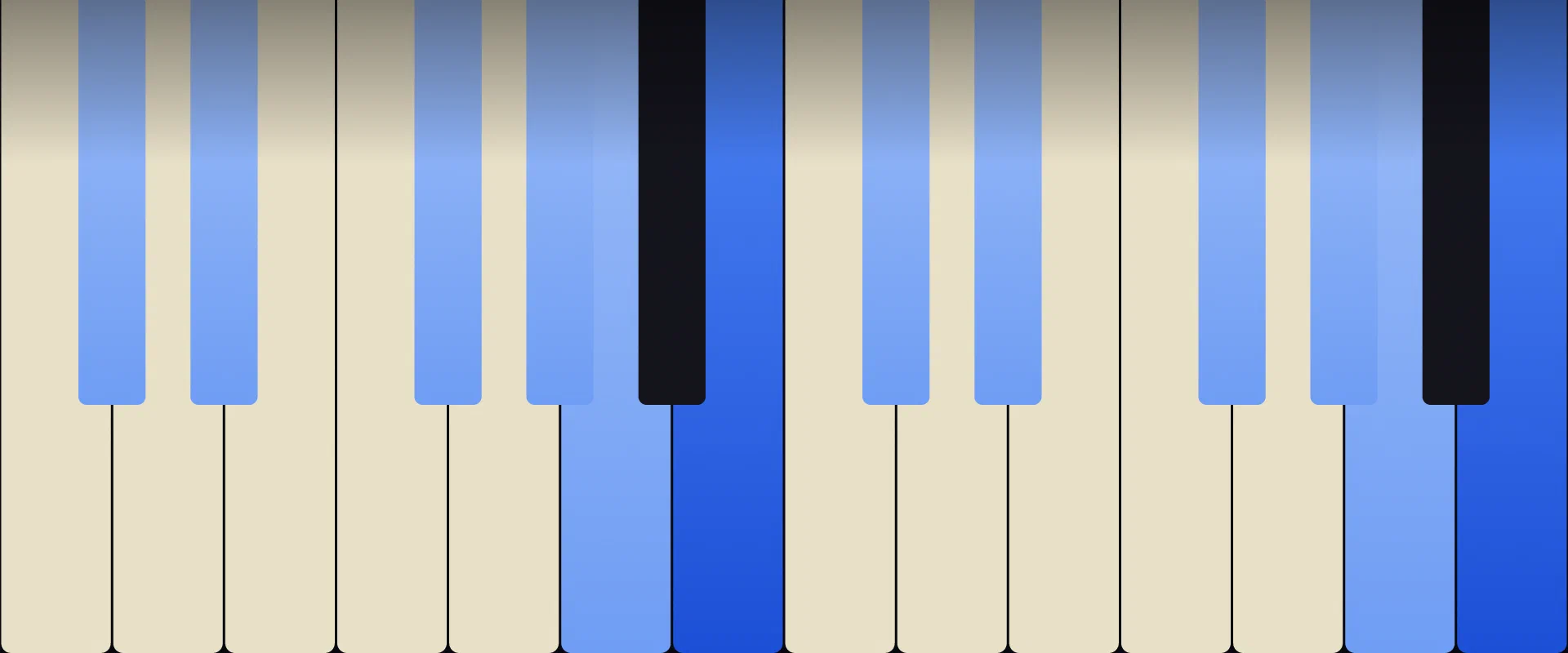
B13 is B, D♯, F♯, A, C♯ and G♯. Six notes. A guitar has six strings and a hand has five fingers, one of them usually holding a barre, so the printed chord and the played chord are different objects. The question is not whether notes get dropped but which ones, and the answer never varies: the fifth goes first, the ninth goes next, and the third and the flattened seventh never go at all, because D♯ and A between them are the only reason the chord is a dominant.
What that leaves, in the shapes guitarists really use, is B, A, D♯ and G♯. Four notes, and they sound more like the full chord than the full chord does.
Try It: B13 in the Chord Finder
Set the root to B, choose B mixolydian and turn the Thirteenth toggle on. The tool builds the complete seven note stack, E included, because that is what stacking thirds through a scale produces. The written symbol leaves the E out.
The Notes of B13
| Degree | Note | Interval from root | Semitones |
|---|---|---|---|
| 1 (root) | B | Perfect unison | 0 |
| 3 | D♯ | Major 3rd | 4 |
| 5 | F♯ | Perfect 5th | 7 |
| ♭7 | A | Minor 7th | 10 |
| 9 | C♯ | Major 9th | 14 |
| 13 | G♯ | Major 13th | 21 |
Written out: B, D♯, F♯, A, C♯, G♯. Four are black keys and only two, B and A, are white, and those two are the root and the seventh, the pair the chord cannot do without. Every sharp in the list falls on a black key where the eye expects it, so nothing here needs explaining away.
The 21 in the last row matters. G♯ is nine semitones above B, and calling it a thirteenth places it an octave higher, above the seventh rather than below it. Put G♯ under the A and the chord is a muddle. Put it above and it sings.
How B13 Is Built
Take B9, which is B, D♯, F♯, A and C♯, and add two more thirds on top: E, then G♯. Now throw the E away. The eleventh clashes with the third exactly as it does in B11, where the settlement is the opposite one, keeping the E and dropping the D♯. A thirteenth chord chooses the third instead, which is why the two are not sizes of the same chord but two answers to one argument.
Sorted, the six notes read B, C♯, D♯, F♯, G♯, A, which is B mixolydian with the E removed: the entire key minus the one degree that would spoil it.
Strip the B off the bottom and D♯, F♯, A and C♯ are D♯m7♭5, a half diminished chord standing on the third of this one. Take the A and C♯ away instead and B, D♯, F♯ and G♯ are B6, which is where the confusion about this chord starts. The two share the G♯, and the whole difference is the A underneath it: without the seventh that G♯ is a colour, and with it the same note is a tension inside a chord that has somewhere to go.
B13 on the Piano
Put B in the left hand, add F♯ above it if the sound needs weight, and the fifth is dealt with. The right hand then takes A, C♯, D♯ and G♯, in that order: seventh, ninth, third, thirteenth. The thumb lands on the white A, the other three fingers sit back on black keys, the span is eleven semitones and the shape falls under 1, 2, 3 and 5 with nothing forced. On this root it is unusually comfortable, since the thumb gets the only white key in the group and the black keys line up behind the longer fingers.
Now find out why that order is the order. G♯ is the black key immediately below A. Play those two in the same octave and the chord snarls, the thirteenth grinding a semitone against the seventh. The voicing above separates them by a major seventh instead, and the same two notes become the sweetest interval in the chord. Only the octave changed.
Behind a singer, give B and A to the left hand instead and the right is left with C♯, D♯ and G♯: three black keys and no thumb trouble at all.
B13 on the Guitar
All six notes will fit. 7 9 7 8 9 9 holds B, F♯, A, D♯, G♯ and C♯ over an index barre at the seventh fret, with the little finger flattened across the top two strings at the ninth. It is playable in the sense that a person has played it. It is not a chord you change to.
The grip everyone uses is 7 x 7 8 9 x: B, A, D♯ and G♯. Index across the sixth and fourth strings at the seventh fret with the fifth muted under it, middle finger on the third string at the eighth, little finger on the second at the ninth. Four notes, no fifth, no ninth, and it is the sound of the chord.
Down at the nut the same four are x 2 x 2 4 4: B and A at the second fret on the fifth and third strings, D♯ and G♯ at the fourth on the top two. The fourth string has to be muted, since an open D belongs to no part of this chord, and this close to the nut the strings are unforgiving.
One more, for the sound rather than the theory. B6 is one finger flat across the top four strings at the fourth fret, and stopping the sixth string at the fifth puts an A underneath it: 5 x 4 4 4 4 sounds A, F♯, B, D♯, G♯. Two fingers, every note but the ninth, and the easiest thirteenth here.
Inversions
| Inversion | Notes | Bass | Symbol |
|---|---|---|---|
| Root position | B D♯ F♯ A C♯ G♯ | B | B13 |
| 1st inversion | D♯ F♯ A C♯ G♯ B | D♯ | B13/D♯ |
| 2nd inversion | F♯ A C♯ G♯ B D♯ | F♯ | B13/F♯ |
| 3rd inversion | A C♯ G♯ B D♯ F♯ | A | B13/A |
| 4th inversion | C♯ G♯ B D♯ F♯ A | C♯ | B13/C♯ |
| 5th inversion | G♯ B D♯ F♯ A C♯ | G♯ | B13/G♯ |
Treat this as bookkeeping rather than advice: a table of complete inversions describes a chord nobody is playing. Two rows are worth hearing anyway. With D♯ in the bass the chord turns thinner and more urgent, because the tritone D♯ to A now sits at the bottom of the stack instead of inside it. With G♯ in the bass the notes read as a G♯ minor seventh carrying an A a semitone above its own root, the least settled position the chord has. See Chord Inversions and Voice Leading.
Voicings
Put the G♯ on top and the A well below it. Every other decision about this chord is smaller than that one.
| Shape | Frets | Result |
|---|---|---|
| B13 | 7 x 7 8 9 x | Root, 7th, 3rd, 13th |
| B13 | x 2 x 2 4 4 | The same four at the nut |
| B13 | 7 9 7 8 9 9 | All six notes, barely |
| B13/A | 5 x 4 4 4 4 | Two fingers, no 9th |
| B9 | x 2 1 2 2 2 | The chord before the 13th |
| B6 | x x 4 4 4 4 | The G♯ with no A under it |
Which Keys Contain B13
- V of E major
- I of B mixolydian
- VII of C♯ natural minor
- IV of F♯ dorian
- II of A lydian
- IV of F♯ melodic minor
The first five rows are one scale wearing five hats. E major, B mixolydian, C♯ natural minor, F♯ dorian and A lydian are the same seven notes read from five starting points, so a player who knows the key of E knows what to play over this chord whatever the chart calls the mode.
The last row is the genuine outlier, and it is there for a reason worth knowing. F♯ melodic minor differs from E major by exactly one note: E is raised to E♯. That breaks most chords built from the key. It does not break this one, because B13 has no E in it. The note the chord throws away is precisely the note that scale alters.
Where B13 Shows Up
| Progression | Chords | Context |
|---|---|---|
| ii V I (E major) | F♯m7, B13, Emaj7 | The G♯ never moves |
| Blues in E | E7, A7, B13 | The V chord, given colour |
| Turnaround (E major) | Emaj7, C♯m7, F♯m7, B13 | Back to the top |
| I to V vamp | E9, B13 | Soul, and a horn section |
Watch the G♯ through the first row. In B13 it is the thirteenth, the note on top. In Emaj7 it is the third, the note that makes the key major, and it does not move. Meanwhile the A beneath it, the seventh of B13, falls one semitone to G♯ as the chord resolves, arriving on a note already sounding above it. That is the trick of a thirteenth chord: the destination is in the room before the journey ends.
The second row is where most guitarists meet this chord. A blues in E turns round on the five chord, and B7 there is correct and slightly plain. Play 7 x 7 8 9 x instead and the bar acquires a horn section without sounding like a jazz intrusion, since G♯ is already the third of the tonic.
That the key is E matters more than it looks. E and B are guitar country, and a thirteenth on B is easy on the instrument. It is horrible on paper for everybody else: an alto saxophone reads this chord as G♯13, a tenor or a trumpet as C♯13, keys with more sharps than a wind player wants to meet at a rehearsal. So B13 turns up constantly in blues, soul and guitar led rhythm and blues, and hardly at all in big band charts, where the tune would have been moved to a flat key long before anyone unpacked an instrument.
Related Chords
- B Dominant 11th Chord, the other settlement of the same argument
- B Dominant 9th Chord, the five notes this one grows from
- B Dominant 7th Chord, the four notes that carry the function
- B Major 6th Chord, the same G♯ with no seventh underneath it
- D♯ Half Diminished Chord, what the four notes above the root spell
Learn More
Practice Chords
Drill chord recognition with a metronome, MIDI support, and score tracking.
Start Practicing