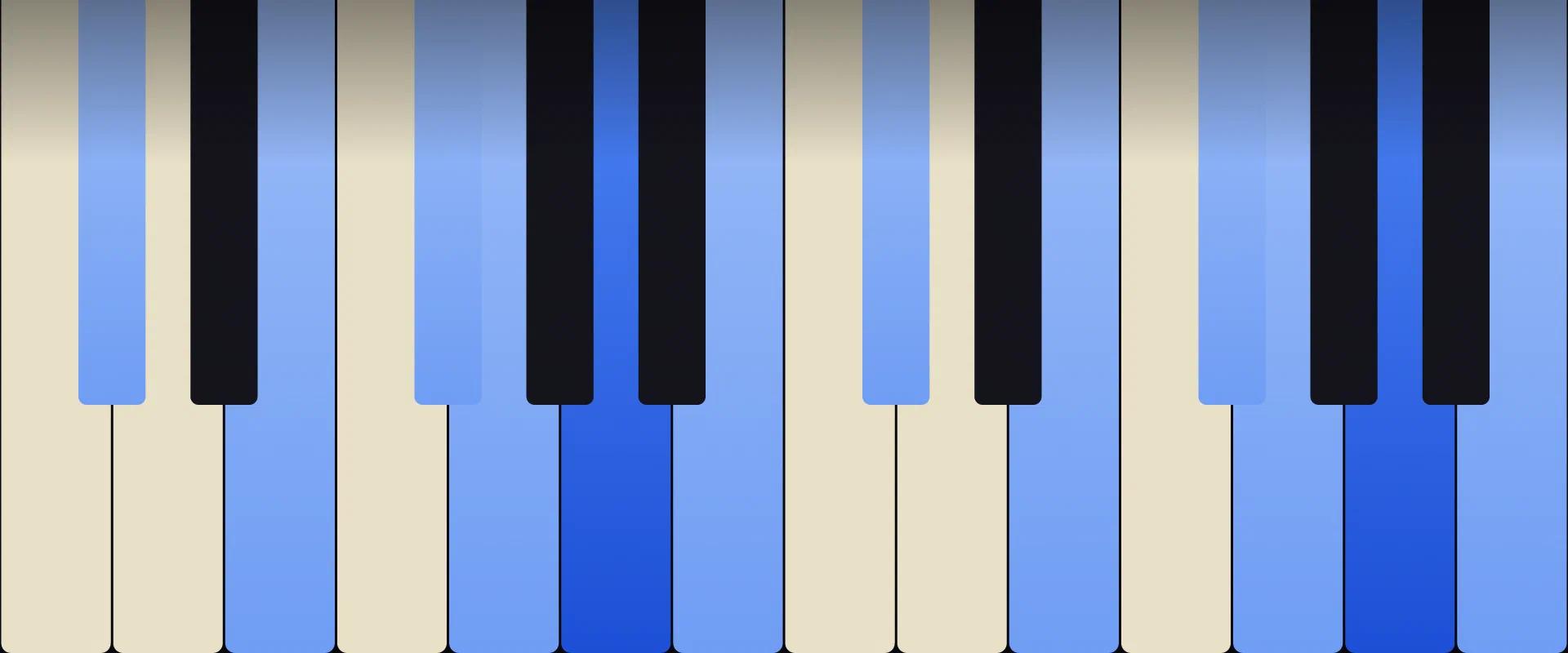
Write out the D major scale, cross off the D and play what is left. E, F♯, G, A, B and C♯, stacked from the A, are A13: root, major third, perfect fifth, minor seventh, major ninth and major thirteenth. Six of the key’s seven notes are in the chord and the only one missing is the note the chord is trying to reach. That is the mechanism of a thirteenth chord, and on this root the key it points at is D.
Six notes is more than a hand holds, so almost every printed A13 is a selection. Two are never negotiable: the C♯ and the G are the third and the seventh, the tritone that makes the chord dominant. Everything else can be sacrificed, and in practice the fifth goes first.
Try It: A13 in the Chord Finder
Set the root to A, choose A mixolydian and switch the Thirteenth toggle on. The finder stacks all seven degrees, so it shows a D as well. That D is the eleventh, the note this chord leaves out.
The Notes of A13
| Degree | Note | Interval from root | Semitones |
|---|---|---|---|
| 1 (root) | A | Perfect unison | 0 |
| 3 | C♯ | Major 3rd | 4 |
| 5 | E | Perfect 5th | 7 |
| ♭7 | G | Minor 7th | 10 |
| 9 | B | Major 9th | 14 |
| 13 | F♯ | Major 13th | 21 |
Written out: A, C♯, E, G, B, F♯. Two black keys and four white ones, and both accidentals are sharps that land where a reader expects them. The 14 and the 21 are placement instructions: the B belongs above the seventh and the F♯ above that, not squashed into the root’s octave.
How A13 Is Built
Take A9, which is A, C♯, E, G and B, and add another third on top. B up to D would be the eleventh, and B up to F♯ is not the next third at all, so strictly the chord is stacked to the thirteenth and then has the eleventh removed. The reason is the one that shapes A11 from the other direction: D and C♯ a semitone apart in one chord is a sound almost nobody wants, so a chord may keep the third or the eleventh but not both. A13 keeps the third.
The F♯ is worth a second look, because it is the same pitch as the sixth of A. What separates A13 from A6 is not the F♯ at all, it is the G underneath it. Take the G away and the tension disappears and the chord stops pointing anywhere. Put it back and the F♯ turns from a colour into the top of a dominant.
A13 on the Piano
Two black keys, C♯ and F♯, and they carry the chord’s character, which suits a hand whose longer fingers already sit over the black keys.
Nobody plays all six in one hand. The standard jazz solution gives the root to the left hand and puts four notes in the right, upwards: C♯, F♯, G, B. That is the third, the thirteenth, the seventh and the ninth, under thumb, index, middle and little finger, with the index dropping onto the F♯ beside the thumb’s C♯. The sound is unmistakable, because the F♯ and the G are a semitone apart in the middle of the voicing and that rub is what a thirteenth chord is for.
A simpler arrangement keeps both hands easy. Left hand takes A and the G above it, root and seventh, and the right hand takes C♯, E and F♯. That is every note but the ninth, in two shapes a learner already owns, and it is the quickest way to hear what the chord loses when the left hand drops the G.
Skip the root if a bass player is present. C♯, E, G, B on its own is a C♯ half diminished chord, and under an A it is all of A13 but the thirteenth.
A13 on the Guitar
Open A7 is x 0 2 0 2 0, and the first string in that shape is an open E, the fifth of the chord. Fret it at the 2nd instead and it becomes F♯. That one movement, x 0 2 0 2 2, is A13: it sounds A, E, G, C♯ and F♯, five of the six notes with only the ninth missing, and it is no harder to hold than the A7 it came from. The blues in A is full of it.
Strip it further and it improves. x 0 x 0 2 2 sounds A, G, C♯ and F♯: root, seventh, third and thirteenth, nothing doubled. Funk players hold it for whole choruses, and it is the voicing to learn first.
Up the neck the sixth string root form starts at the 5th fret. 5 x 5 6 7 x gives those same four notes higher, index at the 5th fret, little finger out at the 7th and the fifth string muted by the underside of the index. Add the ninth on the first string and 5 x 5 6 7 7 sounds A, G, C♯, F♯ and B, which is as much as a normal hand will take.
All six will fit, just about. 5 7 5 6 7 7 sounds A, E, G, C♯, F♯ and B, but it wants the thumb over the neck for the low A while the ring finger stands on the fifth string and the little finger lies across the top two. Most guitarists try it once. The four note grip says the same thing and leaves the fifth to the bass player.
Inversions
| Inversion | Notes | Bass | Symbol |
|---|---|---|---|
| Root position | A C♯ E G B F♯ | A | A13 |
| 1st inversion | C♯ E G B F♯ A | C♯ | A13/C♯ |
| 2nd inversion | E G B F♯ A C♯ | E | A13/E |
| 3rd inversion | G B F♯ A C♯ E | G | A13/G |
| 4th inversion | B F♯ A C♯ E G | B | A13/B |
| 5th inversion | F♯ A C♯ E G B | F♯ | A13/F♯ |
With six notes in play the label matters less than what the ear does with the bass note, and two rows change the meaning outright. Over G the notes read as G, B, F♯, A and C♯, a G major ninth with a sharpened eleventh and no fifth, which is the home chord of G lydian. Over F♯ the lower four notes are an F♯ minor seventh and the G above them turns into a flattened ninth, tense in an entirely different way. Neither will function as a dominant, so keep the A or the C♯ in the bass when the chord has a job to do. See Chord Inversions and Voice Leading.
Voicings
| Shape | Frets | Result |
|---|---|---|
| A13 | x 0 x 0 2 2 | Root, 7th, 3rd, 13th |
| A13 | x 0 2 0 2 2 | Open form, no 9th |
| A13 | 5 x 5 6 7 x | Sixth string root, four notes |
| A13 | 5 x 5 6 7 7 | Adds the 9th on top |
| A13 | 5 7 5 6 7 7 | All six, thumb over the neck |
| A7 | x 0 2 0 2 0 | The chord it grows from |
Which Keys Contain A13
- V of D major
- VII of B natural minor
- IV of E dorian
- III of F♯ phrygian
- II of G lydian
- I of A mixolydian
- VI of C♯ locrian
- IV of E melodic minor
The first seven rows are one collection of seven notes read from seven starting points, so a soloist who knows D major knows what to play over all of them. That is forced rather than lucky: the chord holds six of a key’s seven notes, which leaves a scale exactly one free note, so only two scales in the whole set contain A13 at all.
The second spends its free note on D♯ instead of D. Since D is the note A13 refuses to use, raising it costs the chord nothing, and that is the theory behind playing E melodic minor over A13: every chord tone is still there and the altered note lands where the chord had a hole.
Where A13 Shows Up
| Progression | Chords | Context |
|---|---|---|
| ii V I (D major) | Em9, A13, Dmaj7 | The F♯ never moves |
| Jazz blues in A | A13, D9, A13, E9 | Bars one to four |
| One chord vamp | A13 held | Funk, soul, gospel |
Watch three voices across the first row. The C♯ rises a semitone to D and becomes the tonic, the G falls a semitone to F♯, and the F♯ that was the thirteenth is already the third of Dmaj7 so it stays where it is. That is why a thirteenth resolves so smoothly into a major key: the note furthest from the root does not have to travel.
The second row is the reason guitarists meet this chord early. A blues in A is the default session key on the instrument, the open shapes are all there, and swapping plain sevenths for thirteenths costs one finger per chord. D9 at the fourth bar and an E9 at the turnaround give the twelve bars a jazz surface without changing a single root. The same tune in E♭ would need barre chords from the first beat.
The third row is where the chord stops being a dominant at all. Hold x 0 x 0 2 2 and vamp: the tritone never resolves, and after four bars the ear stops waiting and treats the tension as the colour of the groove. Funk and soul do this constantly, and it works better in A than in most guitar keys, because the open fifth string carries the root while the fretted notes stay thin enough to leave room underneath.
Related Chords
- A Dominant 9th Chord, the five notes underneath the thirteenth
- A11 Chord, the same family with the third dropped instead
- A Dominant 7th Chord, the third and seventh with nothing added
- A Major 6th Chord, the same F♯ with no seventh under it
- C♯ Half Diminished Chord, the four notes above the root
Learn More
Practice Chords
Drill chord recognition with a metronome, MIDI support, and score tracking.
Start Practicing