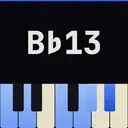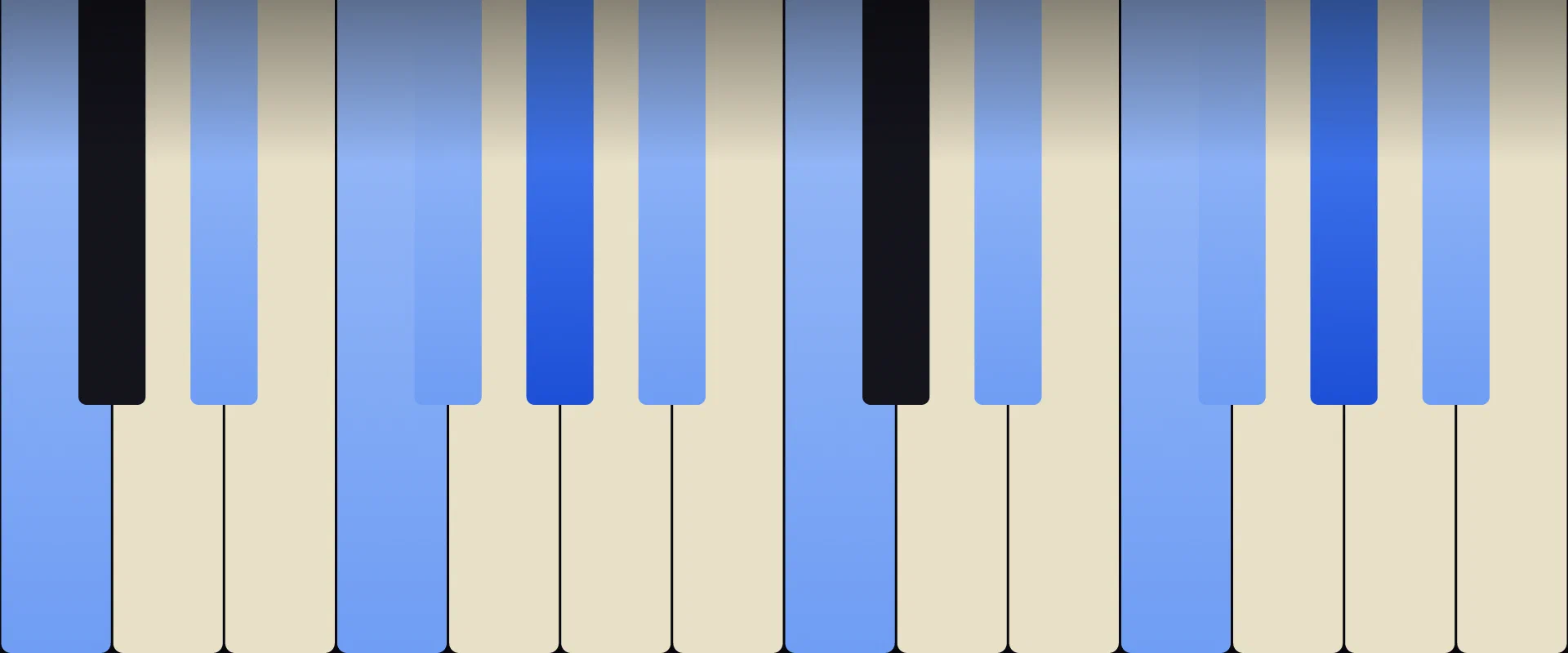
Nearly everything in this chord is under pressure to move. The F is not. A♭13 is A♭, C, E♭, G♭, B♭ and F, and that top F is also the third of D♭ major, the chord an A♭ dominant is usually heading for. Sound the six notes, resolve them, and the highest voice stays exactly where it was while every other one shifts. The urgency comes from the tritone between C and G♭ inside the chord, and the thirteenth does nothing to weaken it. It just hands the arrival a note it already agrees with.
Six notes is the practical problem. A hand has five fingers and a guitar has six strings, so the chord is almost never heard whole. What survives is C and G♭, the third and the seventh, because those two are what make it a dominant at all.
Try It: A♭13 in the Chord Finder
Set the root to A♭, choose mixolydian and switch the Thirteenth toggle on. The tool stacks all seven notes of the scale, so what it builds on the first degree includes a D♭. Take that away and the remaining six are the chord on this page.
The Notes of A♭13
| Degree | Note | Interval from root | Semitones |
|---|---|---|---|
| 1 (root) | A♭ | Perfect unison | 0 |
| 3 | C | Major 3rd | 4 |
| 5 | E♭ | Perfect 5th | 7 |
| ♭7 | G♭ | Minor 7th | 10 |
| 9 | B♭ | Major 9th | 14 |
| 13 | F | Major 13th | 21 |
Written out: A♭, C, E♭, G♭, B♭, F. Four black keys and two white ones, and the two white ones are the pair that give the chord its character: the third that makes it major and the thirteenth that colours it. Twenty one semitones puts F an octave and a major sixth above the root, which is the only difference between calling it a thirteenth and calling it a sixth.
How A♭13 Is Built
Take A♭9, which is A♭, C, E♭, G♭ and B♭, and add F above it. Strictly a thirteenth chord should also contain an eleventh, D♭ in this key, and it does not. The same clash that runs through A♭11 applies here: D♭ sits one semitone above C, and between the two the third wins, because without it the chord stops being a dominant.
That leaves a neat result. A♭ mixolydian is A♭, B♭, C, D♭, E♭, F and G♭, seven notes, and A♭13 is all of them except D♭. The chord is its own scale with one hole in it.
Compare it with A♭6, which is A♭, C, E♭ and F. The same F sits on top of both. What separates them is G♭ underneath: put a minor seventh below a sixth and the note becomes a thirteenth, and the chord acquires somewhere it has to go. Take the G♭ away again and it is content to stay put forever.
A♭13 on the Piano
Six notes need both hands, and the sensible split is not down the middle. Give the left hand A♭ and G♭, root and seventh, an interval wide enough not to muddy. The right hand then takes G♭, B♭, C and F under fingers one, two, three and five: two black keys, then two white ones, in that order going up. The hand starts deep on the keyboard and comes forward, which is an easy motion to find in the dark and a good reason this voicing sticks.
Those four notes span eleven semitones, so nothing is stretched. What has gone is E♭, the fifth, which adds no information a listener does not already have and is the first note any arranger drops when a chord runs out of room. Put it back by taking A♭ and E♭ in the left hand instead, and all six notes fit with no stretch in either.
The right hand alone is worth a moment. C, E♭, G♭ and B♭ are a C half diminished seventh, which is what the third, fifth, seventh and ninth of any dominant ninth spell. Add F and the whole of A♭13 is sitting above its own root.
A♭13 on the Guitar
Six notes, six strings, and for once the arithmetic works. 4 6 4 5 6 6 puts one note on every string: A♭, E♭, G♭, C, F and B♭, the complete chord with nothing doubled. Index barres the fourth fret, ring finger takes the fifth string at the sixth, middle finger the third string at the fifth, and the little finger lies flat across the top two strings at the sixth. It is a demanding grip, but the fourth fret is low enough that the barre still has room.
It is also one string away from a chord most players already know. The A♭9 barre is 4 6 4 5 4 6, and the only difference is the second string moving from the fourth fret to the sixth, lifting E♭ to F. The fifth leaves and the thirteenth arrives in one fingertip, so practise it as a move rather than as two shapes.
In real playing the four note reduction wins. 4 x 4 5 6 x sounds A♭, G♭, C and F: root, seventh, third and thirteenth, with the fifth string and the top string muted. Everything that identifies the chord is in there and nothing else is, which is why it is the grip every guitarist reading a big band chart uses.
The shape rooted on the fifth string is x 11 10 11 11 13, sounding A♭, C, G♭, B♭ and F: five of the six notes, with only E♭ missing. It spans four frets, and high on the neck that is a help rather than a hindrance, because the reach from the tenth to the thirteenth up there is shorter than the same reach at the nut.
With a capo at the first fret, the open G13 shape 3 2 3 0 0 0 sounds A♭, C, G♭, A♭, C and F. Four different notes only, but three strings ring open behind the capo, which no barre in this key manages.
Inversions
| Inversion | Notes | Bass | Symbol |
|---|---|---|---|
| Root position | A♭ C E♭ G♭ B♭ F | A♭ | A♭13 |
| 1st inversion | C E♭ G♭ B♭ F A♭ | C | A♭13/C |
| 2nd inversion | E♭ G♭ B♭ F A♭ C | E♭ | A♭13/E♭ |
| 3rd inversion | G♭ B♭ F A♭ C E♭ | G♭ | A♭13/G♭ |
| 4th inversion | B♭ F A♭ C E♭ G♭ | B♭ | A♭13/B♭ |
| 5th inversion | F A♭ C E♭ G♭ B♭ | F | A♭13/F |
Treat this table as description rather than instruction. A chord this size is reshaped by leaving notes out, not by rotating all six. The last row repays a look, though. From F upwards the first four notes are Fm7 exactly, with G♭ and B♭ resting above them, so a bass player moving to F under a held A♭13 changes the chord without anyone else lifting a finger. See Chord Inversions and Voice Leading.
Voicings
| Shape | Frets | Result |
|---|---|---|
| A♭13 | 4 6 4 5 6 6 | All six notes, one per string |
| A♭13 | 4 x 4 5 6 x | Root, 7th, 3rd, 13th: the working grip |
| A♭13 | x 11 10 11 11 13 | A form, everything but the fifth |
| A♭13 | capo 1, 3 2 3 0 0 0 | G13 shape, three strings ringing |
| A♭9 | 4 6 4 5 4 6 | One fingertip away |
| A♭6 | 4 6 6 5 6 4 | The same F with no seventh under it |
Which Keys Contain A♭13
- I of A♭ mixolydian
- V of D♭ major
- IV of E♭ dorian
- VII of B♭ natural minor
- III of F phrygian
- II of G♭ lydian
- IV of E♭ melodic minor
Six of these seven are the same seven notes read from six different starting points. D♭ major, A♭ mixolydian, E♭ dorian, B♭ natural minor, F phrygian and G♭ lydian are all one parent scale, so a soloist who knows D♭ major knows what to play over the chord in every one of those contexts.
E♭ melodic minor is the exception and the interesting one. It supplies D natural rather than D♭, raising the fourth degree above A♭. Since A♭13 contains neither version of that note, the chord cannot say which it wants and the soloist decides, which is the whole difference between a plain dominant and what jazz writing calls a lydian dominant.
Where A♭13 Shows Up
| Progression | Chords | Context |
|---|---|---|
| ii V I (D♭ major) | E♭m9, A♭13, D♭maj7 | The F never moves |
| Blues in A♭ | A♭13, D♭9, E♭13 | Concert key for horns |
| Shout chorus | A♭13, G13, G♭13 | Parallel and chromatic |
| VII in B♭ minor | B♭m9, A♭13, G♭maj7 | Falling, no leading note |
Follow the top voice through the first row. F is the ninth of E♭m9, the thirteenth of A♭13 and the third of D♭maj7, so a lead line can hold that one pitch across an entire cadence while the function underneath it changes twice. Meanwhile C falls a semitone to D♭ and G♭ falls a semitone to F, and those two moves are the cadence. Nothing else has to happen.
The middle rows explain why so much of this repertoire sits in A♭ at all. Alto and baritone saxophones read concert A♭ as F, trumpets and tenors read it as B♭, and both parts land in easy flat keys with a comfortable range, so big band arrangers write here by default. A shout chorus built on parallel thirteenths slides the four note grip down in semitones without changing shape, which a section can play in unison at speed.
The last row is the one guitarists meet most often. In B♭ minor the chord on the seventh degree is A♭ dominant, and it falls to G♭maj7 instead of resolving upward, because a natural minor key has no leading note to push it. Nothing sounds like a cadence, and the thirteenth is there to make the chord attractive in itself rather than to sharpen an arrival.
Related Chords
- A♭ Dominant 11th Chord, the other way past the ninth, and the one with no third
- A♭ Dominant 9th Chord, the five notes underneath the thirteenth
- A♭ Dominant 7th Chord, the tritone that drives all of them
- A♭ Major 6th Chord, the same F with nothing pushing it anywhere
- C Half-Diminished Chord, what the third through the ninth spell alone
- F Minor 7th Chord, the chord waiting under the thirteenth in the bass
Learn More
Practice Chords
Drill chord recognition with a metronome, MIDI support, and score tracking.
Start Practicing