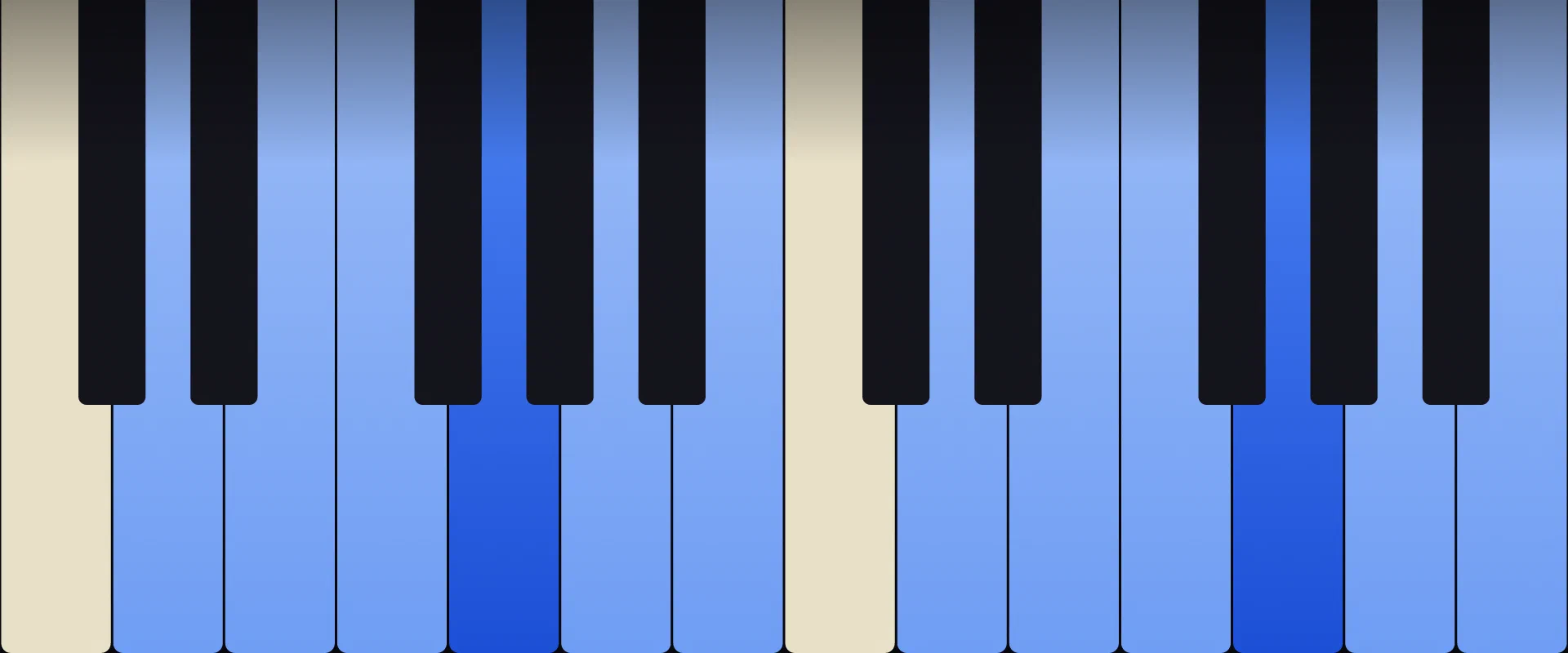
Six notes. A guitar has six strings and a hand has five fingers, so the practical question about G13 is not how to play it but which notes to leave out. The spelling is G, B, D, F, A and E: root, major third, perfect fifth, minor seventh, ninth and thirteenth. Two of those are expendable. The fifth, D, goes first, since it adds nothing the root has not said already, and the ninth, A, goes second. What can never go is the pair of B and F, a tritone, and that tritone is the only thing making this a dominant chord rather than a large and comfortable major one.
There is no eleventh in it, for the same reason that governs G11 from the other direction. The eleventh of G is C, C stands a semitone above B, and the two will not share a chord. G11 keeps the C and throws out the third. G13 keeps the third and never asks for the C.
Try It: G13 in the Chord Finder
Set the root to G, choose G mixolydian and switch the Thirteenth toggle on. The chord on the first degree is this one. Look at the sixth degree, Em7, and all four of its notes are already inside it.
The Notes of G13
| Degree | Note | Interval from root | Semitones |
|---|---|---|---|
| 1 (root) | G | Perfect unison | 0 |
| 3 | B | Major 3rd | 4 |
| 5 | D | Perfect 5th | 7 |
| ♭7 | F | Minor 7th | 10 |
| 9 | A | Major 9th | 14 |
| 13 | E | Major 13th | 21 |
Written out: G, B, D, F, A, E. Not an accidental among them, so the chord lies entirely on white keys and the hand gets no raised key to navigate by. There is no row for an eleventh, and the numbers above 12 in the last column are placement instructions rather than interval names.
How G13 Is Built
Start from G9, which is G, B, D, F and A, and add E on top. That is the only change, and skipping the eleventh makes it an addition rather than another stack of thirds. It is also the end of the line: with the thirteenth in place there is nothing left to add.
Three familiar chords hide inside the six notes. G7 is there as G, B, D and F. Em7 is there as E, G, B and D. And Bm7♭5 is there as B, D, F and A, which is this chord with its root and thirteenth removed, and is the voicing a pianist plays when a bass player has the G.
One pair needs watching. F and E are a semitone apart, the only such pair here, and side by side in one octave they grind. In every voicing on this page the F sits below and the E above, a major seventh apart instead. That single decision is most of what voicing this chord amounts to.
G13 on the Piano
Six white keys, and no hand covers them. G up to E is twenty one semitones, so it is a two hand chord or it is nothing.
Give the root to the left hand, alone or with the D a fifth above it, and the right hand takes four notes: F, A, B, E, under thumb, index, middle and little finger. F to E is a major seventh, an easy stretch, and the order is the point. The seventh sits at the bottom, the thirteenth at the top, and the semitone between them has an octave of daylight in it. Read upwards, those four are the seventh, ninth, third and thirteenth, the rootless voicing a jazz pianist plays behind a bass player without thinking about it.
Play the literal stack once to hear why nobody uses it. G, B, D, F, A and E from the bottom puts the third and the seventh low, where they turn to mud, and strands the E so high it stops sounding like part of the chord. The stack gives you the spelling. It is not the voicing.
G13 on the Guitar
Learn the four note grip first, since it is the one every chord book prints: 3 x 3 4 5 x, sounding G, F, B and E. Middle finger on the sixth string at the 3rd fret, index on the fourth string at the 3rd, ring on the third string at the 4th, little finger on the second string at the 5th, fifth string damped from underneath. No fifth and no ninth, yet unmistakably G13, because the root, the tritone and the thirteenth are all there.
Extend the little finger into a barre across the top two strings and the ninth joins them: 3 x 3 4 5 5 sounds G, F, B, E and A, five of the six notes for three fingers.
The nut has more to offer than the books admit. Five of the six notes are open strings in standard tuning: E is the thirteenth, A the ninth, D the fifth, G the root and B the third. The missing one is F, which lives on the fourth string at the 3rd fret, so 3 0 3 0 0 0 sounds G, A, F, G, B and E: two fingers, six ringing strings, complete except for the fifth you were going to drop anyway. The A sits at A2 and thickens the bottom, so mute that string and 3 x 3 0 0 0 is cleaner.
All six are available at the nut, at a price. 3 0 3 4 3 0 sounds G, A, F, B, D and E, and it wants the thumb over the top of the neck for the sixth string, the index barred across the fourth, third and second strings at the 3rd fret and the ring finger on the third string at the 4th. A real chord that almost nobody plays.
Barred at the 3rd fret, 3 5 3 4 5 5 holds all six as well. Compare it with the G9 barre at the same position, 3 5 3 4 3 5: one note differs, the second string climbing two frets so that a doubled fifth becomes the thirteenth. It wants two barres at once, so most players take 3 x 3 4 5 5.
| Form | Frets | Notes sounded |
|---|---|---|
| The standard grip | 3 x 3 4 5 x | G F B E |
| With the ninth | 3 x 3 4 5 5 | G F B E A |
| Open, all six strings | 3 0 3 0 0 0 | G A F G B E |
| Open, fifth string muted | 3 x 3 0 0 0 | G F G B E |
| Everything, at the nut | 3 0 3 4 3 0 | G A F B D E |
| Everything, barred | 3 5 3 4 5 5 | G D F B E A |
| Fifth string root | x 10 x 10 12 12 | G F B E |
Inversions
| Inversion | Notes | Bass | Symbol |
|---|---|---|---|
| Root position | G B D F A E | G | G13 |
| 1st inversion | B D F A E G | B | G13/B |
| 2nd inversion | D F A E G B | D | G13/D |
| 3rd inversion | F A E G B D | F | G13/F |
| 4th inversion | A E G B D F | A | G13/A |
| 5th inversion | E G B D F A | E | G13/E |
Read these as description, not instruction: a chord this size changes its voicing long before it changes its bass. Two rows are worth hearing. G13/B puts B, D, F and A at the bottom, the half diminished chord on B, with the thirteenth and the root above it. G13/E is the one to avoid, since it places E at the bottom and F a minor ninth above, turning the chord’s one semitone into its most exposed interval. See Chord Inversions and Voice Leading.
Voicings
Discard in this order: the fifth, the ninth, then the root once a bass player has it. Never discard the third or the seventh. Keep the E above the F, and if a note has to sit on top, make it the E.
Which Keys Contain G13
- V of C major
- VII of A natural minor
- I of G mixolydian
- IV of D dorian
- III of E phrygian
- II of F lydian
- VI of B locrian
- IV of D melodic minor
The list is shorter than it looks. Seven of the eight are the same seven notes read from seven starting points, the modes of C major, so a soloist who knows C major knows all of them.
The eighth is the interesting one. G13 uses six notes of that collection and the one it never touches is C. D melodic minor is the same collection with C raised to C♯, and since the chord does not sound a C, the alteration passes it by. No harmonic minor scale appears at all, since raising a seventh degree always lands on one of the six notes this chord does use.
Where G13 Shows Up
| Progression | Chords | Context |
|---|---|---|
| ii V I in C | Dm7, G13, Cmaj7 | The top voice never moves |
| Jazz blues in G | G13, C9, G13, D13 | The I chord of a twelve bar |
| Turnaround in C | Em7, A7, Dm7, G13 | The last bar before the top |
| Soul and Motown | G13 struck short, on the offbeat | Horn section writing |
Follow the E through the first row. It is the ninth of Dm7, the thirteenth of G13 and the third of Cmaj7, so a top voice holds that one note across the whole cadence while everything beneath changes function. Nothing announces the arrival, which is why arrangers reach for a thirteenth where a plain dominant seventh would sound like a shove.
The second row is where the chord earns its keep outside jazz. A twelve bar blues in G has a dominant on every degree, and a horn section playing F, A, B and E over the bass player’s G is what most listeners recognise as a blues band rather than a blues guitarist. On the guitar that job falls to 3 x 3 4 5 x, struck short and damped, which is why the shape turns up in soul and funk far more than in anything that needs to ring.
Set G13 beside G6, which is G, B, D and E. Both hold the E. G6 has no seventh, so it sits still and can end a piece; G13 has the F, and with it a tritone that has to go somewhere. That is the whole distinction between a sixth chord and a thirteenth chord, and it is why an arrangement finishes on the first and never on the second.
Related Chords
- G Dominant 11th Chord, the other way past the ninth: it drops the third
- G Dominant 9th Chord, the five notes underneath the thirteenth
- G Dominant 7th Chord, the core that all of this decorates
- G Major 6th Chord, the same E with no seventh under it
- B Half-diminished Chord, this chord without root or thirteenth
- E Minor 7th Chord, four of the six notes, read from the thirteenth
Learn More
Practice Chords
Drill chord recognition with a metronome, MIDI support, and score tracking.
Start Practicing