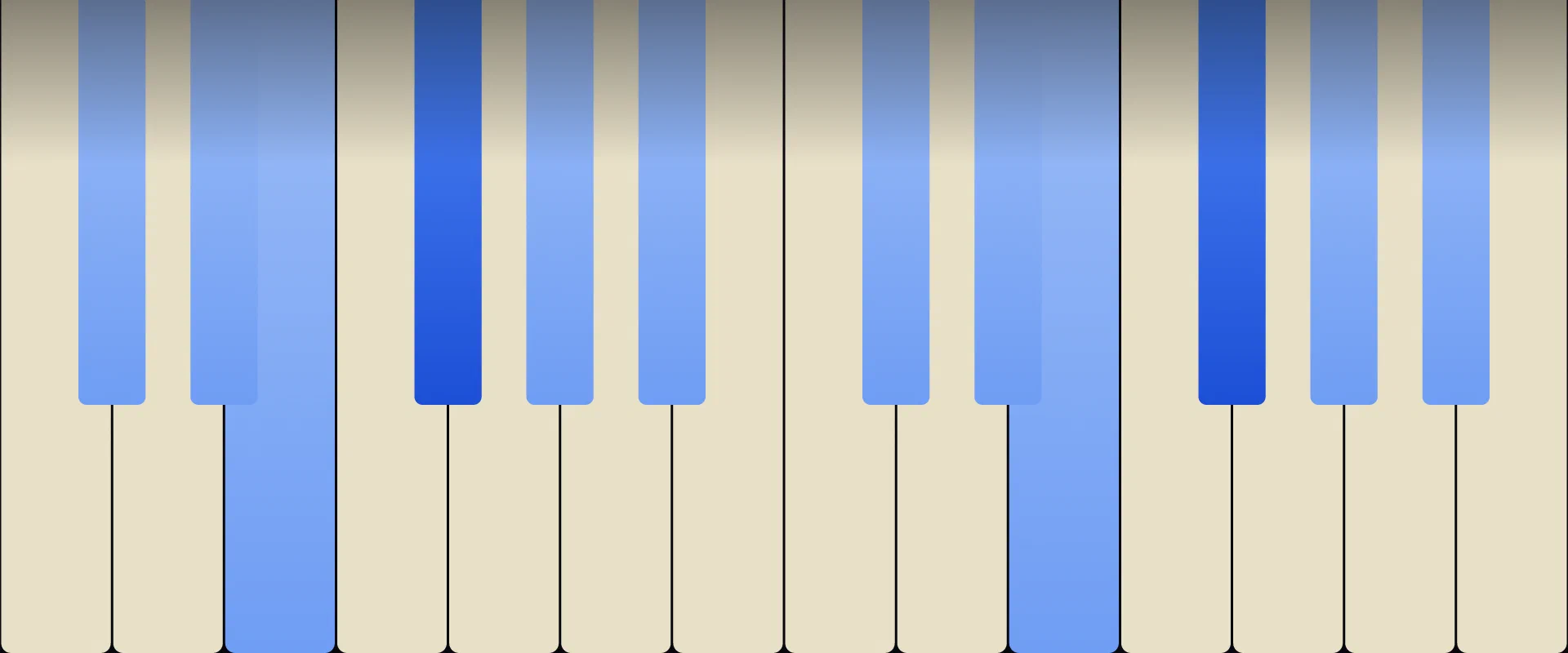
Write out the B major scale, B, C♯, D♯, E, F♯, G♯ and A♯, then cross off the B. What is left is F♯13, note for note: F♯, A♯, C♯, E, G♯ and D♯. The dominant chord of B major contains the entire key apart from the one note it is trying to reach. Nothing is being withheld except the destination, which is a fair description of what a dominant chord is for.
Six notes is more than a hand holds and more than a guitar plays cleanly, so the practical question is never how to sound all of them. It is which to throw away, and the answer never changes: the fifth goes first, the ninth goes next, and A♯ and E stay, because those two are the tritone and without them the chord is not a dominant.
Try It: F♯13 in the Chord Finder
Set the root to F♯ and turn the Thirteenth toggle on, then look at the fifth degree of B major and count what the scale has left over.
The Notes of F♯13
| Degree | Note | Interval from root | Semitones |
|---|---|---|---|
| 1 (root) | F♯ | Perfect unison | 0 |
| 3 | A♯ | Major 3rd | 4 |
| 5 | C♯ | Perfect 5th | 7 |
| ♭7 | E | Minor 7th | 10 |
| 9 | G♯ | Major 9th | 14 |
| 13 | D♯ | Major 13th | 21 |
Written out: F♯, A♯, C♯, E, G♯, D♯. The 21 is the part worth reading twice. D♯ belongs an octave and a major sixth above the root, which puts it eleven semitones above the E rather than one semitone below it. Voice the D♯ under the E and the chord sounds like a mistake.
There is no eleventh in the list. B would be the eleventh, and it would sit a semitone above the A♯, which is the same collision that removes the third from F♯11. A thirteenth chord keeps its third and gives up the eleventh. An eleventh chord does the opposite. They cannot both be had.
How F♯13 Is Built
Take F♯9, which is F♯, A♯, C♯, E and G♯, and put D♯ on top. That is the whole construction. Stacking thirds from F♯ would pass through B, which is exactly the note the chord refuses, so this is an addition rather than a stack.
The D♯ is the same pitch that gives F♯6 its name. F♯6 is F♯, A♯, C♯ and D♯ with no seventh anywhere, so there the D♯ is a sixth sitting in a major chord and going nowhere. Put E underneath it and the same note becomes a thirteenth: the chord acquires a tritone and wants to move to B. One note separates a resting chord from a travelling one.
The four notes that carry the identity are F♯, A♯, E and D♯. Anything else is optional. Extended Chords and Jazz Harmony covers how far this thinning can be pushed before a chord stops being recognisable.
F♯13 on the Piano
Five of the six notes are black keys: F♯, A♯, C♯, G♯ and D♯. Only the E is white, and it is the minor seventh, the note doing the most work. A hand hunting for this chord can find that one white key first and build outwards.
Do not attempt it with one hand. Give F♯ to the left, or F♯ and C♯ as a bare fifth, and leave the right hand four notes: A♯, D♯, E and G♯ from the bottom up. That is the standard rootless shape for any thirteenth chord and it is worth learning as one object. Thumb on A♯, index on D♯, middle on E, little finger on G♯, spanning a minor seventh.
Notice what happens in the middle of it. D♯ and E are neighbours, a semitone apart, with the thirteenth underneath and the seventh on top. That is not an accident to be corrected: the rub between them is most of what people mean when they call a chord bluesy, and inverting the pair removes it. Three black keys and one white, with the middle finger dropped between the others onto the E, so the hand tilts rather than lying flat.
F♯13 on the Guitar
Six strings and six notes look like a match and are not. The complete chord can be written 2 4 2 3 4 4, and it really does sound F♯, C♯, E, A♯, D♯ and G♯, but reaching the fifth string at the fourth fret means crossing a finger behind the one holding the third string at the third, which cannot be done at speed. The C♯ gets dropped instead.
Start at the second fret with 2 x 2 3 4 x. Middle finger on the sixth string for F♯, index on the fourth string for E with its tip damping the fifth, ring on the third string at the third fret for A♯, little finger on the second string at the fourth for D♯. Four notes, root, seventh, third and thirteenth, every one of them essential. This is the grip that turns up in funk and soul records, usually stabbed rather than held.
Put the first string at the fourth fret too and 2 x 2 3 4 4 adds the ninth, sounding F♯, E, A♯, D♯ and G♯: five of the six notes with only the fifth missing. The second fret is close to the nut where string tension is highest, so the shape is heavier under the hand than it looks.
The open first string is a trap. It is E, a chord tone, but it lands one semitone above the D♯ on the second string at the fourth fret, so 2 x 2 3 4 0 puts the seventh directly on top of the thirteenth. That is the piano voicing’s rub moved to the most exposed part of the guitar. Some players want it. Most mute the string.
The fifth-string form sits at the ninth fret: x 9 8 9 x 11. Index on the fourth string at the eighth for A♯, middle and ring on the fifth and third strings at the ninth for F♯ and E, little finger stretched to the first string at the eleventh for D♯. The muted second string in the middle is the awkward part. Frets are narrow this high up, so the stretch is smaller than it reads.
Inversions
| Inversion | Notes | Bass | Symbol |
|---|---|---|---|
| Root position | F♯ A♯ C♯ E G♯ D♯ | F♯ | F♯13 |
| 1st inversion | A♯ C♯ E G♯ D♯ F♯ | A♯ | F♯13/A♯ |
| 2nd inversion | C♯ E G♯ D♯ F♯ A♯ | C♯ | F♯13/C♯ |
| 3rd inversion | E G♯ D♯ F♯ A♯ C♯ | E | F♯13/E |
| 4th inversion | G♯ D♯ F♯ A♯ C♯ E | G♯ | F♯13/G♯ |
| 5th inversion | D♯ F♯ A♯ C♯ E G♯ | D♯ | F♯13/D♯ |
Treat most of this table as bookkeeping. A six note chord is voiced rather than inverted, and the bass note is chosen by whoever plays the bass.
Two rows earn their place. Over A♯ the chord is a first inversion dominant, which puts the leading note of B major in the bass and pulls upwards hard. Over E the six notes stop being a dominant at all: read from E they are root, major third, sharpened eleventh, thirteenth, major seventh and ninth, the lydian chord of E and the reason this collection is at home in E lydian. A bass walking F♯ down to E under a held F♯13 converts tension into shimmer with nothing above it moving. Chord Inversions and Voice Leading takes this further.
Voicings
| Shape | Frets | Result |
|---|---|---|
| F♯13 | 2 x 2 3 4 x | Root, 7th, 3rd, 13th |
| F♯13 | 2 x 2 3 4 4 | Adds the 9th, no 5th |
| F♯13 | x 9 8 9 x 11 | Fifth-string form |
| F♯13 | 2 4 2 3 4 4 | All six notes, unplayable in time |
| F♯9 | 2 4 2 3 2 4 | The chord it grows from |
| F♯7 | 2 4 2 3 2 2 | The four notes underneath |
Which Keys Contain F♯13
- degree 5 (V) of B major
- degree 1 (I) of F♯ mixolydian
- degree 2 (II) of E lydian
- degree 7 (VII) of G♯ natural minor
- degree 4 (IV) of C♯ dorian
- degree 4 (IV) of C♯ melodic minor
The first five rows are the same seven notes read from five starting points, so a player who knows B major knows the whole list. C♯ melodic minor is the outlier: it raises B to B♯, removing the very note F♯13 has no use for, and the chord fits it perfectly as a result. A chord that omits a note is at home in scales that never had it.
Where F♯13 Shows Up
| Progression | Chords | Context |
|---|---|---|
| ii V I in B major | C♯m7, F♯13, Bmaj7 | The full cadence |
| Turnaround in B | B9, E9, F♯13, B | Blues and soul |
| V of V in E major | F♯13, B7, E | Secondary dominant |
| I vamp in F♯ mixolydian | F♯13, B, F♯13 | Funk, no resolution |
Follow the D♯ through the first row. It is the ninth of C♯m7, the thirteenth of F♯13 and the third of Bmaj7, so a top voice can hold one note across the entire cadence while everything beneath it changes function. The arrival lands, but nothing on top announces it.
The third row is the one songwriters reach for without naming it. In E major the chord on F♯ is minor, and raising its third to A♯ turns it into a dominant pointing at B, which then points at E. F♯13 is that move heavily dressed, and it works because the D♯ on top is diatonic to E major anyway. Secondary Dominants and Borrowed Chords covers the mechanism.
The last row is where instruments part company. B major and F♯ suit the guitar: the sixth-string form of this chord sits at the second fret, low enough to be loud and clean, and the key has the open B string in it. Horn players feel the opposite. A trumpet in B♭ reading concert F♯ sees G♯, and B major concert arrives on the stand as C♯ major with seven sharps. An alto saxophone would read it in G♯ major, a signature that needs a double sharp and so never appears. Big band charts migrate to G♭13 and the flat keys while guitar bands stay in F♯.
Related Chords
- F♯ Dominant 9th Chord, the chord this one is built on
- F♯ Dominant 11th Chord, the other way to extend past the ninth
- F♯ Dominant 7th Chord, the four notes at the bottom
- F♯ Major 6th Chord, the same D♯ with no E underneath it
- B Major 7th Chord, where this chord is heading
- B Major Chord, the plainer arrival
Learn More
Practice Chords
Drill chord recognition with a metronome, MIDI support, and score tracking.
Start Practicing