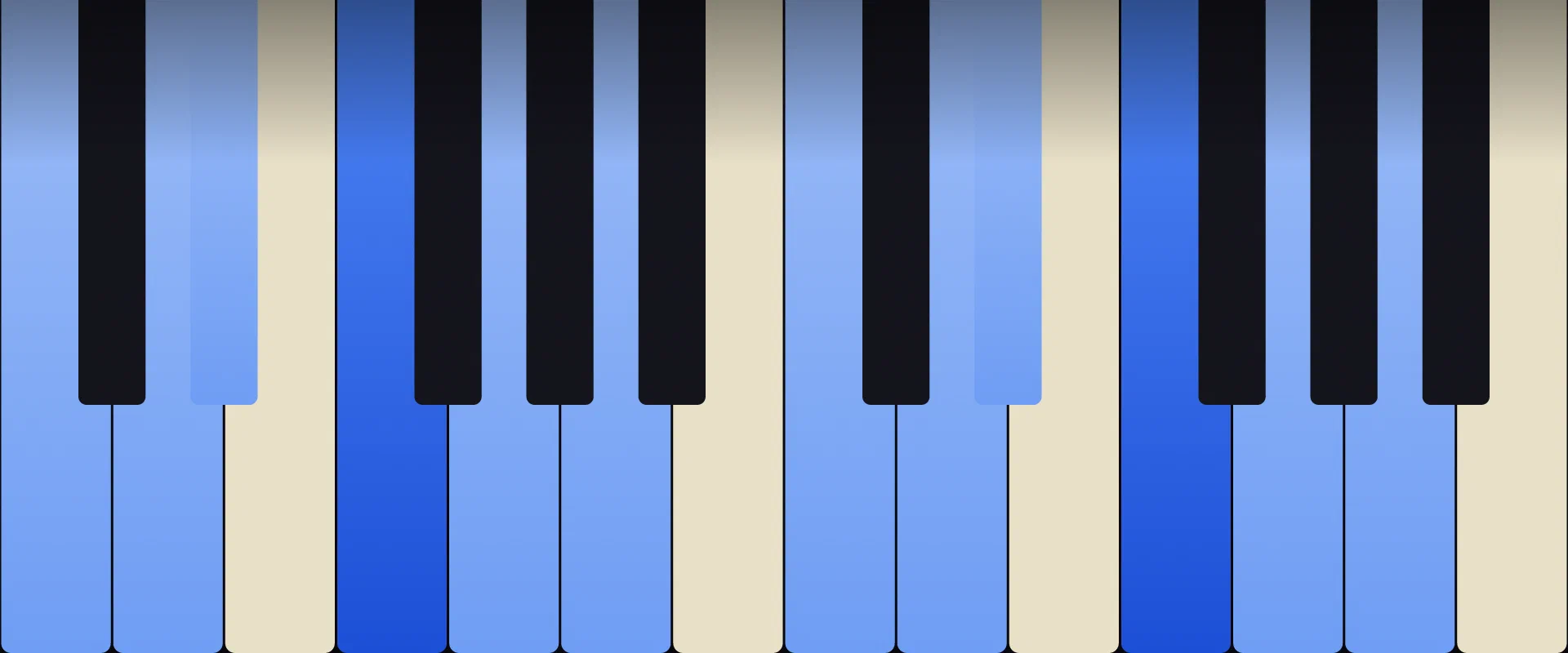
Write out B♭ major, B♭ C D E♭ F G A, then cross off the B♭. Everything left is F13: F, A, C, E♭, G and D. Six of the seven notes of the key, and the one it leaves out is the tonic it spends its whole life pointing at. A dominant that contains nearly everything except the note it wants to reach is a strange object, and a very effective one.
Six notes is more than either instrument really wants. A guitar has six strings and a hand has five fingers, so real F13 voicings leave notes out in a fixed order. The 5th, C, goes first and is never missed. The 9th, G, goes next. The 3rd, A, and the minor 7th, E♭, never go, because those two are a tritone apart and the tritone is the whole reason the chord is called dominant.
Try It: F13 in the Chord Finder
Set the root to F, turn on the Thirteenth toggle and take the first degree of F mixolydian. Then switch to B♭ major and find the same chord on the fifth degree, where it does its usual job.
The Notes of F13
| Degree | Note | Interval from root | Semitones |
|---|---|---|---|
| 1 (root) | F | Perfect unison | 0 |
| 3 | A | Major 3rd | 4 |
| 5 | C | Perfect 5th | 7 |
| ♭7 | E♭ | Minor 7th | 10 |
| 9 | G | Major 9th | 14 |
| 13 | D | Major 13th | 21 |
Written out: F, A, C, E♭, G, D. The stack of thirds would put an 11th, B♭, between the 9th and the 13th, and it is left out for the same reason a dominant 11th chord throws away its 3rd: B♭ sits a semitone above A and the two cannot be in the room together. Leaving out the 11th rather than the 3rd is the choice that keeps the chord dominant.
Only one pair of notes in F13 is a semitone apart, D against E♭, and that is the sound of the chord. Keep the E♭ well below the D and it reads as a gentle rub. Put the E♭ on top of the D and it reads as a mistake.
How F13 Is Built
Take F9, F, A, C, E♭ and G, and add D on top. Nothing underneath moves.
The 13th is the same pitch as a 6th, so the honest comparison is with F6, F, A, C and D. Same D, same triad under it, and the difference is the E♭. That one note turns a settled chord into one that owes B♭ an arrival.
Two more readings save time. Lift the root off and what remains, A, C, E♭ and G, is Am7♭5 with a D above it, which is how a pianist comping rootless thinks about the chord. At the other end, D, F, A and C is Dm7 sitting inside F13 intact, so a bass walking from D to F under a held right hand changes the chord’s name and almost nothing else. More on the family in Extended Chords and Jazz Harmony.
F13 on the Piano
One black key, E♭. The other five, F, A, C, G and D, are white, so the hand sits low on the keys and the single accidental is easy to find under a finger that is already reaching for it.
The voicing to learn first splits the chord across the hands and drops the 5th. Left hand takes F and E♭, root and ♭7. Right hand takes A, D and G: the 3rd, the 13th and the 9th from the bottom. Those three are all white keys and stack in perfect 4ths, A up to D and D up to G, so the hand lies flat under thumb, middle and little finger. Five notes, two easy shapes, and everything that identifies the chord is present.
Splitting the tritone between the hands is what makes it work. Both notes crammed into the left hand down there would be muddy, while A in the right over E♭ in the left stays clear, and the D that names the chord lands in the middle of the right hand where a singer or a horn can sit on it. Move the D to the top, A, G, D from the bottom, and the chord brightens noticeably. What not to do is stack all six notes upwards in one hand: they span twenty one semitones, and even a hand that could reach would bury the tritone at the bottom, which is exactly where it does the least good.
F13 on the Guitar
There is no open F13 in the books, and where E♭ lives near the nut is the reason. In the first three frets the only E♭ on the instrument is on the fourth string at the first fret, and that string is also the one supplying an open D. The ♭7 and the 13th, the two notes that make this chord what it is, are fighting over one string.
The way out is to move the D. There is a second one on the second string at the third fret, which frees the fourth string for the E♭ and gives the standard shape: 1 x 1 2 3 x, sounding F, E♭, A and D. Root, ♭7, 3rd, 13th, no 5th and no 9th, and nobody hearing it is in any doubt about the chord. The index takes both first fret notes and mutes the fifth string with its tip, and the middle and ring fingers do the rest.
The 9th costs one more finger. 1 x 1 2 3 3 adds G on the first string at the third fret, so the grip sounds F, E♭, A, D and G, everything except the 5th. That is the full chord as far as a guitar is concerned.
Higher up, the fifth string root shape at the eighth fret keeps the 5th and loses the 9th: x 8 10 8 10 10 sounds F, C, E♭, A and D. It is an ordinary F7 barre with the first string moved up to the tenth fret, which is where the 13th happens to be. Holding it asks the little finger to lie flat across the top two strings, so most players thin it to x 8 x 8 10 10 and let the bass carry the rest. See the CAGED system for how these shapes travel.
Inversions
| Inversion | Notes | Bass | Symbol |
|---|---|---|---|
| Root position | F A C E♭ G D | F | F13 |
| 1st inversion | A C E♭ G D F | A | F13/A |
| 2nd inversion | C E♭ G D F A | C | F13/C |
| 3rd inversion | E♭ G D F A C | E♭ | F13/E♭ |
| 4th inversion | G D F A C E♭ | G | F13/G |
| 5th inversion | D F A C E♭ G | D | F13/D |
Treat most of this as description. In real writing a voice leaves before a bass note moves. Two rows change the character outright. F13/E♭ is a lydian chord from the bass upwards: read E♭, G, D, F, A, C from the E♭ and you get root, 3rd, major 7th, 9th, ♯11 and 13th, which is why E♭ lydian turns up in the list below. F13/D is the sharpest of the six, because the D now has the E♭ a bare minor 9th above it. See Chord Inversions and Voice Leading.
Voicings
| Shape | Frets | Result |
|---|---|---|
| F13 | 1 x 1 2 3 x | Root, ♭7, 3rd, 13th |
| F13 | 1 x 1 2 3 3 | The same plus the 9th |
| F13 | x 8 10 8 10 10 | Fifth string root, keeps the 5th |
| F13 | x 8 x 8 10 10 | The thinned version of it |
| F9 | 1 x 1 2 1 3 | The chord underneath the 13th |
| F6 | 1 3 3 2 3 1 | The same D with no ♭7 |
Which Keys Contain F13
- V of B♭ major
- degree 7 of G natural minor
- degree 4 of C dorian
- degree 3 of D phrygian
- degree 2 of E♭ lydian
- degree 1 of F mixolydian
- degree 6 of A locrian
- degree 4 of C melodic minor
Seven of those eight rows are one scale. B♭ major, G natural minor, C dorian, D phrygian, E♭ lydian, F mixolydian and A locrian are the same seven notes read from seven starting points, so a soloist who knows B♭ major has already learned all of them. What matters is the eighth.
C melodic minor is B♭ major with its B♭ raised to B natural, one note different and nothing else. F13 fits inside both, and it can only do that because B♭ is precisely the note it leaves out. The six notes of F13 are exactly what those two scales have in common. That is not a curiosity. A soloist may play B♭ over this chord, which gives F mixolydian and the plain sound, or B natural, which gives F lydian dominant and a much sharper one, and the chord will not contradict either. The 4th degree is the one thing F13 has no opinion about, so the improviser decides.
Where F13 Shows Up
| Progression | Chords | Context |
|---|---|---|
| ii V I (B♭ major) | Cm7, F13, B♭maj7 | The missing B♭ arrives |
| Jazz blues in F | F13, B♭13, F13 | A tonic that never settles |
| Turnaround (B♭ major) | Dm7, Gm7, Cm7, F13 | Nothing leaves the key |
| Funk vamp (F mixolydian) | F13 held | One chord, no cadence |
The first row is the opening paragraph paying off. F13 already holds six of the seven notes of B♭ major, so the resolution is one new note arriving rather than a change of scenery. Count the moves: A rises a semitone to B♭ and E♭ falls a semitone to D, and those two are the tritone. Everything else in the chord, F, C, G and D, is either already in B♭maj7 or a step from a note that is. Two semitones do the whole cadence.
The blues row puts the same chord to opposite use. In an F blues the I chord is itself a dominant and never resolves at all, so F13 sits there as the home chord for four bars at a time. Players hear the D in it as a 6th, and the E♭ underneath is the only thing that makes it worth writing 13 instead.
The last row, and the reason arrangers reach for this chord so often, comes down to counting. Take the root off F13 and five notes remain, A, C, E♭, G and D, one note each for five saxophones with nothing doubled and nothing wasted. A section can voice it in five real parts, put the 13th in the lead and let the tritone sit in the middle, which is roughly the founding gesture of the swing era sax soli. The same chord thinned to four strings and struck once a bar is most of funk rhythm guitar. See the ii V I progression for where it goes next.
Related Chords
- F Dominant 9th Chord, the five notes underneath the 13th
- F Dominant 7th Chord, the four note core that does the work
- F Major 6th Chord, the same D with no ♭7 below it
- F Dominant 11th Chord, the sibling that drops the 3rd instead
- D Minor 7th Chord, four of these six notes on their own
- A Half-diminished Chord, four of the five notes above the root
Learn More
Practice Chords
Drill chord recognition with a metronome, MIDI support, and score tracking.
Start Practicing