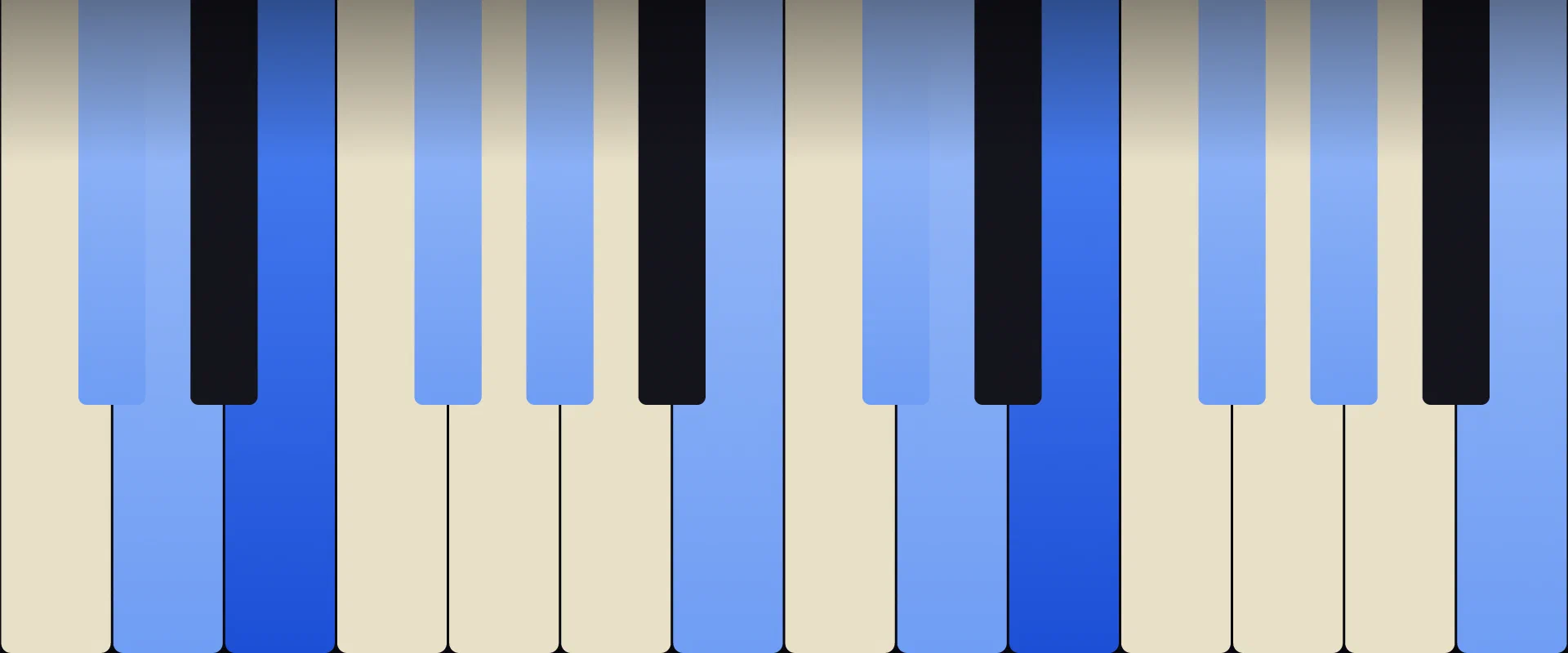
Six notes, and every one of them earns its place: E, G♯, B, D, F♯ and C♯. This is a dominant 7th that keeps piling on thirds, E, G♯, B, D, then F♯, then C♯, stepping over the A on the way because a natural 11th and a major 3rd cannot occupy the same chord. So E13 has a 9th and a 13th but no 11th, and the G♯ stays.
Put E13 beside the A major scale and something neat appears. A major is A, B, C♯, D, E, F♯ and G♯, and this chord uses six of those seven. The only note of the key it will not touch is A itself, which is the note it spends its whole length pointing at.
Try It: E13 in the Chord Finder
Set the root to E and turn on the Thirteenth toggle. Watch the piano: three black keys and three white ones, and the pair that decides what the chord does, G♯ and D, is one of each.
The Notes of E13
| Degree | Note | Interval from root | Semitones |
|---|---|---|---|
| 1 (root) | E | Perfect unison | 0 |
| 3 | G♯ | Major 3rd | 4 |
| 5 | B | Perfect 5th | 7 |
| ♭7 | D | Minor 7th | 10 |
| 9 | F♯ | Major 9th | 14 |
| 13 | C♯ | Major 13th | 21 |
Written out: E, G♯, B, D, F♯, C♯. Three accidentals, all sharps, all of them on black keys, so nothing has to be explained away. The jump from 14 to 21 in the last column is the giveaway: 17 is missing, and 17 is the 11th.
How E13 Is Built
Stack E9, which is E, G♯, B, D and F♯, then keep going. One more third above F♯ lands on A, the 11th, and A is a semitone above G♯. Since the 3rd is what makes this chord dominant, the 11th is skipped. The next third is C♯, which sits a whole tone clear of everything around it, so C♯ is the 13th and the chord is complete.
C♯ is also, as a pitch, the 6th of E. The difference between this chord and E6 is not the C♯ at all, it is the D underneath it. A 6th chord has no minor 7th, so it sits still. A 13th chord has one, so it leans.
The engine is the pair G♯ and D, a tritone, and everything else is decoration around it. That is why players throw the 5th away without hesitation and the 3rd and the 7th never. Drop B and the chord still works. Drop G♯ or D and it is not a dominant any more.
E13 on the Piano
Three black keys and three white ones, and they sort themselves by hand. E, B and D are white, G♯, C♯ and F♯ are black, and a jazz voicing puts the whole white group in the left hand and the whole black group in the right.
Start with the left hand on E and D, root and minor 7th, both white, found by thumb and little finger without looking. Put G♯, C♯ and F♯ in the right hand under thumb, middle and little finger. All three are black and sit in a run of raised keys, so the shape is easier to feel than most triads. Those five notes are the whole chord bar the 5th, which nobody misses. For all six, drop the index onto the white B between the G♯ and the C♯: G♯, B, C♯, F♯ spans ten semitones and fits one hand without strain.
Beginners often meet this chord the other way round, by accident. Play E7 in the left hand and an ordinary C♯ minor triad, C♯, E and G♯, in the right, and the result is E, G♯, B, D and C♯, which is E13 without its 9th. C♯ minor is the upper triad that fits, because its notes are the 13th, the root and the 3rd. Neither neighbour works: B major brings a D♯ against the D, and F♯ minor brings an A against the G♯, the same collision that kept the 11th out to begin with.
E13 on the Guitar
Six notes, six strings, and in E they line up. The open form is 0 2 0 1 2 2, sounding E, B, D, G♯, C♯ and F♯ in that order: every note of the chord, nothing doubled, four fingers, no barre. It is open E7 with the top two strings pushed up two frets, and the two strings left ringing are the low E and the D, which happen to be this chord’s root and minor 7th. That is a coincidence of standard tuning rather than anything true of 13th chords in general, and few other roots get it.
If the little finger will not reach, 0 2 0 1 2 0 sounds E, B, D, G♯, C♯ and E, which is the same chord without its 9th. That is the version most rhythm players actually use, because the open first string keeps ringing while the hand moves.
Away from open position the 5th is the first casualty. x 7 6 7 7 9 puts the root on the fifth string at the 7th fret and sounds E, G♯, D, F♯ and C♯: root, 3rd, 7th, 9th and 13th, no B. The index takes the fourth string at the 6th fret, the middle the fifth string at the 7th, the ring finger lies across the third and second strings at the 7th and the little finger stretches to the first string at the 9th. Cut it to x 7 6 7 x 9, root, 3rd, 7th and 13th, and you have the shape a comping guitarist plays without thinking.
Inversions
| Inversion | Notes | Bass | Symbol |
|---|---|---|---|
| Root position | E G♯ B D F♯ C♯ | E | E13 |
| 1st inversion | G♯ B D F♯ C♯ E | G♯ | E13/G♯ |
| 2nd inversion | B D F♯ C♯ E G♯ | B | E13/B |
| 3rd inversion | D F♯ C♯ E G♯ B | D | E13/D |
| 4th inversion | F♯ C♯ E G♯ B D | F♯ | E13/F♯ |
| 5th inversion | C♯ E G♯ B D F♯ | C♯ | E13/C♯ |
Nobody voices a six note chord by rotating it, so this is a map rather than a set of instructions. Take the root away and the four notes left at the bottom, G♯, B, D and F♯, are a G♯ half diminished 7th, which is why that chord stands in for this one whenever a bass player is covering the E. The third inversion has a name of its own: read from D, the notes are a root, major 3rd, major 7th, 9th, sharpened 11th and 13th, the full D lydian sound with the 5th left out. More on rotating chords in Chord Inversions and Voice Leading.
Voicings
| Shape | Frets | Result |
|---|---|---|
| E13 | 0 2 0 1 2 2 | All six notes, open position |
| E13 | 0 2 0 1 2 0 | Same without the 9th |
| E13 | x 7 6 7 7 9 | Root on string five, no 5th |
| E13 | x 7 6 7 x 9 | Four notes: root, 3rd, 7th, 13th |
| E9 | 0 2 0 1 0 2 | The five notes underneath |
| E7 | 0 2 0 1 0 0 | Where the stack begins |
The open shape is movable, awkwardly. Carry it up five frets and hold the sixth string down as well, 5 7 5 6 7 7, and you get A, E, G, C♯, F♯ and B, a complete A13. It is a hard grip, and it is the price of the free ride E gets at the nut.
Which Keys Contain E13
- V of A major
- I of E mixolydian
- II of D lydian
- IV of B dorian
- VII of F♯ natural minor
- III of C♯ phrygian
- IV of B melodic minor
The first six rows are the same seven notes read from six starting points, so a soloist who knows A major is equipped for all of them. B melodic minor is the one that changes something: it swaps A for A♯, and A♯ against an E root is a sharpened 11th, the one tension a dominant 13th will happily take.
Notice what is absent. A natural minor is not on the list and cannot be, because it contains C rather than C♯. That is the practical rule here: the 13th of E is C♯, so E13 points at A major. Going to A minor asks for E7 with a flattened 13th instead, which is C natural, a different chord with a different name.
Where E13 Shows Up
| Progression | Chords | Context |
|---|---|---|
| V I (A major) | E13, A6/9 | Only the tritone moves |
| ii V I (A major) | Bm7, E13, Amaj7 | Standard jazz cadence |
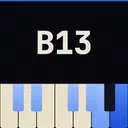
| Jazz blues in E | E13, A13, E13, B13 | The I chord dressed up |
| Soul vamp | E13, A13 | Four notes in common |
The first row is the reason to learn this chord. The six-nine chord on A is A, C♯, E, F♯ and B, and four of those, E, B, F♯ and C♯, are already here, so they simply hold. What moves is the tritone: G♯ rises a semitone to A and D falls a semitone to C♯. An entire perfect cadence carried out by two voices, each travelling one fret, with the rest of the band sustaining.
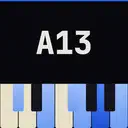
The blues row is where guitarists live. In E the open shape costs nothing, so a blues can carry richer harmony than the usual three dominant 7ths with no extra work for the left hand. Move to A13 for the IV chord and four of the six notes stay put: A13 is A, C♯, E, G, B and F♯, so E, B, C♯ and F♯ carry straight over and only two voices shift, G♯ up to A and D across to G. The top of the voicing holds right through the bar.
E is also where guitar led soul and funk sit, for reasons that come off the fretboard rather than out of theory. Barre chords tire a hand and open shapes do not, so a part that has to run for four minutes gravitates to the keys where the good chords are free. E13 with the open first string, 0 2 0 1 2 0, is such a chord: a scratchy sixteenth note pattern can sit on it all day.
Related Chords
- E Dominant 9th Chord, the five notes this one is built on
- E Dominant 7th Chord, the four note core that never changes
- E Major 6th Chord, the same C♯ with no minor 7th under it
- E11 Chord, the 11th this chord refuses, and the 3rd it gives up to get it
- G♯ Half Diminished Chord, the four notes standing above the root
- Extended Chords: Which Tensions Work, and How to Voice Them
Learn More
Practice Chords
Drill chord recognition with a metronome, MIDI support, and score tracking.
Start Practicing