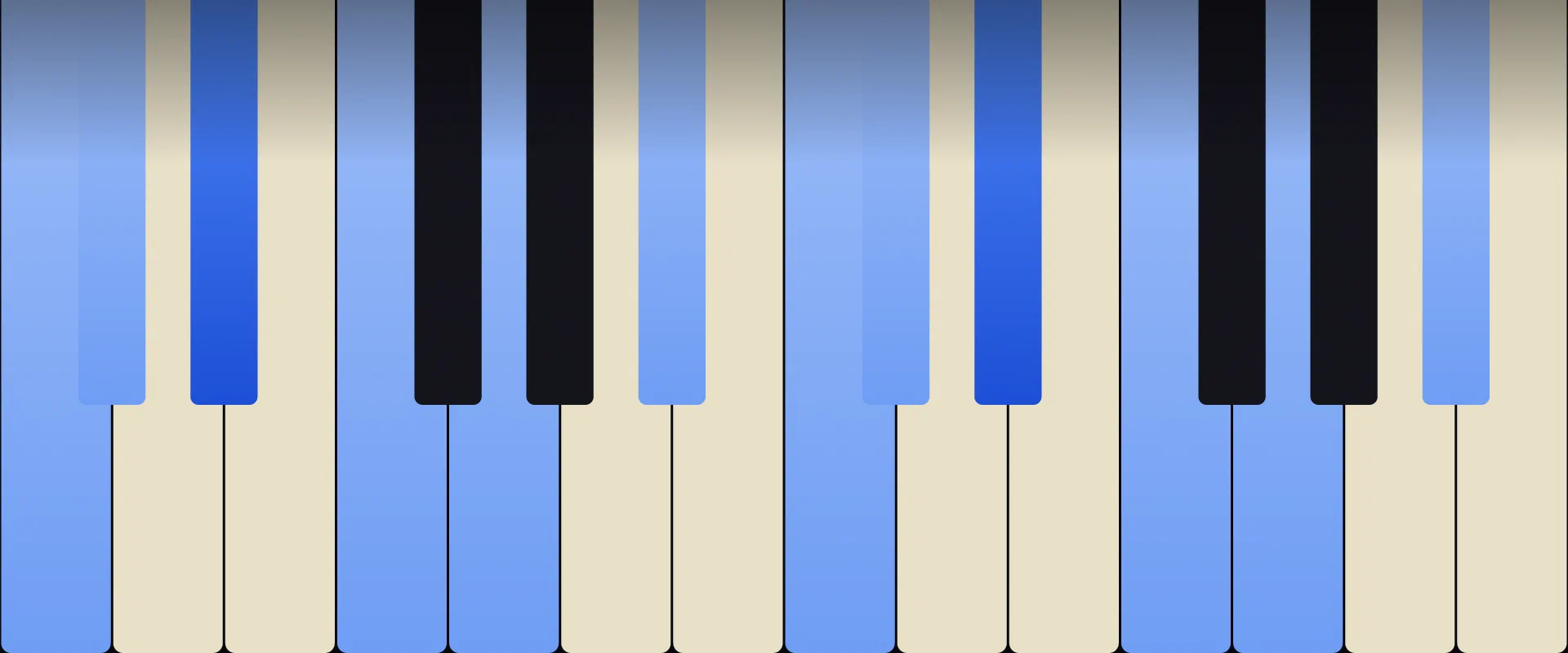
Play E♭ mixolydian, E♭ F G A♭ B♭ C D♭, then leave out the A♭ and sound the other six together. That is E♭13: E♭, G, B♭, D♭, F and C. A thirteenth chord is very nearly a whole scale stacked vertically, and the degree it refuses is the fourth, because A♭ would sit a semitone above the G and smother the third. Six notes is more than a hand or a guitar can hold, so the question here is not what the chord contains but which of the six you keep.
Try It: E♭13 in the Chord Finder
Set the root to E♭, switch the 13th toggle on and listen to the top note against the seventh. Those two, C and D♭, are the character of the chord.
The Notes of E♭13
The chord contains six notes: E♭, G, B♭, D♭, F and C.
| Degree | Note | Interval from root | Semitones |
|---|---|---|---|
| 1 | E♭ | Root | 0 |
| 3 | G | Major 3rd | 4 |
| 5 | B♭ | Perfect 5th | 7 |
| ♭7 | D♭ | Minor 7th | 10 |
| 9 | F | Major 9th | 14 |
| 13 | C | Major 13th | 21 |
Only one pair in that table is a tritone apart: G and D♭. Everything else is decoration around those two, and they are why the chord leans towards A♭ the moment it sounds. Move either and it stops being a dominant.
How E♭13 Is Built
Take E♭9, E♭ G B♭ D♭ F, and put a C on top. The eleventh that would sit between the ninth and the thirteenth is skipped, for the reason set out on the E♭11 page: it cannot share a chord with a major third, and here the third wins, because without it there is no dominant.
Be careful with that C. It is exactly the note that makes E♭6 a sixth chord, E♭ G B♭ C, and the only difference between the two symbols is the D♭ underneath. A sixth chord rests; a thirteenth chord does not. Same top note, opposite job.
Two familiar chords sit inside the six notes. G, B♭, D♭ and F are a complete G half-diminished chord on the third; C, E♭, G and B♭ are Cm7 on the thirteenth. Either, over an E♭ bass, gives most of this chord already.
E♭13 on the Piano
The split is even: E♭, B♭ and D♭ are black keys, G, F and C are white. That balance is unusual in flat key harmony, and it means neither hand ends up stranded among the black keys.
Do not try to hold all six. Put E♭ alone in the left hand and take D♭, F, G and C in the right, fingered 5, 3, 2 and 1. Those four are the seventh, the ninth, the third and the thirteenth, which is to say everything that identifies the chord, and they span a major seventh, so the hand is open but not stretched. The thumb lands on C and the little finger on D♭, one black key at the bottom of an otherwise white shape. The fifth, B♭, is what you gave up, and you will not miss it. In a band the bass player covers the root too, at which point the right hand alone is the chord.
Move one note of that shape and hear what happens. Raise the D♭ under the little finger by a semitone and the seventh turns major: E♭, D, F, G and C is E♭maj13, finished, with nowhere left to go. Lower the C under the thumb by a whole tone instead and the thirteenth becomes a fifth, which puts you back at E♭9. One note at either end of the hand, two different chords.
E♭13 on the Guitar
The open G string is the only open string that belongs here, and one chord tone is not an open chord. Everything below is fretted.
The grip guitarists actually use has four notes. x 6 x 6 8 8 sounds E♭, D♭, G and C: root, seventh, third and thirteenth, with the fifth and the ninth left out. Index barre across the fifth and third strings at the 6th fret, ring finger flat over the top two at the 8th. Easy, movable, and the sound of a big band guitar part.
Fill in the fifth for a bigger version: x 6 8 6 8 8 adds B♭ on the fourth string, giving E♭, B♭, D♭, G and C. Index barre at the 6th, ring finger on the fourth string at the 8th, little finger across the top two at the 8th.
Neither has the ninth, and here you cannot have both F and G. The second string carries the ninth at the 6th fret and the third at the 8th, so x 6 8 6 6 8 buys the F by losing the G. What is left, E♭, B♭, D♭, F and C, is pleasant and no longer a dominant chord. Keep the third.
All six notes are available from the E form at the 11th fret. 11 13 11 12 13 13 sounds E♭, B♭, D♭, G, C and F, root at the bottom and ninth on top: index barre across the 11th, middle finger on the third string at the 12th, ring finger on the fifth string at the 13th, little finger flat over the top two at the 13th. It is a handful in the cramped end of the neck. Drop the first string, 11 13 11 12 13 x, and you have the barred 13 chord every chord book prints.
Inversions
| Inversion | Notes | Lowest note |
|---|---|---|
| Root position | E♭ G B♭ D♭ F C | E♭ |
| 1st inversion | G B♭ D♭ F C E♭ | G |
| 2nd inversion | B♭ D♭ F C E♭ G | B♭ |
| 3rd inversion | D♭ F C E♭ G B♭ | D♭ |
| 4th inversion | F C E♭ G B♭ D♭ | F |
| 5th inversion | C E♭ G B♭ D♭ F | C |
Six notes give six bass notes, and two of the rows are chords in their own right. Read the third inversion from D♭ and you get a major third, a major seventh, a ninth, a raised fourth and a thirteenth: D♭maj13♯11, the floating lydian chord, with no obligation to go anywhere. Read the fifth inversion from C and you get a minor seventh with a flattened ninth above it, the dark C phrygian sound. Nobody voices a thirteenth chord in inversion on purpose, but the table tells you what a bass player on the wrong note will do to your harmony. See Chord Inversions and Voice Leading.
Voicings
| Shape | Frets | Result |
|---|---|---|
| E♭13 | x 6 x 6 8 8 | Four note shell, root 5th string |
| E♭13 | x 6 8 6 8 8 | Five notes, no 9th |
| E♭13 | 11 13 11 12 13 x | Barred at the 11th, no 9th |
| E♭13 | 11 13 11 12 13 13 | All six notes, hard |
| E♭9 | x 6 5 6 6 x | The same chord without the C |
The order of omission is settled and worth memorising. The eleventh is never there, the fifth goes first, then the ninth, and the root goes as soon as somebody else is playing it. The third and the seventh never go, because they are the tritone. See Extended Chords and Jazz Harmony.
A sax section has five parts and this chord has six notes, an old arranging problem with an old answer: the baritone takes the root, the fifth is cut, and the other four spread across the altos and tenors with the thirteenth on the lead.
Which Keys Contain E♭13
- V of A♭ major
- I of E♭ mixolydian
- VII of F natural minor
- IV of B♭ dorian
- II of D♭ lydian
- III of C phrygian
- IV of B♭ melodic minor
Six notes rule out most scales, so the list is short. The first four rows are the same seven pitches read from four starting notes: a player who knows A♭ major knows everything available over this chord.
The melodic minor entry is the interesting one. B♭ melodic minor is B♭ C D♭ E♭ F G A, and its fourth degree carries E♭13 because the A natural is not needed. Improvise on that scale rather than E♭ mixolydian and the A arrives as a raised eleventh, the usual way to add heat to a thirteenth chord.
Where E♭13 Shows Up
B♭m7, E♭13, A♭maj7. The standard ii V I in A♭ major with the dominant dressed. Three of the six notes, E♭, G and C, are already in A♭maj7, so the resolution barely moves: B♭ falls to A♭, D♭ falls to C, and the thirteenth on top becomes the third of the tonic without shifting. An arranger who wants the arrival felt rather than announced puts the C in the lead voice.
B♭7, E♭13, B♭7. A blues in B♭, where E♭ is the fourth degree and the chord arriving in bar five. Every blues pianist in the flat keys has this under the hand, and on guitar it is the four note grip at the 6th fret.
B♭m7 to E♭13, repeated. A two chord vamp that never resolves, and the home of a great deal of Latin, soul and modal jazz. B♭, D♭ and F belong to both chords, so the change is only the bass and the arrival of G and C.
E♭ is the key this chord was born in. Flat keys belong to the horns, the horns belong to big band and blues writing, and thirteenth chords are what those arrangers reach for when a plain dominant sounds thin. See The ii V I Progression in Jazz.
Related Chords
- E♭ Dominant 9th Chord, the same chord without the C
- E♭ Dominant 7th Chord, the four notes everything here is added to
- E♭11 Chord, the extension that had to drop the third
- E♭ Major 6th Chord, the same C with no D♭ beneath it
- G Half-diminished Chord, the four notes stacked on the third
- C Minor 7th Chord, the four notes stacked on the thirteenth
Learn More
Practice Chords
Drill chord recognition with a metronome, MIDI support, and score tracking.
Start Practicing