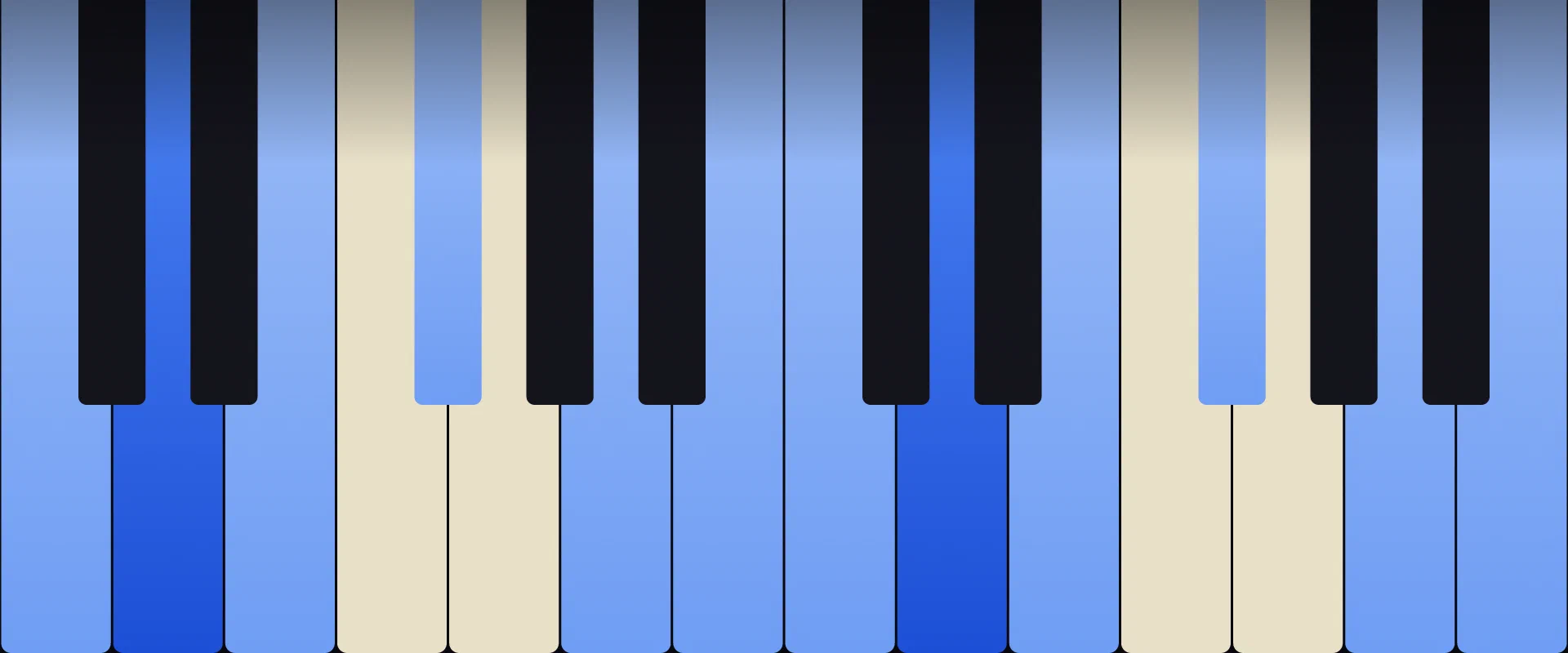
Write out G major, G A B C D E F♯, then cross out the G. What is left is D, F♯, A, C, E and B, and that is this chord exactly. A dominant thirteenth holds everything its key has except the note it is heading for, which is why it sounds full and unfinished at once. Six notes is more than a hand or a fretboard will take politely, so the real work is knowing which ones you may drop. The fifth, A, goes first. The third and the minor seventh, F♯ and C, never go: that pair is the whole reason the chord is called dominant.
Try It: D13 in the Chord Finder
Set the root to D, choose Mixolydian and switch the Thirteenth toggle on. The tool stacks all seven degrees, so it shows a G as well. That G is the eleventh, a semitone above the F♯, which is precisely why the written symbol leaves it out. Ignore it and the six notes left are D13.
The Notes of D13
| Degree | Note | Interval from root | Semitones |
|---|---|---|---|
| 1 (root) | D | Perfect unison | 0 |
| 3 | F♯ | Major 3rd | 4 |
| 5 | A | Perfect 5th | 7 |
| ♭7 | C | Minor 7th | 10 |
| 9 | E | Major 9th | 14 |
| 13 | B | Major 13th | 21 |
Written out: D, F♯, A, C, E, B. One accidental and it behaves: F♯ is a black key, so there is nothing to puzzle over at the keyboard. The 21 in the bottom row matters more than it looks. B is only nine semitones above D, and the chord is written with it an octave higher for a reason. Down at nine semitones the B lies directly under the C, and that close to the bass the pair thickens instead of colouring.
How D13 Is Built
Stack thirds from D and you get D, F♯, A, C, E, G, B: seven notes, one too many, and the one that has to go is the G. A natural eleventh sits a semitone above the major third, and the third is not negotiable in a dominant chord, so the eleventh is dropped and the thirteenth put on in its place. D13 is therefore D9 with a B added and nothing else changed.
The B is the note people trip over, because B is also the sixth of D. The difference between this chord and D6 is the C underneath. D6 is D, F♯, A and B, settled enough to end a song, and adding the minor seventh turns that same B from a colour into a tension.
Two familiar chords are hiding in the stack. Drop the root and F♯, A, C and E is F♯m7♭5 in root position. Take the outer notes instead and B, D, F♯ and A is Bm7, so four of the six notes spell the relative minor seventh of the key this chord wants to resolve to.
D13 on the Piano
One black key, F♯, and it falls under the middle finger of the right hand where you would want it. The five white notes are D, A, C, E and B.
Nobody plays all six in a row. D up to B is twenty-one semitones, and stacking the chord as written strands the E and the B two octaves above the bass. The professional answer is a rootless voicing: give D to the left hand on its own, and play C, E, F♯, B in the right. That is the minor seventh, ninth, third and thirteenth, it spans a major seventh, and it sits under thumb, index, middle and little finger with the black key in the middle of the hand. The A is not played at all, and nobody misses it.
Turn that right hand round to F♯, B, C, E and you have the other standard form, third at the bottom and ninth on top. Here the B sits a semitone under the C and the two grind, which is not a mistake: that rub between the thirteenth and the seventh is the sound jazz pianists are after, and it makes the chord unmistakable with no bass under it at all. Keep the pair in the middle of the keyboard, though. An octave lower, two notes that close stop sounding like harmony and start sounding like interference.
D13 on the Guitar
Six notes, six strings, and it still does not fit. The A goes, and often the E goes too, and what survives is the root, the third, the seventh and the thirteenth.
The standard shape has its root on the fifth string at the fifth fret: x 5 4 5 5 7. It sounds D, F♯, C, E and B, five of the six notes, everything except the fifth. Middle finger on the fifth string for the root, index behind it on the fourth string at the fourth fret, ring finger flat across the third and second strings at the fifth, and the little finger out at the seventh for the B. Note what that grip is: D9 is x 5 4 5 5 x, so the thirteenth costs one finger, and it is the little finger, which is why players who know their ninth chords pick up their thirteenths in an afternoon.
The sixth string form sits at the tenth fret, 10 x 10 11 12 x, sounding D, C, F♯ and B. Four notes, no fifth and no ninth, and it is the purest statement of the chord there is: root, seventh, third, thirteenth, in that order. The fifth string has to be damped by the fretting index, and the frets up there are narrow.
D has one advantage no barre chord offers. The fourth string is already a D, so the root is free and all four fingers can go on the part that matters: x x 0 5 7 7 gives D, C, F♯ and B over an open bass, and it is far easier than either barre. Beware the third string, though. Open it sounds G, the eleventh, the one note this chord must not contain, so on D13 the guitar’s most convenient open string is the enemy.
Inversions
| Inversion | Notes | Bass | Symbol |
|---|---|---|---|
| Root position | D F♯ A C E B | D | D13 |
| 1st inversion | F♯ A C E B D | F♯ | D13/F♯ |
| 2nd inversion | A C E B D F♯ | A | D13/A |
| 3rd inversion | C E B D F♯ A | C | D13/C |
| 4th inversion | E B D F♯ A C | E | D13/E |
| 5th inversion | B D F♯ A C E | B | D13/B |
Read this as description rather than instruction. A dominant thirteenth is doing a job that depends on the bass, so in practice the D stays put and the notes above it get rearranged, which is voicing and not inversion. The one row worth hearing is the first: with F♯ underneath, the four lowest notes are F♯m7♭5 and the chord loses its grip on the floor, which is exactly what a bass player wants when a cadence should arrive gently. See Chord Inversions and Voice Leading.
Voicings
Put the B on top wherever you can. It is the note that separates this chord from D9, and underneath the E it disappears.
| Shape | Frets | Result |
|---|---|---|
| D13 | x 5 4 5 5 7 | Fifth string root, no 5th |
| D13 | x x 0 5 7 7 | Open D bass, four essential notes |
| D13 | 10 x 10 11 12 x | Sixth string root, root 7th 3rd 13th |
| D13 | 10 x 10 11 12 12 | The same with the 9th on top |
| D9 | x 5 4 5 5 x | One finger away |
| D7 | x x 0 2 1 2 | The skeleton underneath |
Which Keys Contain D13
- V of G major
- I of D mixolydian
- VII of E natural minor
- IV of A dorian
- II of C lydian
- IV of A melodic minor
The first five rows are one scale wearing five names. G major, D mixolydian, E natural minor, A dorian and C lydian are the same seven notes begun in different places, so a soloist who knows G major has already learned all five. That is what a six note chord does to a list like this: it leaves so little room that only rotations of one scale fit.
A melodic minor is the exception. It holds D, F♯, A, C, E and B as well, but its seventh degree is G♯ rather than G, so the note the plain symbol has to omit comes back raised. Over that scale the chord is D13♯11, with the G♯ welcome instead of forbidden.
Where D13 Shows Up
| Progression | Chords | Context |
|---|---|---|
| ii V I (G major) | Am7, D13, Gmaj7 | The 13th is the arrival’s 3rd |
| Jazz blues in D | D13, G13, D13, A13 | Every chord a thirteenth |
| Vamp (D mixolydian) | D13, C, D13 | Soul and Hammond organ |
| Gospel cadence | D11, D13, G | The suspension colours as it falls |
Follow the B through the first row. In D13 it is the thirteenth, the most highly coloured note in the chord, and in Gmaj7 it is the plain major third, so it does not move at all. Meanwhile the C falls a semitone to B and the F♯ rises a semitone to G: the two notes that make the tension slide into place around a note that was already home. That is why a thirteenth resolves so smoothly where a bare seventh sounds blunt.
The blues row is the working musician’s reason for learning the shape. In a jazz blues in D nobody plays a plain D7 for the first four bars; they play D13 and slide the same grip about. It is x 5 4 5 5 7 for the one chord and the identical shape at the tenth fret for G13, so twelve bars become three positions of one hand.
D is a guitar key and an organ key rather than a horn key. Concert D reads as E on a trumpet or tenor and B on an alto, four sharps and five, so big band writers stay in the flat keys and D13 turns up far more often under the hands of blues guitarists, Hammond players and gospel pianists. It is a chord too big for a horn section to voice by accident, and exactly the size of two hands.
Related Chords
- D Dominant 9th Chord, the five notes underneath the thirteenth
- D Dominant 7th Chord, the four note skeleton every voicing keeps
- D Major 6th Chord, the same B with no C beneath it
- D Dominant 11th Chord, the other way to deal with the eleventh
- B Minor 7th Chord, four of these six notes on their own
- F♯ Half Diminished Chord, what sits above the root
Learn More
Practice Chords
Drill chord recognition with a metronome, MIDI support, and score tracking.
Start Practicing