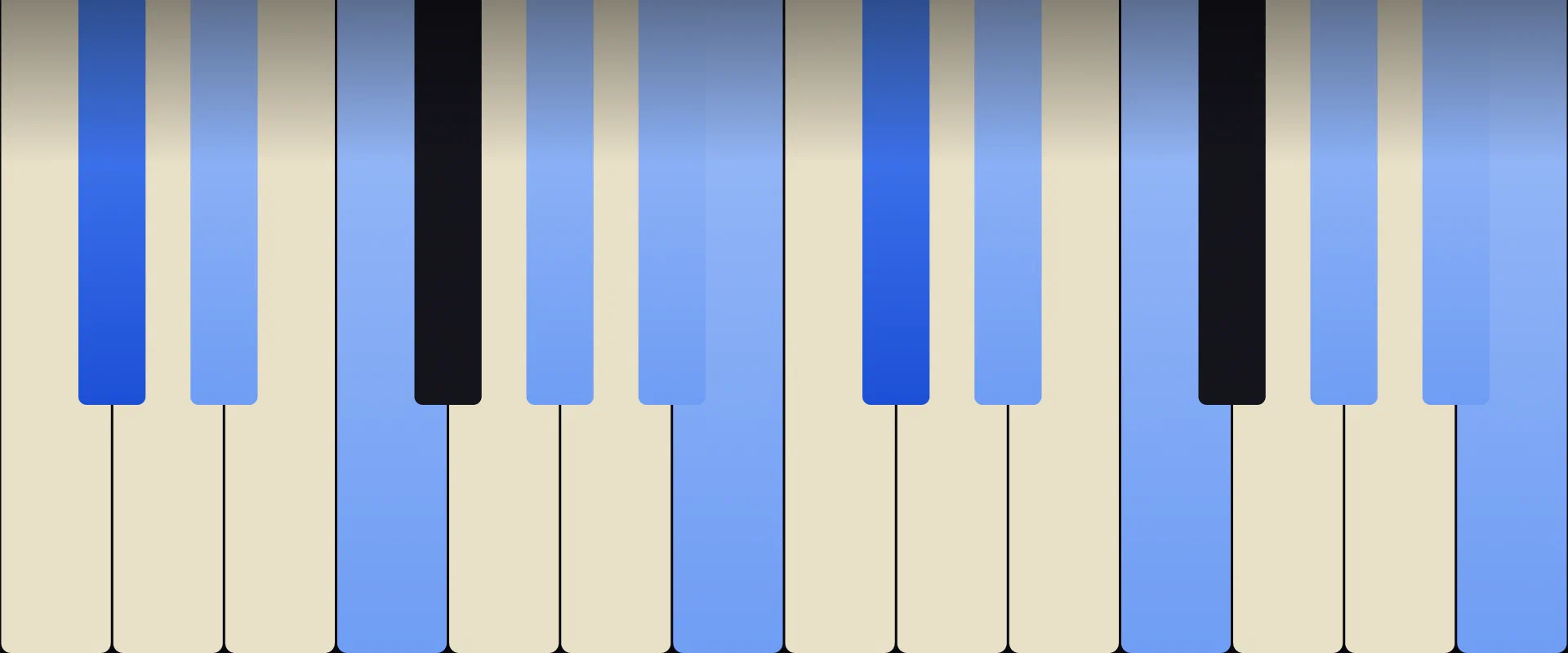
Six notes, five fingers. C♯13 is the point where a chord stops being something you play and starts being something you choose from. The full set is C♯, E♯, G♯, B, D♯ and A♯, and almost nobody sounds all six at once. What every real voicing keeps is E♯ and B, the major third and the minor seventh, because those two are what make the chord a dominant. The fifth goes first, the ninth goes next, and the chord still answers to its name.
Try It: C♯13 in the Chord Finder
Set the root to C♯, choose Mixolydian and switch the Thirteenth toggle on. Play the first degree, then compare it with C♯ Lydian Dominant, which holds all six of these notes and adds a raised eleventh, the tension soloists reach for over this chord.
The Notes of C♯13
| Degree | Note | Interval from root | Semitones |
|---|---|---|---|
| 1 (root) | C♯ | Perfect unison | 0 |
| 3 | E♯ | Major 3rd | 4 |
| 5 | G♯ | Perfect 5th | 7 |
| ♭7 | B | Minor 7th | 10 |
| 9 | D♯ | Major 9th | 14 |
| 13 | A♯ | Major 13th | 21 |
Written out: C♯, E♯, G♯, B, D♯, A♯. Four black keys, C♯, G♯, D♯ and A♯, and two white ones. The white ones are B, which surprises nobody, and E♯, which surprises almost everybody.
E♯ is the white key F. There is no key between E and F to put it on, so the sharp has nowhere to go and lands where F already is. The name is not a mistake and F is not an alternative: a chord built on C♯ takes every other letter upwards, C, E, G, B, D, A, so its third has to be a kind of E. Write C♯ F G♯ instead and the gap between the first two notes reads as a fourth, which would make this a suspended chord. Play F, write E♯, and the arithmetic on the page stays honest.
How C♯13 Is Built
Take C♯9, which is C♯, E♯, G♯, B and D♯, and add one more third above the D♯. That lands on F♯, the eleventh, and it cannot stay, because a natural eleventh is a semitone above the major third E♯ and the pair will not sit together. Skip it and put A♯ on top instead. That is the whole construction. C♯11 takes the same lesson the other way round, keeping the eleventh and dropping the third.
The distance between this chord and C♯6 is one note. C♯6 is C♯, E♯, G♯ and A♯. That A♯ is the same pitch in both, but here it has a B underneath it, and the minor seventh turns a resting chord into one that wants to move. Sixth or thirteenth is not a question about the top note, it is a question about whether a seventh sits below it.
C♯13 on the Piano
Split the chord and choose. The left hand takes C♯, or C♯ and G♯ where the register is high enough to carry both without mud. The right hand then takes the four notes professionals reach for first: E♯, A♯, B and D♯, which is third, thirteenth, seventh, ninth, in that order going up. From F to D♯ is ten semitones, so it falls under one relaxed hand.
Note what happens between the second and third fingers. A♯ and B are a semitone apart, and that rub is the sound of a thirteenth chord rather than a fault in the voicing. In the middle of the keyboard it reads as colour. Move the same pair down two octaves and it reads as a mistake, which is why this voicing lives above middle C and the left hand stays out of its way.
The keyboard picture is easy once the E♯ stops looking wrong. The thumb takes F, the white key immediately below the group of three black keys. The second finger climbs to A♯ at the top of that group, the third drops back to the white B beside it, and the little finger reaches D♯ in the pair of black keys above. Two black, two white, alternating, while the left hand has only black keys to find.
C♯13 on the Guitar
Nothing rings open here. Of the six open strings only B is a note of C♯13, so an open form is not in the books. Both usable shapes are fretted right across, and both throw notes away before the hand even reaches the neck.
The one at the 4th fret is the fuller of the two. x 4 6 4 6 6 sounds C♯, G♯, B, E♯ and A♯: root, fifth, seventh, third and thirteenth, with the ninth gone. Index across the fifth and third strings at the 4th fret, then the fourth, second and first strings at the 6th.
The 9th fret shape is the one guitarists actually use, and it is deliberately thin. 9 x 9 10 11 x gives just C♯, B, E♯ and A♯: root, seventh, third, thirteenth. Four strings, with the fifth string muted by the underside of the index finger. Up here the frets are narrow enough that the diagonal across the 9th, 10th and 11th falls into the hand almost by itself, which is why this grip appears in every rhythm part written for horns and guitar together.
Both keep E♯ and B, both give up the ninth, and the thinner one gives up the fifth as well. That is the right order of sacrifice for any dominant. Guitar Chord Shapes: The CAGED System covers where the movable forms come from.
Inversions
| Inversion | Notes | Bass | Symbol |
|---|---|---|---|
| Root position | C♯ E♯ G♯ B D♯ A♯ | C♯ | C♯13 |
| 1st inversion | E♯ G♯ B D♯ A♯ C♯ | E♯ | C♯13/E♯ |
| 2nd inversion | G♯ B D♯ A♯ C♯ E♯ | G♯ | C♯13/G♯ |
| 3rd inversion | B D♯ A♯ C♯ E♯ G♯ | B | C♯13/B |
| 4th inversion | D♯ A♯ C♯ E♯ G♯ B | D♯ | C♯13/D♯ |
| 5th inversion | A♯ C♯ E♯ G♯ B D♯ | A♯ | C♯13/A♯ |
Six notes give six rows, and five of them are theory rather than practice. The third inversion is not. Read the same six pitches from B and they become a root, a major third in D♯, a major seventh in A♯, a ninth in C♯, a thirteenth in G♯ and a raised eleventh in E♯. That is B lydian stacked to the top, with no fifth in it, which is why the keys list below has this chord sitting on the second degree of B lydian. A bass player who walks down to B under a held C♯13 turns a dominant into a floating major chord without anybody’s hand leaving the keys. See Chord Inversions and Voice Leading.
Voicings
Put A♯ on top or near it. A thirteenth buried in the middle of a chord is a seventh chord with extra weight and no extra colour.
| Shape | Frets | Result |
|---|---|---|
| C♯13 | 9 x 9 10 11 x | Root, ♭7, 3rd, 13th |
| C♯13 | x 4 6 4 6 6 | Adds the 5th, drops the 9th |
| C♯13 | x 4 3 4 4 6 | Root, 3rd, ♭7, 9th, 13th |
| C♯7 | x 4 6 4 6 4 | The four notes it grows from |
| C♯6 | x 4 6 6 6 6 | The 13th with no ♭7 below it |
Which Keys Contain C♯13
- degree 5 (V) of F♯ major
- degree 1 (I) of C♯ mixolydian
- degree 2 (II) of B lydian
- degree 4 (IV) of G♯ melodic minor
Four entries is a short list, and the shortness is the point: six notes leave a scale very little room. The first three rows hold the same seven pitches read from different starting notes, so a soloist who knows F♯ major knows all of them. The fourth is the interesting one. The fourth degree of G♯ melodic minor is C♯ Lydian Dominant, which keeps every note of this chord and raises the eleventh by a semitone, to the pitch G. That puts the note which had to be thrown out a whole tone clear of the third, and it returns as a tension instead of a clash.
Look for F♯ natural minor and it is not there. The chord on the fifth degree of a natural minor key has a minor third, and this one does not, so a V13 in minor is always borrowed rather than found. See Secondary Dominants and Borrowed Chords. The same six sounds do turn up in E♭ natural minor under other names, spelled D♭, F, A♭, C♭, E♭ and B♭, which is how a flat key signature writes these identical pitches.
Where C♯13 Shows Up
| Progression | Chords | Context |
|---|---|---|
| ii V I (F♯ major) | G♯m7, C♯13, F♯maj7 | Top voice never moves |
| Blues in F♯ | F♯13, B13, C♯13 | The turnaround chord |
| I of C♯ Mixolydian | C♯13, G♯m7 | Funk vamp, no cadence |
| Big band shout | C♯13, C♯7♯9 | The 13th sours on cue |
The first row hides the reason this chord became standard. A♯ is the thirteenth of C♯13 and it is also the major third of F♯, so the top voice sits still through the resolution while E♯ steps up to F♯ and B falls to A♯ underneath it. The chord that sounds richest is also the one that asks the least of the melody.
The second row usually arrives on the stand spelled the other way. Guitarists think of that blues as being in F♯, while a horn section reads the identical twelve bars as a blues in G♭ and this chord gets written D♭13. Same six pitches, same grips, different page, because brass and reeds were built around flat key signatures and nobody wants six sharps on a part they have to sight read.
The third row is where the chord stops resolving altogether. Hold C♯13 for eight bars over a sixteenth note bass line and the seventh stops sounding like an obligation, because no cadence is coming. Funk and soul treat dominant thirteenths as static harmony, and the grip at the 9th fret exists mostly to be scratched in that context. For where the chord goes when it does resolve, see Chord Progressions Every Musician Should Know.
Related Chords
- C♯ Dominant 11th Chord, the other answer to the same clash
- C♯ Dominant 9th Chord, the five notes this grows from
- C♯ Major 6th Chord, the same A♯ with no seventh under it
- C♯ Dominant 7th Chord, the engine room of all of these
- F♯ Major Chord, where it resolves, with the 13th already in place
- Extended Chords and Jazz Harmony for which notes to drop and in what order
Learn More
Practice Chords
Drill chord recognition with a metronome, MIDI support, and score tracking.
Start Practicing