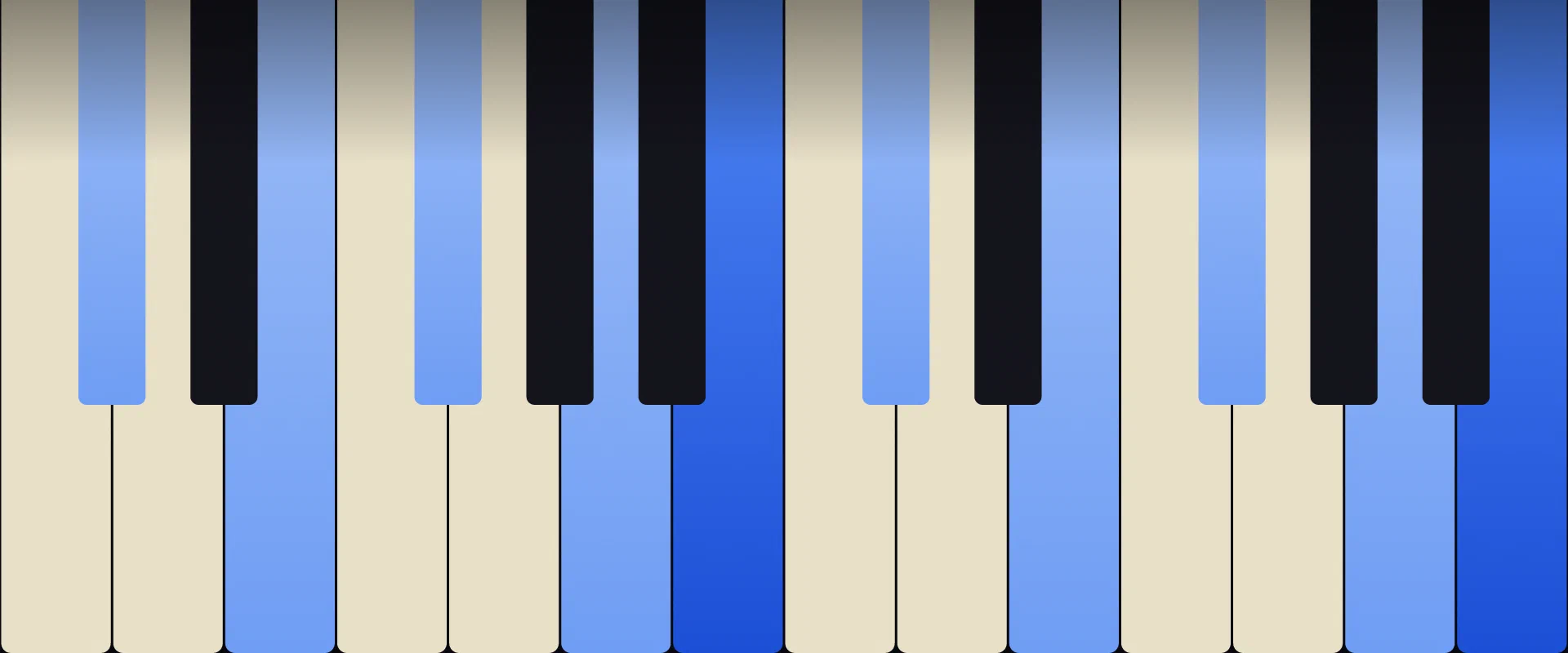
Lay one finger flat across the top five strings at the second fret and strum. What comes out is B, E, A, C♯ and F♯: a complete B11, five notes, one of each, nothing doubled and nothing left out. Chords this size are rarely this cheap.
The reason it is cheap is the same reason the chord looks wrong on paper. B11 is B, F♯, A, C♯ and E, and there is no D♯ in it anywhere. A dominant eleventh is written without its third, because the eleventh sits one semitone above the major third and the two will not share a chord. Take the D♯ out and what is left is a B7sus4 with a ninth on top, which is why most arrangers write B7sus and mean precisely this.
Try It: B11 in the Chord Finder
Set the root to B, pick B mixolydian and switch the Eleventh toggle on. The tool stacks all six notes the scale offers on that degree, D♯ included, because a diatonic stack asks no questions. The written symbol B11 is that stack with the D♯ removed.
The Notes of B11
| Degree | Note | Interval from root | Semitones |
|---|---|---|---|
| 1 (root) | B | Perfect unison | 0 |
| 5 | F♯ | Perfect 5th | 7 |
| ♭7 | A | Minor 7th | 10 |
| 9 | C♯ | Major 9th | 14 |
| 11 | E | Perfect 11th | 17 |
Written out: B, F♯, A, C♯, E. Two of the five are black keys, F♯ and C♯, and neither is a spelling trap: both sharps land where the eye expects them. The 17 in the last row is a placement instruction rather than an interval name. E is a fourth above B, and calling it an eleventh says it belongs an octave above that, sitting over the C♯ rather than under it.
How B11 Is Built
Start from B9, which is B, D♯, F♯, A and C♯, and put one more third on top: C♯ up to E. Then take the D♯ away again. On a keyboard the argument for doing so is visible before a note is played, because D♯ is a black key and E is the white key touching it on the right. Sound both and the chord turns to gravel.
What remains divides neatly. Above the root stand F♯, A, C♯ and E, and those four are F♯m7 note for note. Take the F♯ away as well and A, C♯ and E are a plain A major triad. Working musicians use that second reading far more than the symbol B11: A/B on a chart means these five notes, and the pianist reading it plays a major triad in the right hand over one bass note in the left. Underneath all of it, B, E and F♯ are Bsus4.
The five notes are also a complete scale. Sorted upward from A they read A, B, C♯, E, F♯, which is A major pentatonic, and read from F♯ the same five are F♯ minor pentatonic. A soloist over this chord can play the chord.
B11 on the Piano
Give the B to the left hand and leave it there. It is a white key, it sits immediately below C with the group of three black keys behind it, and the left hand has nothing else to do.
That leaves A, C♯ and E for the right hand, and those three are an A major triad in root position: white, black, white, under fingers 1, 2 and 3 with no stretch anywhere. Most players had that shape before they could read. Add the F♯ underneath, so the right hand holds F♯, A, C♯ and E, and the chord is complete, though the thumb now starts on a black key. Turn that over to A, C♯, E, F♯ and the span shrinks to a major sixth, the thumb returns to a white key and the fifth rather than the eleventh ends up on top. It is the more comfortable of the two and the one to learn first.
If B9 is already under the hand, the change is a single finger. Slide off the D♯ onto the E beside it and the chord loses its third and gains its eleventh in one movement. The loss is audible: the chord stops announcing that it is major, and starts waiting.
B11 on the Guitar
Four of the six open strings sound notes of this chord: both Es, the A and the B. Only the D and G strings are foreign to it, which is why the grips below stay so light.
x 2 2 2 2 2 is the whole chord under one finger. Barre the top five strings at the second fret and the notes run B, E, A, C♯, F♯ from low to high: root, eleventh, seventh, ninth, fifth, one of each. The sixth string stays out, since a low E underneath would put the eleventh in the bass and rename the chord.
Let the top string ring open instead, x 2 2 2 2 0, and the barre only has to cover four strings. The fifth goes, the eleventh doubles, and nobody misses either. This is the version that survives a fast change.
Why the third can never join in is visible on the fourth string. Open B7 is x 2 1 2 0 2, and its third, D♯, is the fourth string at the first fret. The eleventh, E, is the same string at the second. One fret apart on one string, so the guitar states the collision as plainly as the keyboard does.
Higher up, 7 7 7 9 7 9 puts the root on the sixth string at the seventh fret and spreads the five notes over all six: B, E, A, E, F♯, C♯. Index barred at the seventh fret, ring and little fingers out at the ninth on the third and first strings. The doubled E thickens it, which is what you want when no bass player is covering the root.
Inversions
| Inversion | Notes | Bass | Symbol |
|---|---|---|---|
| Root position | B F♯ A C♯ E | B | B11 |
| 1st inversion | F♯ A C♯ E B | F♯ | B11/F♯ |
| 2nd inversion | A C♯ E B F♯ | A | B11/A |
| 3rd inversion | C♯ E B F♯ A | C♯ | B11/C♯ |
| 4th inversion | E B F♯ A C♯ | E | B11/E |
Two rows are other chords wearing a borrowed name. With F♯ in the bass the five notes read as an F♯ minor seventh with a fourth added. With A in the bass they spell A6/9 in root position, a bright, restful chord with no seventh and no obligation to go anywhere, which is a startling thing to find inside a dominant. Only the bass note separates the two. See Chord Inversions and Voice Leading.
Voicings
Keep the E below the C♯. The eleventh is the note doing the work, and giving it the top of the chord makes it shrill rather than warm.
| Shape | Frets | Result |
|---|---|---|
| B11 | x 2 2 2 2 2 | All five notes, one finger |
| B11 | x 2 2 2 2 0 | Open top string, no 5th |
| B11 | 7 7 7 9 7 9 | Root on the 6th string, fret 7 |
| B7sus4 | x 2 2 2 0 2 | The chord underneath, no 9th |
| B7 | x 2 1 2 0 2 | The third back, the eleventh gone |
Which Keys Contain B11
- V of E major
- II of A major
- VI of D major
- V of E melodic minor
- I of B mixolydian
- I of B dorian
- I of B natural minor
The last three rows are the payoff for having no third. B mixolydian is a major flavoured scale and B natural minor is not, and this chord is the first degree of both, because the note that would force a choice has been left out.
Note which key is missing. B major does not contain it. That scale has A♯, not A, so the chord written on B belongs to the key of E rather than to the key of its own root, which is what being a dominant means.
Where B11 Shows Up
| Progression | Chords | Context |
|---|---|---|
| ii V I (E major) | F♯m7, B11, Emaj7 | The top four notes hold |
| IV over V (E major) | A/B, E | Pop, gospel, worship |
| ii V I (A major) | B11, E7, A | The ii chord, third omitted |
| I vamp (B dorian) | B11, E9 | Static funk and soul |
Follow the first row with your hands still. F♯m7 is F♯, A, C♯ and E, and those are the four notes sitting above the B in this chord. Going from the ii chord to the V chord therefore asks nothing of the upper voices: the bass drops a fifth from F♯ to B and everything else stays where it is. Then the D♯ arrives with the tonic and the cadence lands.
The second row is why so many players know this chord without knowing its name. E major is the guitar’s home key, B is its dominant, and B is also the awkward chord of that key, the one with no open form. Writing it as A/B solves the problem twice over: the shape is one finger, and the sound is the unhurried arrival that gospel, worship and 1970s soul built endings on. It is still a dominant. It refuses to sound urgent about it.
The last row leaves the dominant behind. Held still, with no E chord near it, B11 stops sounding like a chord going somewhere and starts sounding like a place. Bass on B, one chord for sixteen bars, and the third never arrives, which is a good deal of modal funk in a sentence.
Related Chords
- B Dominant 9th Chord, the same chord with its third still in place
- B Dominant 7th Chord, the four notes this one is built from
- B Sus4 Chord, the same refusal, in three notes
- F♯ Minor 7th Chord, what the top four notes spell alone
- A Major Chord, the triad a pianist actually plays over the B
- B Add9 Chord, the other way to add a ninth to this root
Learn More
Practice Chords
Drill chord recognition with a metronome, MIDI support, and score tracking.
Start Practicing