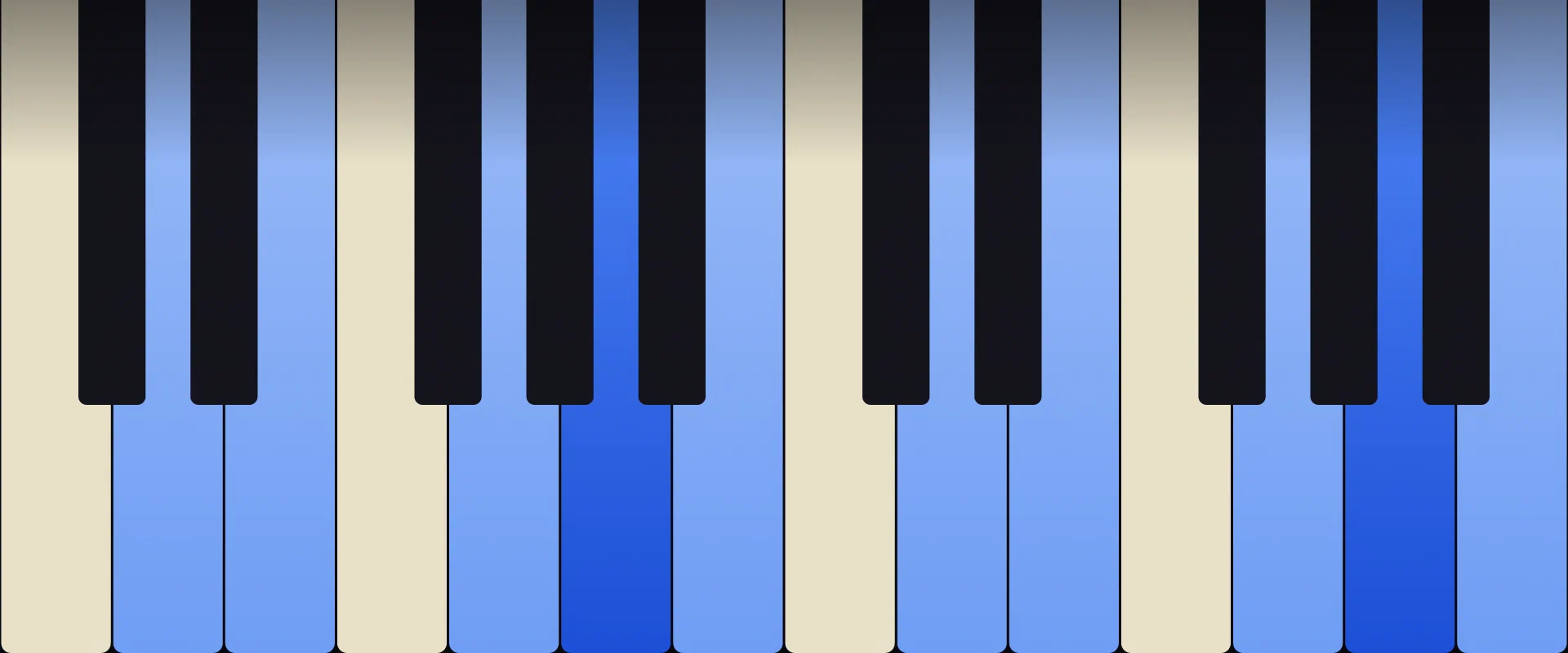
Take your left hand off a guitar’s neck entirely and strum everything except the lowest string. What sounds is A, D, G, B and E, and those five notes are A11 complete, in root position, nothing added and nothing missing. Most chords have to be assembled. This one is what the instrument does when it is left alone.
The notes are A, E, G, B and D: root, perfect fifth, minor seventh, major ninth and perfect eleventh. There is no third, and that is not an omission to apologise for. A natural eleventh sits one semitone above a major third, so the C♯ that would make the chord dominant would grind against the D above it. The third goes, the eleventh stays, and what is left is A7sus4 with a ninth on top. That is why most arrangers write A7sus and mean exactly these five notes.
Try It: A11 in the Chord Finder
Set the root to A and switch the Eleventh toggle on. The finder stacks every third it can reach, so on the first degree of A mixolydian it adds a C♯. Leave that note out and the rest is this chord.
The Notes of A11
| Degree | Note | Interval from root | Semitones |
|---|---|---|---|
| 1 (root) | A | Perfect unison | 0 |
| 5 | E | Perfect 5th | 7 |
| ♭7 | G | Minor 7th | 10 |
| 9 | B | Major 9th | 14 |
| 11 | D | Perfect 11th | 17 |
Written out: A, E, G, B, D. Five notes, no third and no accidental anywhere. The 14 and the 17 are placement instructions: the B and the D belong above the seventh, not squashed in beside the root.
How A11 Is Built
Start from A9, which is A, C♯, E, G and B. Add a fourth third on top, B up to D, then delete the C♯, because the D and the C♯ cannot share a chord this size without one of them sounding like a mistake. Five notes are left and the chord keeps the name A11 even though the interval that made it dominant has gone.
Two other readings are more useful than the stack. Take the G, B and D out on their own and they are a G major triad, which is why charts write this chord as G/A more often than as A11 and mean the same thing four notes at a time. Take E, G, B and D and they are Em7 note for note, sitting on an A bass. Read the whole set from G and it is G6/9.
A11 on the Piano
Every note is white. A, E, G, B and D use no black key at all, which is true of the dominant eleventh on exactly three of the twelve roots: D, G and A, three neighbours on the circle of fifths. On the other nine it needs at least one black key, so this is the root at which to learn the shape.
One hand will not hold it. A up to D is seventeen semitones with three notes standing inside, so the thumb and little finger are flat out before the middle fingers have anywhere to sit. Give the A to the left hand and the right has E, G, B and D under thumb, index, middle and little finger, a shape most players already own from E minor.
Better still, split it by function. Left hand takes A and the E above it, an open fifth, and the right hand plays a plain G major triad. That is the gospel and soul voicing, the one written G/A, and it puts the two notes a listener is waiting on, the B and the D, at the top where they can be heard.
That right hand serves two chords. Move the bass from A to C and it becomes Cmaj9.
A11 on the Guitar
The open strings are the chord, so the shape costs nothing: x 0 0 0 0 0 sounds A, D, G, B and E, root in the bass. Let the sixth string ring as well and 0 0 0 0 0 0 gives the same five notes over a low E, which players usually call Em7add11.
The price of a free chord is that it does not move. Slide it up one fret and it is nothing at all, so everything above the nut has to be fingered from scratch. The compact answer is 5 x 5 4 3 x, sounding A, G, B and D: root, seventh, ninth and eleventh, no fifth, which is the first note a chord this size gives up. It is the grip guitarists already know as G11 at the 3rd fret, moved up two.
All five will fit at the 5th fret if you want them. 5 7 5 7 5 7 sounds A, E, G, D, E and B, index barred at the 5th with three fingers standing on the 7th, and the ninth arriving on the first string where it belongs. It is a stretch rather than a barre, and worth it mainly when a bass player already has the low A.
There is one thing here that runs backwards. A7sus4 with its seventh is x 0 2 0 3 0, two fingers down. Adding the ninth to make A11 means taking both fingers off. The bigger chord is the easier grip, which happens here and almost nowhere else.
Inversions
| Inversion | Notes | Bass | Symbol |
|---|---|---|---|
| Root position | A E G B D | A | A11 |
| 1st inversion | E G B D A | E | A11/E |
| 2nd inversion | G B D A E | G | A11/G |
| 3rd inversion | B D A E G | B | A11/B |
| 4th inversion | D A E G B | D | A11/D |
Two of these rows are chords in their own right rather than descriptions. A11/E is what six open strings sound, and a listener hears an E minor seventh with an A hanging in it. A11/G is G6/9 in root position, a sixth chord with a ninth added and no seventh anywhere, about as far from a dominant as five notes travel. A11/B is the one to avoid: from that bass the notes read as a B minor seventh with an eleventh and a G above it, dark and unsettled. See Chord Inversions and Voice Leading.
Voicings
The D is the whole argument. Buried in the middle it sounds like a wrong note in a vague A7. On top it sounds deliberate.
| Shape | Frets | Result |
|---|---|---|
| A11 | x 0 0 0 0 0 | Five open strings, all five notes |
| A11/E | 0 0 0 0 0 0 | The same chord over a low E |
| A11 | 5 x 5 4 3 x | Movable, four notes, no 5th |
| A11 | 5 7 5 7 5 7 | All five, ninth on top |
| A7sus4 | x 0 2 0 3 0 | The chord without its ninth |
| A7 | x 0 2 0 2 0 | Where the third comes back |
Which Keys Contain A11
- VI of C major
- II of G major
- V of D major
- I of A natural minor
- I of A dorian
- I of A mixolydian
- V of D melodic minor
Three major keys hold this chord, C, G and D, and they sit next to each other on the circle of fifths. That is not a coincidence: A, B, D, E and G are the G major pentatonic scale exactly, and the same five notes read from E are the E minor pentatonic scale, the first scale most guitarists ever learn. A pentatonic belongs to three keys at once, so this chord does too, and a soloist can play its chord tones as a scale and never leave it. It is also why A11 sounds settled rather than urgent: a dominant pushes with its third and its seventh, and this one has no third.
Where A11 Shows Up
| Progression | Chords | Context |
|---|---|---|
| ii V I (D major) | Em9, A11, Dmaj9 | The D on top never moves |
| Suspension (A blues) | A11, A7, D7 | The D falls to C♯ |
| Gospel cadence (D major) | G/A, Dmaj9 | Four of the five notes |
Follow the D through the first row. It is the seventh of Em9, the eleventh of A11 and the root of Dmaj9, so a top voice can hold one note across the whole cadence while everything under it changes function. The dominant arrives without announcing itself, which is why this chord ends a quiet phrase better than a plain A7 does.
The second row is the working blues use, and A is where blues on a guitar lives. Strum the open strings, then set the fourth string at the 2nd fret and the second string at the 3rd, which is A7sus4. Pull that second finger back one fret to C♯ and the chord is A7. The suspension resolves in the time it takes to move a fingertip. Country and gospel players do this in the last bar of a turnaround so often that a listener hears the delay rather than the chord.
The third row is a keyboard habit. G major over an A bass is one of the most used slash chords in soul and gospel, because a pianist can put the key’s IV chord in the right hand and the dominant in the left, which is far quicker to reach than a five note stack. It lands where a V chord lands, but the usual guide tones are missing, so the resolution feels like a door opening rather than a lock turning. Bands transpose into D partly for this: on guitar the V chord is free, on keys it is two familiar shapes.
Related Chords
- A Dominant 9th Chord, the chord this one grows from
- A Dominant 7th Chord, the third restored and the eleventh gone
- A Sus4 Chord, the D against the A with nothing else added
- E Minor 7th Chord, what the top four notes spell on their own
- C Major 9th Chord, the same right hand over a different bass
Learn More
Practice Chords
Drill chord recognition with a metronome, MIDI support, and score tracking.
Start Practicing