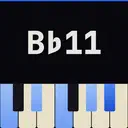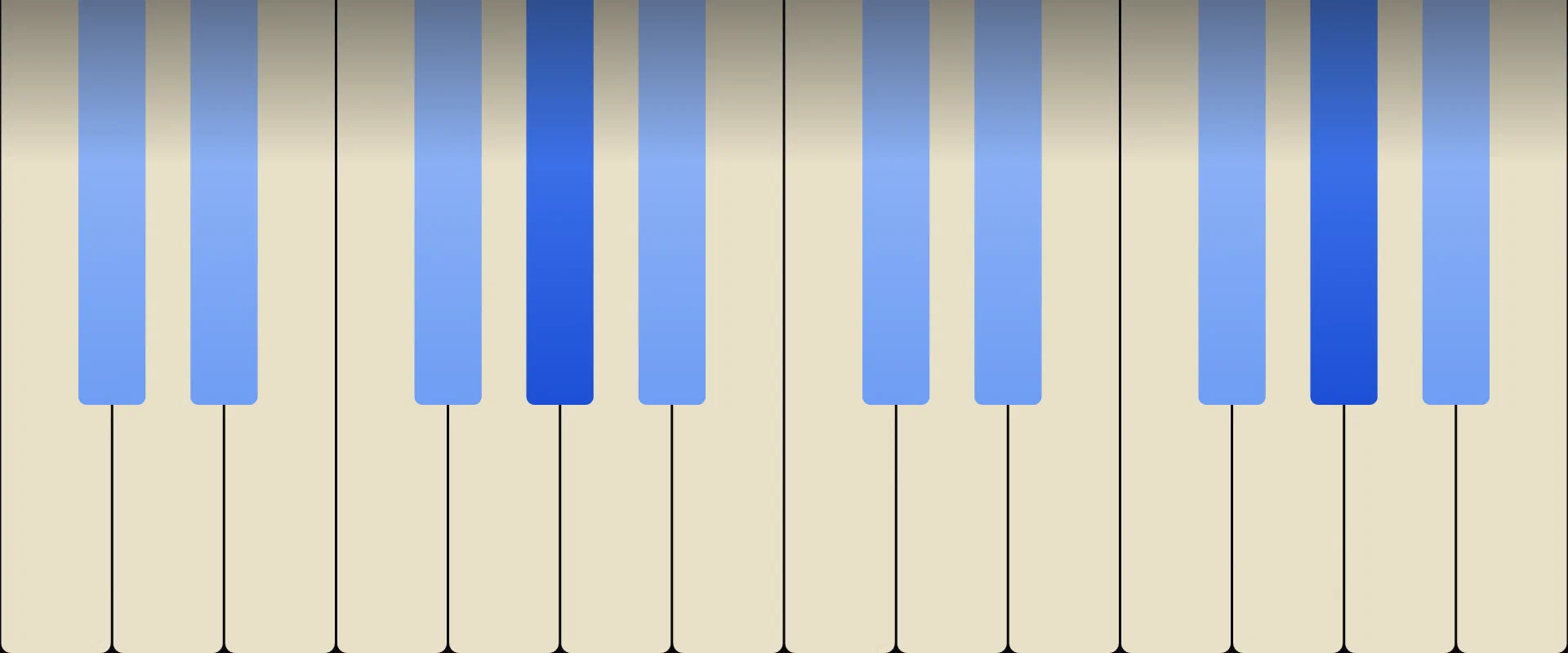
Play every black key on the piano at once. That is this chord, complete, with nothing left over and nothing missing. A♭11 is A♭, E♭, G♭, B♭ and D♭, and the keyboard’s five black keys are those five notes exactly. No other root manages it: the chord is five perfect fifths in a row, G♭ to D♭ to A♭ to E♭ to B♭, and A♭ is the only note that sits in the middle of a run of five falling entirely on black keys.
The next thing to say is what is not there. A♭11 has no third, and that is not an oversight to apologise for. A natural eleventh sits one semitone above the major third, so C and D♭ would grind against each other in the middle of the chord. The spelling keeps the eleventh and drops the third, leaving a suspension with a ninth on top.
Try It: A♭11 in the Chord Finder
Set the root to A♭, choose mixolydian and switch the Eleventh toggle on. The tool stacks every third the scale offers, so the chord it builds arrives with a C in it. Silence that C and what remains is the five notes on this page.
The Notes of A♭11
| Degree | Note | Interval from root | Semitones |
|---|---|---|---|
| 1 (root) | A♭ | Perfect unison | 0 |
| 5 | E♭ | Perfect 5th | 7 |
| ♭7 | G♭ | Minor 7th | 10 |
| 9 | B♭ | Major 9th | 14 |
| 11 | D♭ | Perfect 11th | 17 |
Written out: A♭, E♭, G♭, B♭, D♭. Five notes, five flats, no white keys and no enharmonic decision to make anywhere. The 14 and the 17 are placement instructions rather than interval names. D♭ is a fourth above the root and belongs an octave higher than that, which is the whole reason for calling it an eleventh instead of a fourth.
How A♭11 Is Built
Start from A♭9, which is A♭, C, E♭, G♭ and B♭. Add D♭ on top and take the C away. The minor seventh stays, so the chord is still a dominant and still wants to move.
Two other names describe the same five notes and both beat the symbol for usefulness. A♭, D♭, E♭ and G♭ is A♭sus4 with a seventh on it, and B♭ completes the chord, so an eleventh is a suspended dominant with a ninth added. That is why charts so often say A♭7sus4 or A♭9sus4 instead.
The second name is the one to use at a keyboard. E♭, G♭, B♭ and D♭ are E♭m7 note for note, and they are also the fifth, seventh, ninth and eleventh here, so the chord is E♭m7 with A♭ underneath it. Drop the E♭ too and it is G♭/A♭, a plain G♭ major triad over an A♭ bass. Extended Chords covers why the eleventh behaves unlike every other tension.
A♭11 on the Piano
The fingers have an easy time of this and the hand span has a hard one. All five notes are black, so the grip sits deep on the keyboard where the keys are narrow and evenly spaced, and nothing has to be threaded between two white neighbours.
The reach is the problem. A♭ up to D♭ is seventeen semitones with three notes inside it. Give the root to the left hand, add E♭ a fifth above it, and the right holds G♭, B♭ and D♭, a plain G♭ major triad. Most players take all four upper notes instead, E♭, G♭, B♭ and D♭ under fingers one, two, three and five, which is an E♭ minor seventh in root position. Anyone who has worked in E♭ minor already owns that shape, so learning this chord means putting a familiar hand over an unfamiliar bass note.
Rolling that right hand changes the colour and not the name. G♭, B♭, D♭, E♭ puts the fifth on top and sounds almost settled, while B♭, D♭, E♭, G♭ is the version that sounds most like gospel.
A♭11 on the Guitar
Not one open string is a note in this chord. E, A, D, G and B are all naturals and A♭11 is all black keys, so there is nothing free at the nut. Then the instrument turns round and hands over the whole chord for one finger.
Lay a full barre across the eleventh fret and let every string sound. Out comes E♭, A♭, D♭, G♭, B♭ and E♭, the complete chord with the fifth in the bass. The open strings are themselves an eleventh chord, E, A, D, G, B and E spelling A11 with its root on the fifth string, and eleven frets up that string reads A♭. Mute the sixth string for x 11 11 11 11 11 and the root is back underneath.
Down at the fourth fret the shape rooted on the sixth string costs more. 4 6 4 6 4 6 sounds A♭, E♭, G♭, D♭, E♭ and B♭, again the complete chord, but it wants an index barre at the fourth fret and three separate fingers at the sixth on the fifth, third and first strings, arching clear of the two strings between them. Flatten the top string onto the barre and 4 6 4 6 4 4 is far easier, though it is now A♭7sus4 with no ninth.
The cheap answer in this key is a capo, and here it is also the good one. Clamp the first fret, play the open G11 shape 3 0 0 0 1 1, and the sounding notes are A♭, B♭, E♭, A♭, D♭ and G♭: every note of the chord, one finger and a two string barre, three strings ringing behind the capo. Guitarists in flat keys tend to be at the first fret anyway.
Inversions
| Inversion | Notes | Bass | Symbol |
|---|---|---|---|
| Root position | A♭ E♭ G♭ B♭ D♭ | A♭ | A♭11 |
| 1st inversion | E♭ G♭ B♭ D♭ A♭ | E♭ | A♭11/E♭ |
| 2nd inversion | G♭ B♭ D♭ A♭ E♭ | G♭ | A♭11/G♭ |
| 3rd inversion | B♭ D♭ A♭ E♭ G♭ | B♭ | A♭11/B♭ |
| 4th inversion | D♭ A♭ E♭ G♭ B♭ | D♭ | A♭11/D♭ |
With no third in the chord the bass note carries more weight than usual, and two rows are better known under other names. Read the first inversion from its own bass and E♭, G♭, B♭, D♭, A♭ is an E♭ minor seventh with an eleventh on it. Read the second from G♭ and the same pitches are a G♭ major triad with a sixth and a ninth added. Five notes, three plausible roots, and only the bass player deciding which name the chart carries. See Chord Inversions and Voice Leading.
Voicings
Keep D♭ high. It is the note that makes the chord an eleventh rather than a ninth, and it is also the note a third would have clashed with, so burying it in the middle wastes it twice over.
| Shape | Frets | Result |
|---|---|---|
| A♭11 | x 11 11 11 11 11 | One finger, root in the bass |
| A♭11 | 11 11 11 11 11 11 | Same barre, fifth in the bass |
| A♭11 | 4 6 4 6 4 6 | E form, all five notes |
| A♭7sus4 | 4 6 4 6 4 4 | The same grip, ninth gone |
| A♭11 | capo 1, 3 0 0 0 1 1 | G11 shape, three strings ringing |
| A♭9 | 4 6 4 5 4 6 | The third back, the eleventh gone |
Which Keys Contain A♭11
- I of A♭ mixolydian
- V of D♭ major
- I of A♭ dorian
- IV of E♭ natural minor
- VII of B♭ natural minor
- III of F phrygian
- rooted on degree 3 of, and entirely contained in, E♭ minor pentatonic
The last row is the useful one. E♭ minor pentatonic is E♭, G♭, A♭, B♭ and D♭, this chord and nothing else, so a soloist can play that one box over A♭11 and never land outside the harmony.
A♭ mixolydian and A♭ dorian both appear, which cannot happen for a chord that has a third: those two modes disagree about C against C♭, and A♭11 declines to take a position. The site also spells these notes the sharp way in places. On F♯ major the same chord sits on the second degree written G♯, D♯, F♯, A♯ and C♯: identical sounds, renamed so that scale can spell its letters once each.
Where A♭11 Shows Up
| Progression | Chords | Context |
|---|---|---|
| ii V I (D♭ major) | E♭m7, A♭11, D♭maj7 | Only the bass moves |
| Suspension resolving | A♭11, A♭7, D♭ | The eleventh falls to the third |
| I vamp (A♭ dorian) | A♭11, G♭maj7 | Modal soul and funk |
| iv chord (E♭ minor) | E♭m9, A♭11, B♭m7 | Minor key, no leading note |
The first row is the reason the chord exists. Play E♭m7 with both hands and have the bass move from E♭ down to A♭. Nothing in either hand changes, yet the harmony has gone from the two chord of D♭ major to the five chord. The whole cadence costs the pianist one movement, which is why gospel and soul players reach for the eleventh where a horn arranger would write a plain seventh.
The second row is what happens when a piece wants the tension resolved rather than enjoyed. Drop D♭ to C and A♭7 appears with its third present at last. Most charts write that as A♭7sus4 to A♭7 and never mention the eleventh.
The key explains the last two rows. A♭ is horn and keyboard country rather than guitar country. Alto and baritone saxophones read concert A♭ as F, trumpets and tenors read it as B♭, and both are comfortable keys, so an arranger writing for horns lands here without thinking about it. The guitarist in that band goes to the first fret with a capo, and the open G11 shape above is why the eleventh is the one extended chord that survives the journey with every note intact.
Related Chords
- A♭ Dominant 9th Chord, the chord this one extends and takes the third from
- A♭ Dominant 7th Chord, the plain dominant underneath all of it
- A♭ Sus4 Chord, the suspension at the centre of the stack
- E♭ Minor 7th Chord, the top four notes on their own
- E♭ Minor 9th Chord, which adds F and moves the whole thing into E♭ minor
- Suspended Chords: Sus2, Sus4, and the Art of Tension for what a fourth does when a third is absent
Learn More
Practice Chords
Drill chord recognition with a metronome, MIDI support, and score tracking.
Start Practicing