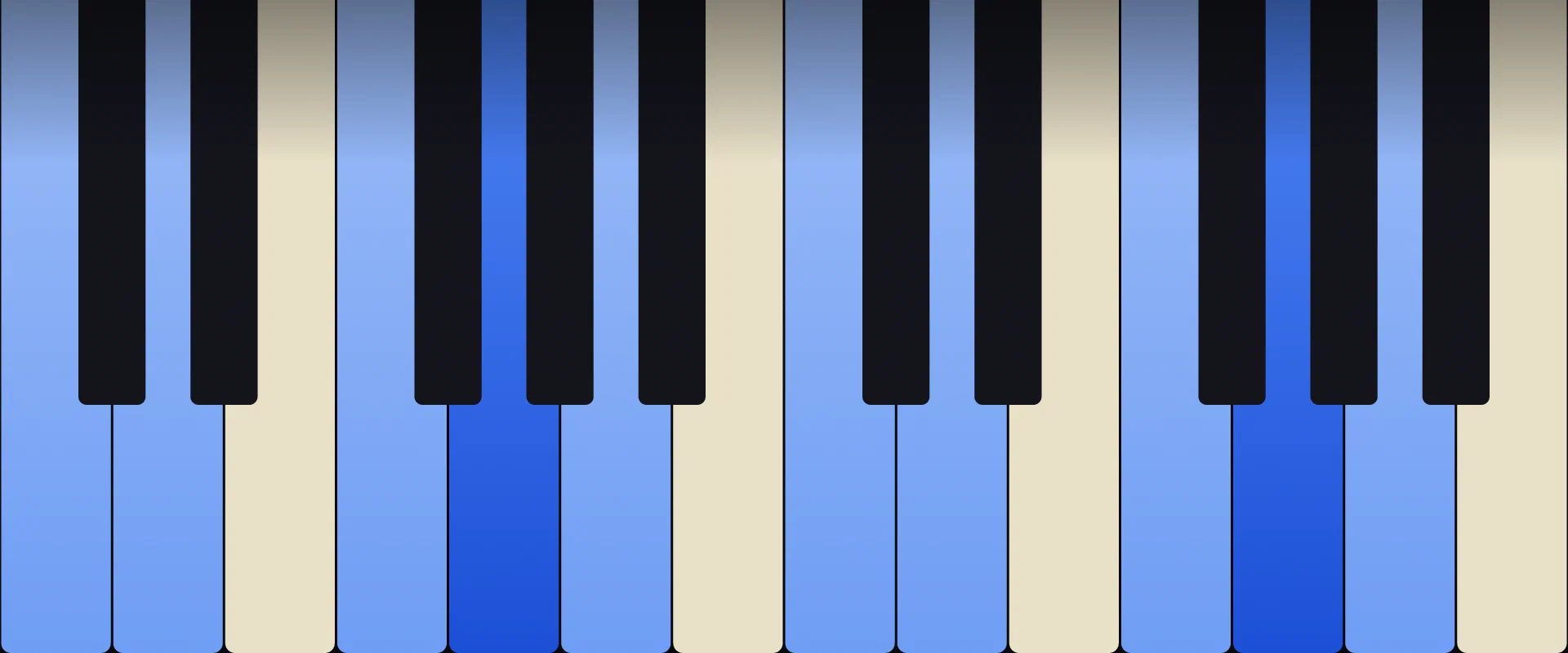
Begin with what is missing. G11 has no B in it. The chord is spelled G, D, F, A and C, five notes where a stack of thirds from G would have produced six, and the one thrown out is the major third. That is not an omission to apologise for. The eleventh of G is C, and C stands a semitone above B, so a chord holding both would put its brightest note and its most restless one hard against each other. The third loses. What is left is a G7sus4 with a ninth added on top, which is exactly why most arrangers write G9sus4 on the chart and leave the figure 11 alone.
Line the five notes up in fifths rather than thirds and the character of the chord explains itself. F, C, G, D, A: five consecutive links of the circle of fifths with the root in the middle. No two notes are a semitone apart and no two are a tritone apart, so nothing here is under pressure to move.
Try It: G11 in the Chord Finder
Set the root to G and switch the Eleventh toggle on. Compare the first degree of G mixolydian with the first degree of G dorian: the eleventh chord is identical in both, because the note those two scales disagree about is the one it leaves out.
The Notes of G11
| Degree | Note | Interval from root | Semitones |
|---|---|---|---|
| 1 (root) | G | Perfect unison | 0 |
| 5 | D | Perfect 5th | 7 |
| ♭7 | F | Minor 7th | 10 |
| 9 | A | Major 9th | 14 |
| 11 | C | Perfect 11th | 17 |
Written out: G, D, F, A, C. There is no row for a third, and no row is missing by accident. Every one of the five is a white key, so the chord never asks for an enharmonic decision, and it never gives the hand a black key to steer by either.
How G11 Is Built
Take G9, which is G, B, D, F and A, remove the B and put C in its place. Those two moves are what separate the two chords, and the second one is only possible because of the first.
The most useful way to read the result is from the fifth up. Above the G stand D, F, A and C, and those four notes in that order are D minor 7th in root position. G11 is Dm7 with a G underneath it, which is why charts often write it as Dm7/G and why a pianist who can already play Dm7 has nothing new to learn. Read it from the seventh instead and F, A and C form a complete F major triad, so the pop keyboard cliche written F/G is this chord with the ninth left off.
One consequence deserves its own sentence. B and F are the tritone inside G7, and that tritone is the entire reason a dominant seventh leans towards its tonic. Remove the B and the lean goes with it. G11 is built on a dominant root and spelled with a minor seventh, yet it does not pull anywhere. Suspended Chords covers the same trick with four notes instead of five.
G11 on the Piano
Five white keys and no landmark. A chord with an accidental in it can be found by touch, because the raised key tells the fingers where they are. This one cannot, so learn it by counting up from G rather than by feel.
One hand will not hold it. G up to C is seventeen semitones with three notes inside the span, so give the G to the left hand and the right hand takes D, F, A and C under thumb, index, middle and little finger. That right hand is Dm7 in root position, a shape most players already own.
The other division is worth practising as well. Put G and D in the left hand as an open fifth and let the right hand take F, A and C as a plain F major triad. Nothing in either hand is difficult, and the sound arrives fully formed: the fifth keeps the bottom clear and the triad on top is what a listener actually hears.
G11 on the Guitar
Chord books list no open G11, and they are wrong about this one. Start from the open G7sus4 at 3 3 0 0 1 1 and lift the finger off the fifth string. The C it held drops to the open A and the ninth arrives for free: 3 0 0 0 1 1 sounds G, A, D, G, C and F, all five notes, two fingers, six ringing strings.
It has one real flaw. The A lands at A2, a whole tone above the bass G and far below the register where a second reads as colour rather than as mud. The fix is to move the ninth up an octave and drop the fifth string. 3 x 0 2 1 1 sounds G, D, A, C and F, the same five notes with the A now above the D: index barred across the top two strings at the 1st fret, middle finger on the third string at the 2nd, ring finger on the sixth string at the 3rd. That is the voicing to learn.
Away from the nut there is a one finger version. The five open strings of a guitar, E, A, D, G and B, happen to spell A11 exactly, so barring all five at the 10th fret transposes that chord up to G: x 10 10 10 10 10 sounds G, C, F, A and D. The frets are cramped up there, but a single barre is not much to ask.
Be careful with the sixth string barre. The shape usually taught at the 3rd fret is 3 3 3 5 3 3, which sounds G, C, F, C, D and G: there is no A in it, so it is not an eleventh chord at all but G7sus4 with the root doubled twice. Move every other string up two frets instead and 3 5 3 5 3 5 sounds G, D, F, C, D and A, all five notes, an index barre at the 3rd fret with three fingers stepping over it onto the fifth, third and first strings at the 5th.
| Form | Frets | Notes sounded |
|---|---|---|
| Open, all six | 3 0 0 0 1 1 | G A D G C F |
| Open, ninth raised | 3 x 0 2 1 1 | G D A C F |
| Top four only | x x 0 2 1 1 | D A C F |
| Fifth string barre | x 10 10 10 10 10 | G C F A D |
| Sixth string barre | 3 5 3 5 3 5 | G D F C D A |
| The barre usually taught | 3 3 3 5 3 3 | G C F C D G |
| G7sus4 it grows from | 3 3 0 0 1 1 | G C D G C F |
Inversions
| Inversion | Notes | Bass | Symbol |
|---|---|---|---|
| Root position | G D F A C | G | G11 |
| 1st inversion | D F A C G | D | G11/D |
| 2nd inversion | F A C G D | F | G11/F |
| 3rd inversion | A C G D F | A | G11/A |
| 4th inversion | C G D F A | C | G11/C |
One row is a chord in its own right. G11/F, read from its own bass, is F, A, C, D and G, and that is F6/9 note for note: a major sixth chord with a ninth, no seventh and no tension anywhere. Walking a bass from G down to F under a held G11 turns a suspended dominant into a resting major chord without one upper voice moving. See Chord Inversions and Voice Leading.
Voicings
Keep the C above the F. The eleventh is the note the chord is named for and the note that forced the third out, so it belongs near the top rather than buried in the middle. When a hand or a fretting position runs out of room, drop the fifth: it is the one note here that neither names the chord nor colours it.
Which Keys Contain G11
- V of C major
- II of F major
- I of G mixolydian
- I of G dorian
- I of G natural minor
- IV of D natural minor
- VI of B♭ major
The three rows in the middle are the interesting ones. G mixolydian has a B, G dorian and G natural minor have a B♭, and that one note is the whole difference between a major sounding mode and a minor one. G11 contains neither, so it is the tonic chord of all three at once. A vamp built on it can turn major or minor whenever the melody decides, with nothing underneath changing.
Where G11 Shows Up
| Progression | Chords | Context |
|---|---|---|
| ii V I in C | Dm7, G11, Cmaj7 | The hands hold still, the bass moves |
| Delayed cadence | G11, G7, C | C falls to B, then the chord resolves |
| Gospel and neo soul | Cmaj7, G11, Cmaj7 | A dominant that never threatens |
| Pop keyboard cliche | F/G, C | The same chord minus its ninth |
| Modal pedal in G | G11 held, melody free | Sixteen bars on one chord |
Watch the first row on the keyboard rather than on the chart. Dm7 is D, F, A and C. G11 is D, F, A and C with a G below. Not one note in the right hand moves; the bass walks from D to G and the harmony changes function anyway. That is the cheapest ii to V there is, and it is why the chord turns up throughout the ii V I without ever being announced.
The second row explains the chord’s name in the classical literature. Hold G11, then move the C down to B. Everything else stays and the chord becomes G9, tritone restored, pointing at C major. The eleventh has behaved exactly like a suspension: prepared, held, resolved by step. A listener hears a cadence politely delayed, not a new chord.
The last row is where the guitar and the organ part company. A Hammond or a Rhodes will sit on G11 for sixteen bars while a soloist works through G mixolydian above it. A guitarist gets a few seconds of decay from the open form and then has to strum again, so the chord that feels like a landscape on a keyboard becomes a rhythm figure on six strings. Funk players lean into that, chopping x x 0 2 1 1 on the offbeat and letting the bass hold the G.
Related Chords
- G Dominant 9th Chord, the third put back, the eleventh removed
- G Sus4 Chord, the three note ancestor of the idea
- G Dominant 7th Chord, what the eleventh resolves into
- D Minor 7th Chord, the top four notes on their own
- F Major Chord, the triad standing on the seventh
- G Major 7th Chord, built on the two notes this chord refuses
Learn More
Practice Chords
Drill chord recognition with a metronome, MIDI support, and score tracking.
Start Practicing