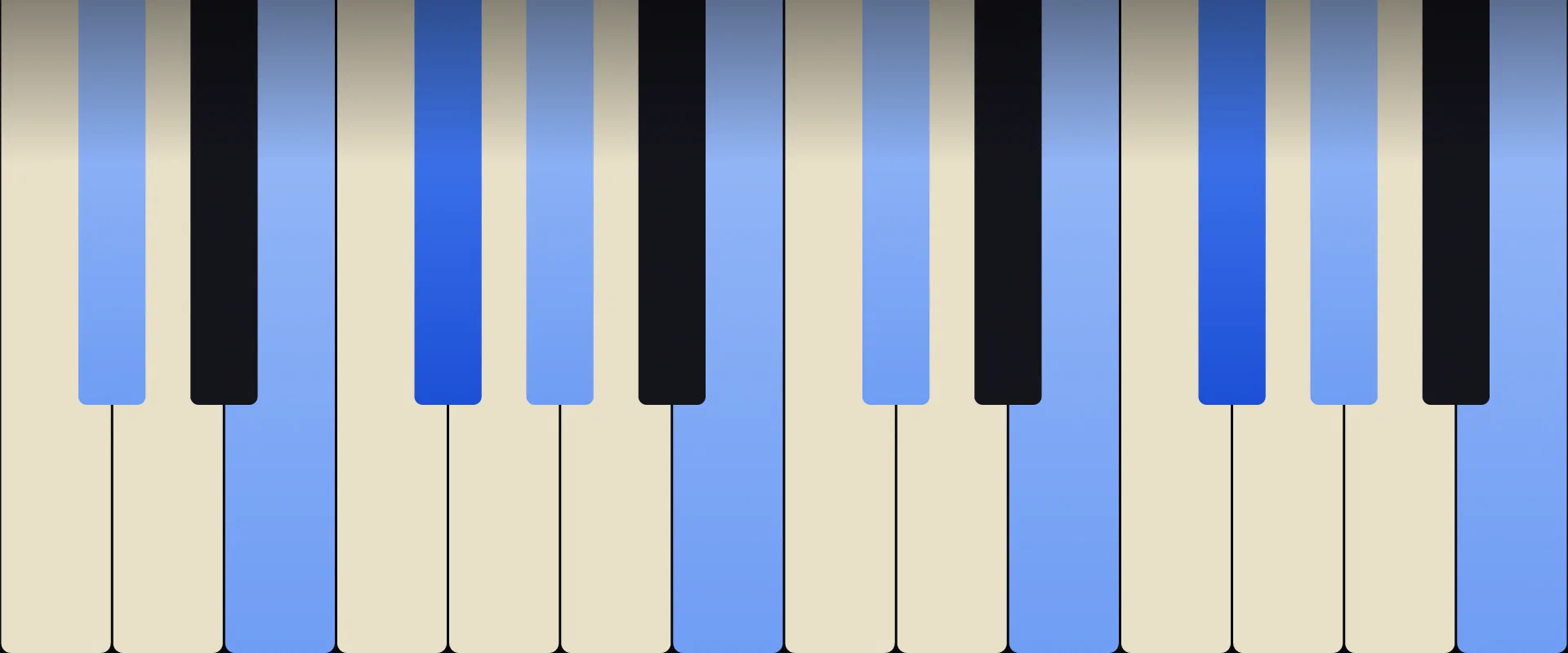
There is no A♯ in this chord, and there was never going to be one. F♯11 is F♯, C♯, E, G♯ and B: root, perfect fifth, minor seventh, major ninth and perfect eleventh. The major third is absent by design. A natural eleventh stands one semitone above the major third, and B grinding against A♯ in the middle of a chord is not a colour anybody writes a symbol for. Drop the third and the argument stops.
What remains is an F♯7sus4 with a ninth on top, which is why most arrangers write F♯7sus or F♯9sus4 and mean these exact five notes. Read the top four alone and they spell C♯m7. Read the top three and they spell a plain E major triad, which is why the same harmony reaches guitarists as E/F♯.
Try It: F♯11 in the Chord Finder
Set the root to F♯ and turn the Eleventh toggle on. The chord on the first degree of F♯ mixolydian and the chord on the fifth degree of B major are the same five notes.
The Notes of F♯11
| Degree | Note | Interval from root | Semitones |
|---|---|---|---|
| 1 (root) | F♯ | Perfect unison | 0 |
| 5 | C♯ | Perfect 5th | 7 |
| ♭7 | E | Minor 7th | 10 |
| 9 | G♯ | Major 9th | 14 |
| 11 | B | Perfect 11th | 17 |
Written out: F♯, C♯, E, G♯, B. Five notes and no third, which is a fact about the chord rather than a shortcut somebody took. The 14 and the 17 are placement instructions: G♯ belongs a whole tone above the octave and B a perfect fourth above that, not crushed into the same octave as the root.
These five notes answer to another name. E, F♯, G♯, B and C♯ is the E major pentatonic scale, and the same collection read from C♯ is the C♯ minor pentatonic. F♯11 is that scale sounded all at once, which settles the question of what to play over it: take the pentatonic and every note is a chord tone.
How F♯11 Is Built
Start from F♯9, which is F♯, A♯, C♯, E and G♯. Put B on top and take the A♯ away. Two operations, and the second one is not negotiable.
Or arrive from underneath. F♯sus4 is F♯, B and C♯. Add E and the chord is F♯7sus4. Add G♯ above that and it is complete. Nothing is suspended in the old sense, because no third is waiting to step down onto the B, but the label stuck.
The third route is the one bands actually use. E, G♯ and B is an E major triad, and it supplies the seventh, ninth and eleventh in one grab. Hand F♯ to the bass player, hand E major to the keyboard player, and the chord assembles itself with nobody thinking about elevenths. Restore the C♯ underneath and all five notes are present.
Extended Chords and Jazz Harmony covers why an eleventh is welcome over a minor chord and refused over a major third.
F♯11 on the Piano
Three of the five notes are black keys, F♯, C♯ and G♯, and two are white, E and B. No accidental lands anywhere surprising, so the keyboard shows the chord exactly as the page spells it.
One hand cannot hold it. F♯ up to B is seventeen semitones. Give F♯ to the left hand on its own, or F♯ and C♯ as a fifth, and the right hand is left with C♯, E, G♯ and B. That is C♯m7 in root position, a shape most players already own from working in E major or C♯ minor, so the whole job at the keyboard is putting a familiar minor seventh over an unfamiliar bass note.
That right hand alternates black, white, black, white going up. The thumb sits on C♯, so the hand rides forward between the raised keys rather than hanging off the front edge, and the index and little fingers reach back to E and B without the palm dropping.
There is a better voicing if both hands are free. Bottom to top: C♯, F♯, B, E, G♯. Three perfect fourths in a row with a major third on the end. Fourths spread these five notes far more evenly than thirds do, so nothing in the middle thickens, and the F♯ is not even in the bass unless somebody puts it there.
F♯11 on the Guitar
Two of the six open strings are chord tones. The sixth and first strings are E, the minor seventh, and the second string is B, the eleventh. For a chord carrying three sharps that is generous, and it means the nut is not out of bounds the way it usually is.
The cheapest useful grip is 2 x 2 1 0 0. Middle finger on the sixth string at the second fret for F♯, index on the fourth string at the second fret for E with its tip damping the fifth string, and the third string at the first fret for G♯. The open second and first strings finish it, and the chord sounds F♯, E, G♯, B and E: root, seventh, ninth and eleventh, no fifth. The fifth is the first note any extended chord gives up.
For all five notes, barre the sixth-string form at the second fret: 2 4 2 4 2 4, sounding F♯, C♯, E, B, C♯ and G♯. It is 2 4 2 4 2 2, which is F♯7sus4, with the first string raised two frets. The index bars the second fret while three fingers stand on the fourth across the fifth, third and first strings, and string tension is at its highest this close to the nut.
The fifth-string form is the joke of the chord type. x 9 9 9 9 9 is one finger lying flat across the ninth fret, and it sounds F♯, B, E, G♯ and C♯: every note of F♯11 with nothing left over. Every guitarist has played it by accident while a barre chord went wrong. Lay the same finger across the sixth string too and 9 9 9 9 9 9 adds C♯ underneath, which is F♯11 over its own fifth rather than a different chord. Frets are narrow this high up, which one flat finger does not mind at all. See Guitar Chord Shapes: The CAGED System for how the two forms relate.
Inversions
| Inversion | Notes | Bass | Symbol |
|---|---|---|---|
| Root position | F♯ C♯ E G♯ B | F♯ | F♯11 |
| 1st inversion | C♯ E G♯ B F♯ | C♯ | F♯11/C♯ |
| 2nd inversion | E G♯ B F♯ C♯ | E | F♯11/E |
| 3rd inversion | G♯ B F♯ C♯ E | G♯ | F♯11/G♯ |
| 4th inversion | B F♯ C♯ E G♯ | B | F♯11/B |
Two of these rows are other chords with their own names. Over C♯ the notes read as root, minor third, fifth, seventh and eleventh, so the chord is a C♯ minor seventh with its eleventh added. Over E they read as root, major third, fifth, sixth and ninth, which is E6/9 exactly. A bass player walking F♯ down to E under a held F♯11 turns a dominant into a resting place with nothing above it moving. Chord Inversions and Voice Leading has more on trading chord names this way.
Voicings
Keep B on top or near it. The eleventh is the one note that makes this chord different from F♯9, so burying it in the middle is a waste.
| Shape | Frets | Result |
|---|---|---|
| F♯11 | 2 x 2 1 0 0 | Near the nut, no 5th |
| F♯11 | 2 4 2 4 2 4 | All five notes, demanding |
| F♯11 | x 9 9 9 9 9 | One flat finger, all five |
| F♯11 | 9 9 9 9 9 9 | The same, with C♯ in the bass |
| F♯7sus4 | 2 4 2 4 2 2 | The chord it grows from |
| E major | x 7 9 9 9 x | Play over an F♯ bass |
Which Keys Contain F♯11
- degree 5 of B major
- degree 2 of E major
- degree 6 of A major
- degree 1 of F♯ mixolydian
- degree 1 of F♯ dorian
- degree 1 of F♯ natural minor
- degree 4 of C♯ natural minor
The three F♯ rows are the reward for having no third. F♯ mixolydian, F♯ dorian and F♯ natural minor disagree about whether the chord on F♯ is major or minor, and F♯11 declines to take a side, so it fits all three, as F♯sus4 and F♯7sus4 do and for the same reason. It also fills E major pentatonic and C♯ minor pentatonic exactly.
Where F♯11 Shows Up
| Progression | Chords | Context |
|---|---|---|
| ii V I in B major | C♯m7, F♯11, Bmaj7 | The V never commits |
| V vamp in B major | F♯11, F♯7, B | Delay, then resolve |
| i vamp in F♯ dorian | F♯11, B, F♯11 | Modal, no cadence |
| Slash chord in E major | E/F♯ over F♯ | Gospel and soul |
In B major the eleventh is B, the tonic of the key. That is the whole trick of the first row. The dominant chord already contains the note it is supposed to be heading towards, so it points home without moving, and the arrival at Bmaj7 sounds inevitable rather than dramatic. Songwriters use this when a chorus needs to land softly.
The second row makes the delay explicit. Hold F♯11 for a bar, then move one note, B down to A♯, and the chord becomes F♯7 with a tritone in it and somewhere to go. The resolution to B then happens twice, once loosely and once for real.
The fourth row is where guitarists meet this chord without learning its name. E major is the friendliest key on the instrument, F♯ is its second degree, and a bass player holding F♯ under an ordinary E chord produces F♯11 without its fifth. Gospel keyboard players build whole vamps on it, since the upper structure can slide around the E major scale over a stationary bass and nothing ever sounds wrong.
Related Chords
- F♯ Dominant 9th Chord, the chord this one is built from
- F♯ Sus4 Chord, the suspension at the centre of it
- F♯ Dominant 7th Chord, the third and the tritone restored
- C♯ Minor 7th Chord, what the top four notes spell alone
- E Major Chord, the triad that sits on top of the F♯
- F♯ Add9 Chord, a ninth over a third rather than instead of one
Learn More
Practice Chords
Drill chord recognition with a metronome, MIDI support, and score tracking.
Start Practicing