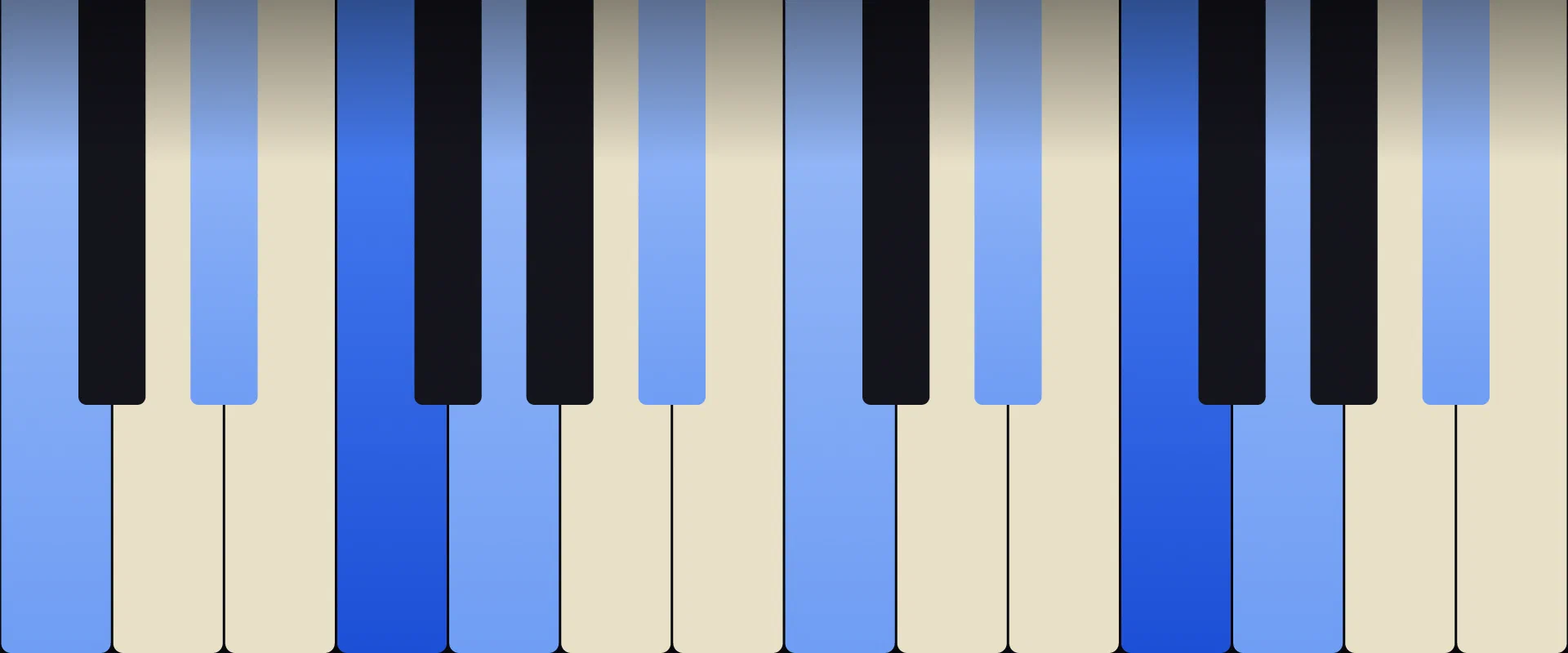
Five notes, and not one of them is a 3rd. F11 is F, C, E♭, G and B♭, so the note that would tell a listener whether this chord is major or minor, the A or the A♭, is simply not there. That is deliberate rather than careless. A perfect 11th sits one semitone above a major 3rd, and no spacing makes B♭ and A agree with each other, so the 3rd is the note that leaves. What remains is an F7sus4 with a 9th stacked on top, which is why most arrangers write F7sus over the bar and mean these five notes exactly.
Line them up from the bottom and a scale appears. F, G, B♭, C, E♭ is C minor pentatonic note for note, and read from E♭ the same five are E♭ major pentatonic. F11 is a pentatonic scale sounded all at once.
Try It: F11 in the Chord Finder
Set the root to F and switch on the Eleventh toggle, then look at the first degree of F mixolydian and the fifth of B♭ major. Play the notes one at a time up the keyboard and listen for the scale hiding inside the chord.
The Notes of F11
| Degree | Note | Interval from root | Semitones |
|---|---|---|---|
| 1 (root) | F | Perfect unison | 0 |
| 5 | C | Perfect 5th | 7 |
| ♭7 | E♭ | Minor 7th | 10 |
| 9 | G | Major 9th | 14 |
| 11 | B♭ | Perfect 11th | 17 |
Written out: F, C, E♭, G, B♭. There is no row for the 3rd, and that is the finished chord rather than a shorthand for something fuller. The 14 and the 17 are placement instructions and not interval names: both notes belong an octave above the triad. Down at the bottom the B♭ sounds like a suspension owing somebody a resolution. An octave higher it just sounds like colour.
How F11 Is Built
Take F9, which is F, A, C, E♭ and G, put the 11th B♭ on top and take the A away. The stack of thirds is the official derivation and it is the least useful way to hold the chord in your head.
Two other readings do more work. Remove the F and what is left, C, E♭, G and B♭, is Cm7 in root position, so F11 is a C minor 7th chord with an F underneath it and nothing else going on. Remove the C as well and the remaining E♭, G and B♭ are a plain E♭ major triad, which is why gospel and soul charts write E♭/F and get four fifths of this chord for three fingers.
The other way in starts from Fsus4, F, B♭ and C: add the minor 7th E♭ to make F7sus4, then the 9th G on top. Suspended Chords covers why the B♭ stops behaving like a suspension once there is a 7th under it, and Extended Chords and Jazz Harmony covers the 3rd against 11th collision in general.
F11 on the Piano
Two black keys, E♭ and B♭, and three white ones, F, C and G. Both accidentals fall on black keys, so there is no enharmonic trap anywhere in the chord and nothing on the keyboard contradicts what is written on the page.
One hand will not hold all five in the spacing that suits them. F up to B♭ is seventeen semitones. Give the F to the left hand on its own and the right hand is left with C, E♭, G and B♭, a minor 7th from thumb to little finger, which is the C minor 7th shape most players already own from working in E♭ major. Learning F11 at the keyboard is mostly a matter of putting a familiar right hand over an unfamiliar bass note.
There is a lazier version that arrangers use constantly. Left hand on F, right hand on E♭, G and B♭ as a straight major triad. Four notes, no stretch at all, and the only loss is the C, which the bass player is supplying anyway. Rotate that triad to B♭, E♭, G and the 11th drops to the bottom of the right hand, a bare perfect 4th above the bass, which is the hollow sound people mean when they call this chord modal.
F11 on the Guitar
Exactly one open string belongs to this chord. Of the six, E, A, D, G, B and E, only the G is a chord tone, and it is the 9th. Everything else would have to be fretted or muted, which is why the books carry no open F11.
That single open G is still worth using. Barre the first fret across the three lowest strings, leave the G string ringing and mute the top two: 1 1 1 0 x x sounds F, B♭, E♭ and G, the root, the 11th, the ♭7 and the 9th. One finger, one open string, and the only absentee is the 5th, which is the first note any extended chord gives up.
All five are available at the same fret if you insist. 1 1 1 0 1 1 adds C and F on the top two strings, but with the index already flat across three strings and the open G in the middle of the shape, two more fingers have to stand at that same fret and arch clear of the string between them. It works. Almost nobody tries it twice.
Then there is the eighth fret, where this chord becomes the easiest thing on the page. Barre the top five strings and stop: x 8 8 8 8 8 sounds F, B♭, E♭, G and C, every note of F11, nothing doubled, one finger. That is not luck. Standard tuning stacks perfect 4ths everywhere except between the third and second strings, so a flat barre across five strings produces root, 4th, ♭7, 9th and 5th, which is the quartal shape an 11th chord wants. The 3rd cannot creep in because no finger is near it. More on shapes that move in the CAGED system.
Inversions
| Inversion | Notes | Bass | Symbol |
|---|---|---|---|
| Root position | F C E♭ G B♭ | F | F11 |
| 1st inversion | C E♭ G B♭ F | C | F11/C |
| 2nd inversion | E♭ G B♭ F C | E♭ | F11/E♭ |
| 3rd inversion | G B♭ F C E♭ | G | F11/G |
| 4th inversion | B♭ F C E♭ G | B♭ | F11/B♭ |
Because the five notes are a pentatonic scale, every rotation is another mode of that scale, and none of them sounds like an accident. A seventh chord cannot claim that. Two rows have names of their own. F11/C is Cm7 with an F on top, which is what a keyboard player ends up with whenever the bass holds C under this chord. F11/E♭ is E♭6/9 exactly, nothing added and nothing taken away, so one handful of keys is an unresolved suspended dominant over one bass note and a sweet, finished major chord over another. See Chord Inversions and Voice Leading.
Voicings
Where the B♭ sits decides how the chord reads. Put it directly above the root, as the eighth fret barre does, and it sounds like a suspension. Lift it above the E♭ and it stops asking to resolve and starts sounding like an added colour.
| Shape | Frets | Result |
|---|---|---|
| F11 | x 8 8 8 8 8 | All five notes, one barre |
| F11 | 1 1 1 0 x x | Root, 11th, ♭7, open 9th |
| F11 | 1 1 1 0 1 1 | All five at the nut, awkward |
| F11 | x 8 8 8 x x | Root, 11th, ♭7 only |
| F7sus4 | 1 3 1 3 1 1 | The same chord without the 9th |
| Fsus4 | 1 3 3 3 1 1 | The three note core |
Which Keys Contain F11
- V of B♭ major
- degree 2 of E♭ major
- degree 4 of C natural minor
- degree 1 of F dorian
- degree 1 of F mixolydian
- degree 5 of B♭ melodic minor
- entirely contained in C minor pentatonic and in E♭ major pentatonic
That list is longer than a five note chord usually manages, and the missing 3rd is the reason. F11 has no opinion about major and minor, so it fits any scale holding these five notes whatever that scale puts a third above F. In B♭ major the chord built on F is F7 and the implied 3rd is A, so F11 there is a dominant keeping its leading tone back. In C natural minor and F dorian the chord is Fm7 and the implied 3rd is A♭, so the same five notes are a minor chord biding its time. The chord refuses to choose, which is exactly why a writer puts F7sus over the bar.
The last row is the one a soloist should read twice. C minor pentatonic is F11 and F11 is C minor pentatonic, so you can improvise over this chord using only the chord and never miss. Add the G♭ that turns it into C blues and that single extra note is the only one in the whole scale with any bite to it.
Where F11 Shows Up
| Progression | Chords | Context |
|---|---|---|
| ii V I (B♭ major) | Cm7, F11, B♭maj7 | Only the bass moves |
| Blues in F | F11, F7, B♭7 | The B♭ falls to A |
| Modal vamp (F dorian) | F11, E♭maj9 | One note changes |
| iv chord (C minor) | Cm7, F11, Cm7 | The same four notes twice |
Follow the first row with your eyes on the right hand. Cm7 is C, E♭, G and B♭, and every one of those is in F11, so the hands hold still and the bass player alone turns the ii chord into the V. Then into B♭maj7, B♭, D, F and A, every voice moves by a step or stays: E♭ falls to D, G falls to F, C rises to D, B♭ holds. A cadence this smooth is why arrangers reach for the 11th at the end of a phrase rather than a plain F7, which lands harder because its A is the leading note of B♭ and behaves like one.
The blues row costs nothing and buys a lot. Opening an F blues on F11 rather than F7 keeps A out of the first bar entirely, so when the 3rd finally turns up it counts for something.
The modal row is the cheapest good sound here. E♭maj9 is E♭, G, B♭, D and F, four of which are already in F11: only the C moves, and it moves to D. Rock that one voice over a held F bass and you have the vamp a great many soul records live on for eight bars at a time. F is not a generous key at the nut, which is one more reason the eighth fret barre gets so much use.
Related Chords
- F Dominant 9th Chord, the chord this one swaps a note out of
- F Sus4 Chord, the three note core underneath it
- F Dominant 7th Chord, what the absent A would turn it into
- C Minor 7th Chord, the four notes above the bass
- E♭ Major 6th Chord, the same chord read from its ♭7
- F Minor 7th Chord, the minor reading the missing 3rd permits
Learn More
Practice Chords
Drill chord recognition with a metronome, MIDI support, and score tracking.
Start Practicing