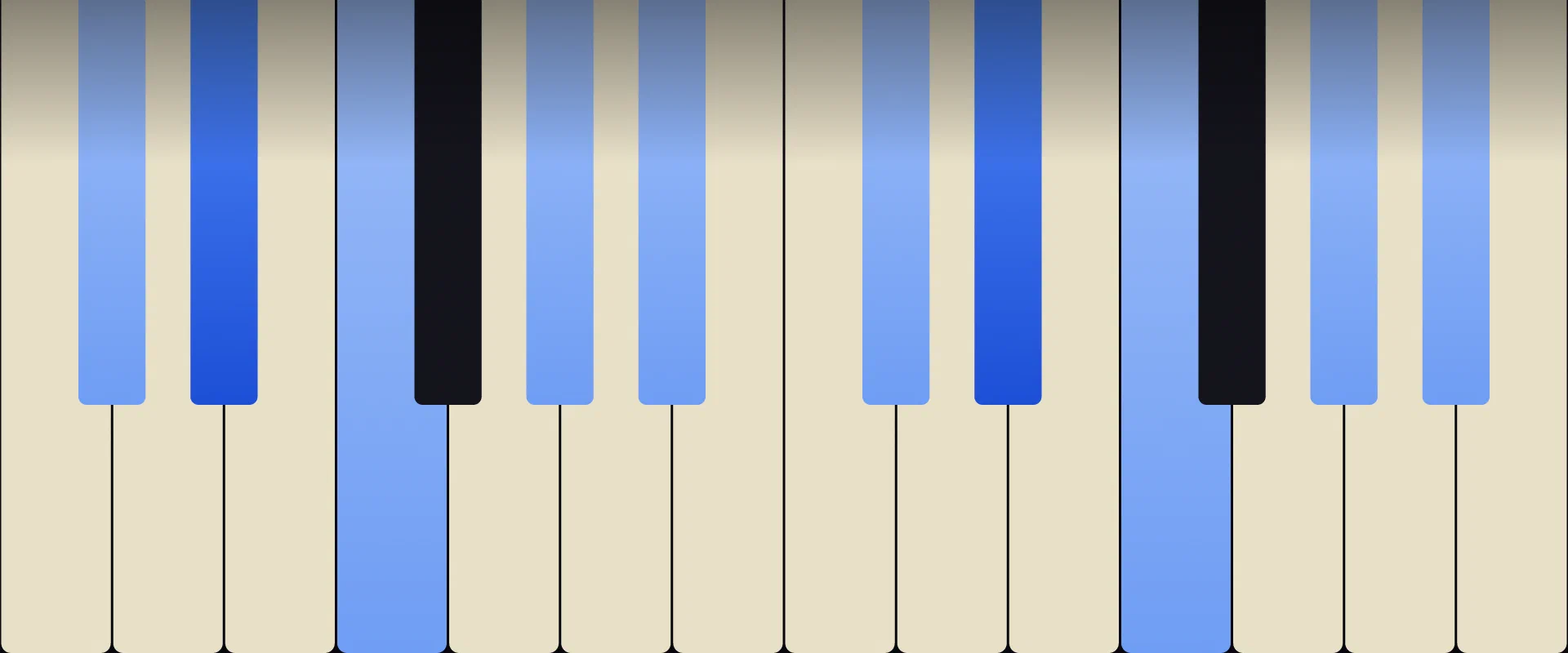
Write D♭/E♭ on a chart and any pianist will play this chord without pausing to work out what an eleventh is. A D♭ major triad with an E♭ underneath it is E♭11, complete. The five notes are E♭, B♭, D♭, F and A♭, and the top three of those are that triad. What is missing matters more: there is no G. The major third has been removed, because the eleventh, A♭, sits one semitone above it, and a chord holding both sounds like a mistake rather than a colour.
Try It: E♭11 in the Chord Finder
Set the root to E♭ and switch the 11th toggle on. The tool spells the chord the way charts do, with no third in it.
The Notes of E♭11
The chord contains five notes: E♭, B♭, D♭, F and A♭.
| Degree | Note | Interval from root | Semitones |
|---|---|---|---|
| 1 | E♭ | Root | 0 |
| 5 | B♭ | Perfect 5th | 7 |
| ♭7 | D♭ | Minor 7th | 10 |
| 9 | F | Major 9th | 14 |
| 11 | A♭ | Perfect 11th | 17 |
No third appears anywhere in that table, and that is the point. A complete dominant eleventh would be six notes, E♭ G B♭ D♭ F A♭, but nobody voices it that way, so the symbol E♭11 has come to mean the five above.
How E♭11 Is Built
Start from E♭9, which is E♭ G B♭ D♭ F. Add A♭ on top and take the G away. The seventh stays flat, so the chord is still nominally a dominant, but the interval that gave it any bite has gone.
What remains is E♭sus4 with two extra notes: E♭, A♭ and B♭ are the suspension, D♭ adds the seventh and F the ninth. That is why arrangers write E♭7sus far more often than E♭11. See Suspended Chords: sus2, sus4 and Tension.
Stack the five notes in fifths instead of thirds and they line up without a gap: D♭ to A♭ to E♭ to B♭ to F. Five consecutive perfect fifths, which is another way of saying this chord is a pentatonic scale sounded all at once. Those exact pitches are B♭ minor pentatonic.
E♭11 on the Piano
Four of the five notes are black keys: E♭, D♭, A♭ and B♭. Only F is white. Look at the black keys as a group and the shape is easy to remember, because the chord is all five of them with G♭ moved down a semitone to F. Nothing else changes.
The white key causes the one problem. F sits in the middle of the chord, not at either end, so any right hand grouping that begins below it starts on a black key. Accept it rather than fight it. Give E♭ and B♭ to the left hand as a plain fifth, fingered 5 and 1, and take D♭, F and A♭ in the right with 1, 2 and 4. The thumb is on D♭ and the hand sits well forward between the black keys, which is where D♭ major triads always want it.
That right hand is a D♭ major triad and nothing more. Move the left hand between D♭ and E♭ beneath it and the chord swaps between plain D♭ major and E♭11 with nothing above the bass moving at all.
The other useful split gives four notes to the right hand: B♭, D♭, F and A♭, which is a B♭ minor seventh chord in root position, with E♭ alone underneath. Pianists who already play B♭m7 get this chord free, and the move from B♭m7 to E♭11 becomes a single note in the left hand.
E♭11 on the Guitar
Not one of the six open strings belongs to this chord: E, A, D, G and B are all outside E♭, B♭, D♭, F and A♭. An open form here is not merely uncatalogued, it is impossible. What the instrument offers instead is better.
Lay one finger flat across the top five strings at the 6th fret. x 6 6 6 6 6 sounds E♭, A♭, D♭, F and B♭, which is the whole chord, every note, one finger. This works because the guitar is tuned in fourths apart from the third string to the second: a straight barre spells a root, a fourth, a seventh, a ninth and a fifth, which is the recipe for an eleventh chord.
Carry the barre across all six strings, 6 6 6 6 6 6, and you add a B♭ underneath. Still a chord tone, but the fifth is now in the bass and the chord loses its footing, so mute the sixth string with the thumb.
Higher up, the movable E form sits at the 11th fret: 11 11 11 13 11 13, sounding E♭, A♭, D♭, A♭, B♭ and F. Index barre across the 11th, ring finger on the third string at the 13th, little finger on the first string at the 13th. All five notes, root in the bass this time, ninth on top where it belongs, and the frets are narrow up there so the barre is less work than it looks.
Down at the nut, x x 1 1 2 1 gives E♭, A♭, D♭ and F on the top four strings: index across the first fret, middle finger on the second string at the second. Two fingers, and only the fifth is missing. See Guitar Chord Shapes: The CAGED System.
Inversions
| Inversion | Notes | Lowest note |
|---|---|---|
| Root position | E♭ B♭ D♭ F A♭ | E♭ |
| 1st inversion | B♭ D♭ F A♭ E♭ | B♭ |
| 2nd inversion | D♭ F A♭ E♭ B♭ | D♭ |
| 3rd inversion | F A♭ E♭ B♭ D♭ | F |
| 4th inversion | A♭ E♭ B♭ D♭ F | A♭ |
A chord with no third has no strong claim on any root, so these rows rename it rather than recolour it. First inversion is B♭ D♭ F A♭ with an E♭ on top, which the ear takes as B♭m7 with an added fourth. Second inversion is more striking: from D♭ the notes read as a major triad with a sixth and a ninth on it, restful rather than dominant. Put E♭ in the bass and the chord wants A♭; put D♭ in the bass and it wants nothing. See Chord Inversions and Voice Leading.
Voicings
| Shape | Frets | Result |
|---|---|---|
| E♭11 | x 6 6 6 6 6 | All five notes, one finger |
| E♭11 | 6 6 6 6 6 6 | Same, fifth in the bass |
| E♭11 | 11 11 11 13 11 13 | E form, root in the bass |
| E♭11 | x x 1 1 2 1 | Four notes at the nut, no fifth |
| E♭11 | x 1 1 1 2 1 | All five, fifth in the bass |
At the keyboard the order of omission is not the usual one. Drop B♭, as in any extended chord, but never A♭: it is the note the symbol names, and without it what is left is an E♭7 with a ninth and no third. Four notes, E♭, D♭, F and A♭, carry the chord completely.
Which Keys Contain E♭11
- V of A♭ major
- II of D♭ major
- VII of F natural minor
- I of E♭ mixolydian
- I of E♭ dorian
- IV of B♭ dorian
- degree 2 of, and entirely inside, D♭ major pentatonic
Two of those entries are the reason the chord exists. E♭ mixolydian is a major sounding mode and E♭ dorian is a minor one, and E♭11 is the first degree of both, because the note that would decide between them has been removed. It fits E♭ natural minor just as well. No triad can do that.
The chord appears in sharp keys under other letters. The F♯ major scale holds it on its sixth degree, spelled D♯, A♯, C♯, E♯ and G♯: the same five sounds, since a sharp key cannot borrow flat spellings.
Where E♭11 Shows Up
B♭m7, E♭11, A♭maj7. The ii V I in A♭ major, and the cheapest one on the instrument. B♭, D♭, F and A♭ are the whole of B♭m7 and also the top four notes of E♭11, so between the first two chords only the bass moves. Not until the arrival at A♭ does the hand change.
E♭11 to E♭7 to A♭. The eleventh treated as a suspension. A♭ falls to G, the third arrives late, and the cadence lands with more force than a plain dominant would have managed. Gospel and soul keyboard players do this at the end of almost every phrase, often writing it as D♭/E♭ to E♭7.
B♭7, E♭11, F11. A blues in B♭ with the fourth degree taken as an eleventh rather than a seventh chord. On guitar that is the barre at the 6th fret and the same barre at the 8th, one finger each, which is why funk rhythm parts in flat keys sound as they do.
Eight bars of E♭11 and nothing else. Modal writing uses this chord as a place to stay rather than a place to leave. With no third and no leading note, it does not ask to resolve, and a soloist can work through B♭ minor pentatonic for as long as the vamp lasts. See Pentatonic Scales for Improvisation.
E♭ is where most of this music lives. An alto saxophone reads concert E♭ as C and a trumpet reads it as F, so a horn section handed this chord is working in the two easiest keys it owns. Big bands, gospel choirs and soul rhythm sections default to E♭ and A♭ for that reason, while guitar led rock, whose open strings share nothing with this chord, almost never does.
Related Chords
- E♭ Dominant 9th Chord, the same chord with G in place of A♭
- E♭ Dominant 7th Chord, the dominant underneath all of this
- E♭ Sus4 Chord, the three notes E♭11 is built around
- B♭ Minor 7th Chord, what the top four notes spell on their own
- E♭ Add9 Chord, the same F added to a chord that kept its third
Learn More
Practice Chords
Drill chord recognition with a metronome, MIDI support, and score tracking.
Start Practicing