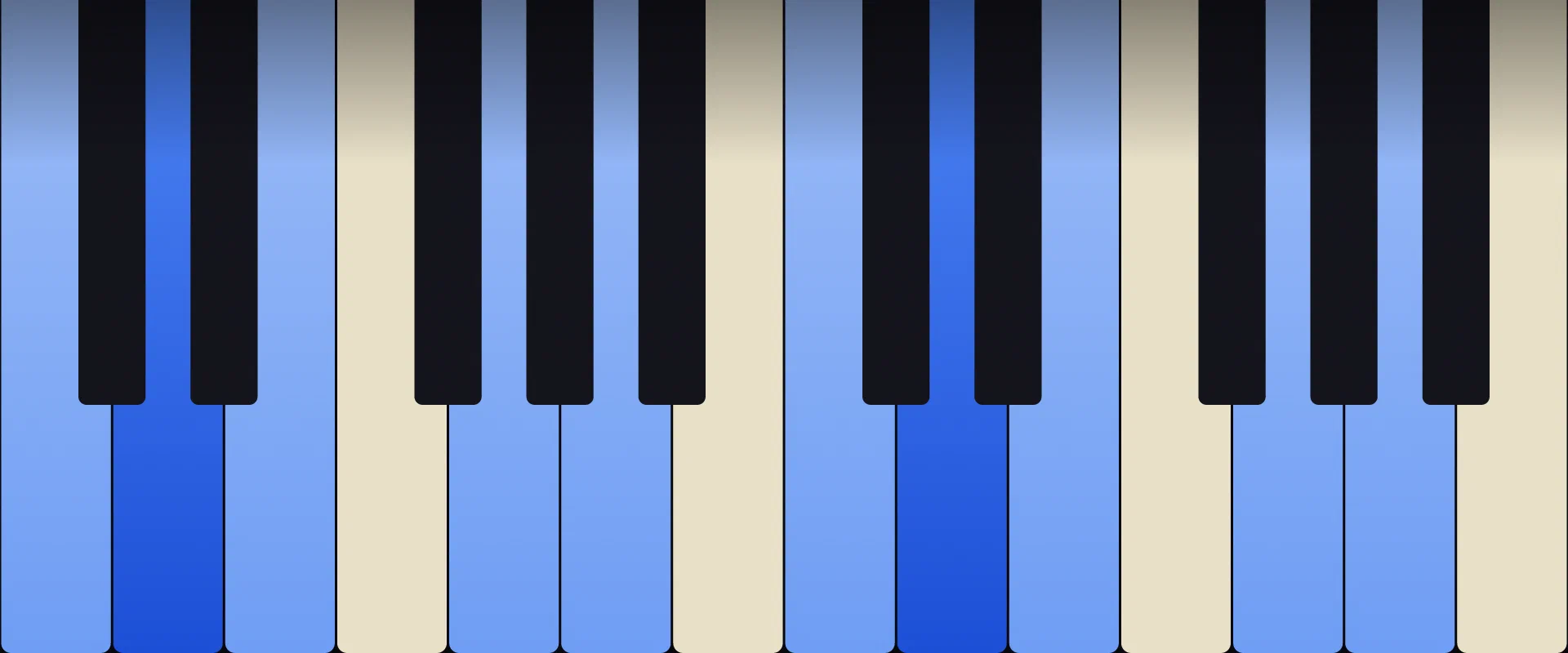
Take the A minor pentatonic scale, the first scale most guitarists ever learn, and sound all five of its notes at once over a D in the bass. That is this chord, complete. A, C, D, E and G are the pentatonic box note for note, and read from D they are the root, fifth, minor seventh, ninth and eleventh. Nothing is added and nothing left over. The five notes are D, A, C, E and G, every one a white key, and the note that is absent is F♯. A dominant eleventh has no third, because a natural eleventh sits a semitone above the major third and the two will not share a chord.
Try It: D11 in the Chord Finder
Set the root to D, choose Mixolydian and switch the Eleventh toggle on. The tool stacks six diatonic thirds, so the F♯ it shows on the first degree is exactly the third the written symbol leaves out. Choosing A and Minor Pentatonic is the quicker demonstration: the five notes lit on the keyboard are this chord entire.
The Notes of D11
| Degree | Note | Interval from root | Semitones |
|---|---|---|---|
| 1 (root) | D | Perfect unison | 0 |
| 5 | A | Perfect 5th | 7 |
| ♭7 | C | Minor 7th | 10 |
| 9 | E | Major 9th | 14 |
| 11 | G | Perfect 11th | 17 |
Written out: D, A, C, E, G. Five rows and no third among them. The 14 and the 17 are placement instructions rather than interval names: the E is a whole tone above the root, the G a fourth above it, and both belong an octave higher than that. Sort the five into one octave and no two of them come closer than a whole tone, so there is not a single semitone anywhere in D11.
How D11 Is Built
Start from D9, which is D, F♯, A, C and E, and put a G on top. The G lands a semitone above the F♯, so one of them has to go, and since the eleventh is the note you came for, the third leaves.
What is left is a suspension. D, G, A and C is Dsus4 with a minor seventh in it, and the E sits as a ninth on top. This is why most arrangers write D7sus4 or D9sus4 instead of D11: the symbol with the eleventh in it promises a third that never arrives, while the sus spelling says out loud what the hand is doing.
Read the same five notes from the second one up and something practical appears. A, C, E and G are Am7 in root position, so D11 is Am7 with a D underneath, which is how both instruments voice it and how a chart often writes it, as Am7/D. Read them from the C and they spell a six-nine chord on C. Stack them from the E instead and you get E, A, D, G, C, four perfect fourths in a row, which happen to be the guitar’s four lowest open strings with one note added on the end.
D11 on the Piano
Not one black key. D11 is one of only three dominant elevenths lying entirely on the white keys, the other two being the chords on G and on A, and every remaining root needs an accidental. A beginner can find all five notes here without knowing what a sharp is.
One hand cannot hold them. D up to G is a perfect eleventh, seventeen semitones, with three notes standing inside it. Give the D to the left hand alone and the right is left with A, C, E and G, which spans a minor seventh and sits under thumb, index, middle and little finger. That right hand is Am7 in root position, a shape most players own already from C major or A minor, so learning this chord at the keyboard is mostly a matter of putting a familiar grip over a strange bass note.
Because the chord holds no semitone, there is no bad voicing of it. Spread the right hand as C, E, G and A, or double the G on top: nothing clouds. Chords this size normally punish a low left hand, and this one does not, so the D can sit an octave lower than you would risk with D9.
D11 on the Guitar
The standard chord books print no open form for D11. They are wrong to, and the reason sits under your fingers before you fret anything. The open strings are E, A, D, G, B and E, and the four lowest of those are the ninth, the fifth, the root and the eleventh of this chord. Only the B is a stranger, and the one note missing, the C, lives on that same second string at the first fret.
So the whole chord is one finger. x x 0 0 1 0 sounds D, G, C and E: root, eleventh, minor seventh, ninth, root in the bass, no fifth, which is the first note any extended chord gives up.
Come at it from the open D7, x x 0 2 1 2, and the logic is plainer. Two of those fretted notes are the third and the fifth, F♯ on the first string and A on the third. Lift both fingers and the open strings supply E and G in their place, the ninth and the eleventh. The third this chord cannot have is the note you are letting go of.
Let the fifth string ring as well and x 0 0 0 1 0 gives all five notes, at the cost of putting the A in the bass.
Higher up the movable forms are ordinary. A flat barre across the fifth fret, x 5 5 5 5 5, gives D, G, C, E and A: one finger again, all five notes, root on the fifth string. The sixth string form sits at the tenth fret, 10 12 10 12 10 12, where the frets are cramped and three fingers stand two frets above a full barre.
Inversions
| Inversion | Notes | Bass | Symbol |
|---|---|---|---|
| Root position | D A C E G | D | D11 |
| 1st inversion | A C E G D | A | D11/A |
| 2nd inversion | C E G D A | C | D11/C |
| 3rd inversion | E G D A C | E | D11/E |
| 4th inversion | G D A C E | G | D11/G |
A chord with no third has no strong opinion about which note sits on the bottom, so these are less inversions than renamings. Over A the five notes are Am7 with an eleventh added. Over C they are a six-nine chord in root position and do not sound inverted at all. Over G they read as a suspended G with a ninth and a sixth, the drone at the end of a folk tune. See Chord Inversions and Voice Leading.
Voicings
Keep the G somewhere audible. It is the note that turns D9 into D11, and if it ends up buried under the E nobody hears the difference.
| Shape | Frets | Result |
|---|---|---|
| D11 | x x 0 0 1 0 | Open, one finger, no 5th |
| D11 | x 0 0 0 1 0 | All five notes, 5th in the bass |
| D11 | x 5 5 5 5 5 | Flat barre at the 5th fret |
| D11 | 10 12 10 12 10 12 | Sixth string root, cramped |
| D7sus4 | x x 0 0 1 3 | The same chord without the 9th |
| D9 | x 5 4 5 5 x | The chord it grows out of |
Which Keys Contain D11
- I of D mixolydian
- V of G major
- II of C major
- I of D dorian
- I of D natural minor
- IV of A natural minor
- rooted on degree 3 of, and entirely inside, A minor pentatonic
- rooted on degree 2 of, and entirely inside, C major pentatonic
Look at the fourth and fifth rows together. The same chord is the tonic of D dorian and of D natural minor, and it is also the dominant of G major. A chord with no third can do that, because it takes no side. The one key on D it will not fit is D major itself: the C here is natural, and D major wants C♯. No harmonic minor appears at all, in any of the twelve keys, since the raised seventh of every candidate sharpens one of these five notes.
Where D11 Shows Up
| Progression | Chords | Context |
|---|---|---|
| ii V I (G major) | Am7, D11, Gmaj7 | The bass moves, the hand does not |
| V11 V7 I (G major) | D11, D7, G | The suspension breaks |
| I vamp (D mixolydian) | D11, C, D11 | Folk rock, fiddle tunes |
| Turnaround (D dorian) | Dm9, D11, Dm9 | The third comes and goes |
The first row is the one to steal. Am7 and D11 share the same four upper notes, so a keyboard player holding A, C, E and G moves from the two chord to the five chord by telling the bass player to drop from A to D. The whole ii V is one shape. Then the arrival: C falls to B, G falls to F♯, and G major appears.
The second row is that same F♯ arriving late. Let the G slide down to F♯ and the chord becomes plain D7 with nothing else moving, the sound of every gospel cadence that hangs on the dominant before it gives in. On guitar it is x x 0 0 1 0 to x x 0 2 1 2, two fingers going back down.
The last two rows are why this chord lives where it lives. D with a C natural is D mixolydian and D dorian territory: folk rock, Irish and old time fiddle music, modal jazz. D is the home key of the fiddle and of the guitar’s open strings alike, so the drone underneath costs nothing on either. And the chord is the A minor pentatonic scale, so every note in the box a guitarist learned first is a chord tone.
Related Chords
- D Dominant 9th Chord, the chord this one comes from, F♯ and all
- D Sus4 Chord, the same G standing in for the same F♯
- A Minor 7th Chord, what the top four notes spell on their own
- D Dominant 7th Chord, where the suspension resolves
- D Minor 7th Chord, the other common way to put a C natural over D
- Suspended Chords: sus2, sus4 and Tension for why a fourth behaves like this
Learn More
Practice Chords
Drill chord recognition with a metronome, MIDI support, and score tracking.
Start Practicing