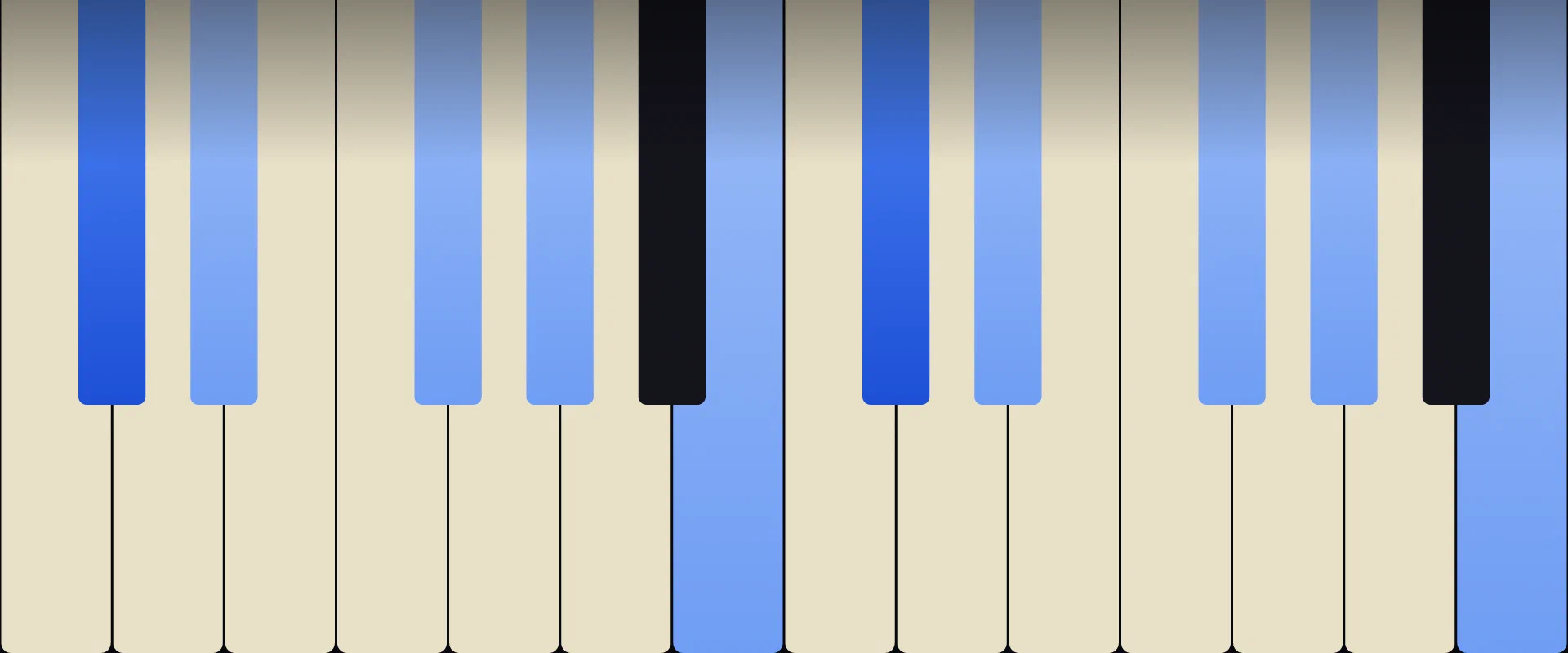
Put a capo on the 4th fret of a guitar, strum all six strings open and listen. That is this chord. Every string lands on a chord tone: G♯, C♯, F♯, B, D♯ and G♯ again, which is the fifth, the root, the eleventh, the minor seventh, the ninth and the fifth. The five notes of C♯11 are C♯, G♯, B, D♯ and F♯, and the surprise for most readers is what is not in that list. There is no E♯. A dominant eleventh is written without its third, because a natural eleventh sits one semitone above the major third and the two will not share a chord.
Try It: C♯11 in the Chord Finder
Set the root to C♯, choose Mixolydian and turn the Eleventh toggle on. The chord on the first degree is this one. Then switch to C♯ Dorian and look again: the first degree gives the same five notes, because nothing in the chord touches the third.
The Notes of C♯11
| Degree | Note | Interval from root | Semitones |
|---|---|---|---|
| 1 (root) | C♯ | Perfect unison | 0 |
| 5 | G♯ | Perfect 5th | 7 |
| ♭7 | B | Minor 7th | 10 |
| 9 | D♯ | Major 9th | 14 |
| 11 | F♯ | Perfect 11th | 17 |
Written out: C♯, G♯, B, D♯, F♯. Four of the five carry a sharp and all four of those are black keys. B is the only white key in the chord, and no accidental here lands anywhere surprising, which is not something every sharp root can claim.
The 14 and the 17 in the last two rows are placement instructions rather than interval names. D♯ is a whole tone above the root and F♯ is a perfect fourth above it, and both belong an octave higher than that, above the seventh.
How C♯11 Is Built
Start from C♯9, which is C♯, E♯, G♯, B and D♯. Add F♯ on top and the E♯ underneath has to go. F♯ against E♯ is a minor ninth, the harshest interval in tonal music, and no amount of spacing makes it sound deliberate. Take the E♯ out and the chord is suddenly stable.
What is left is worth naming properly. C♯, F♯, G♯ and B is C♯sus4 with a seventh on it, a C♯7sus4, and D♯ is a ninth sitting above that. Arrangers who want this sound usually write C♯7sus4 or C♯9sus4 rather than C♯11, because those symbols say out loud what the eleven leaves a player to work out. See Suspended Chords: Sus2, Sus4 and Tension.
There is a shorter description still. G♯, B, D♯ and F♯ spell G♯m7 exactly, so this chord is a G♯ minor seventh with C♯ underneath it. Drop the G♯ as well and the remaining B, D♯ and F♯ are a plain B major triad, which is why pop charts often write this chord as B/C♯ and leave it at that.
C♯11 on the Piano
The hand sits high, on the raised black key plateau, and that is the whole story of this chord at the keyboard. C♯, G♯, D♯ and F♯ are all black keys and only the B is down on the white level, so the fingers work above the front edge of the keyboard rather than in and out of it.
Give C♯ to the left hand on its own. The right hand then holds G♯, B, D♯ and F♯, a span of ten semitones that falls comfortably under thumb, index, middle and little finger. That right hand is G♯m7 in root position, a shape most players already own from working in B major or G♯ minor, so learning C♯11 at the piano means placing a familiar grip over an unfamiliar bass note.
Thumb on the black G♯ feels wrong for a week and then stops mattering, because the fingers above it are on black keys too and the whole hand sits at one height. If it still bothers you, take G♯ into the left hand and play B, D♯ and F♯ alone in the right: a plain B major triad, and the chord loses nothing a listener will miss.
C♯11 on the Guitar
This is one of the easiest extended chords on the instrument and one of the least known. Lay the index finger flat across all five upper strings at the 4th fret and stop: x 4 4 4 4 4 sounds C♯, F♯, B, D♯ and G♯, which is the complete chord, root, eleventh, seventh, ninth and fifth, from a single finger. The same shape at the nut, x 0 0 0 0 0, is an A11, so this is nothing more exotic than the open strings moved up four frets.
The 4th fret is a friendly place for it. Down here the string tension is high enough that a flat finger gets a clean note out of all five strings, and the frets are wide enough that the barre does not have to be precise.
An open form does not exist, for a concrete reason: of the six open strings only B belongs to C♯11. That single open B is the seventh, and some players keep it ringing while fingering the rest higher up.
The six string form at the 9th fret is a real barre and worth having. 9 9 9 11 9 11 puts the root in the bass and again contains all five notes: index flat across the 9th fret, ring finger on the third string at the 11th, little finger on the first string at the 11th. Up here the frets are cramped and the two stretched fingers sit close together, which suits some hands and not others. The CAGED logic behind both shapes is in Guitar Chord Shapes: The CAGED System.
Inversions
| Inversion | Notes | Bass | Symbol |
|---|---|---|---|
| Root position | C♯ G♯ B D♯ F♯ | C♯ | C♯11 |
| 1st inversion | G♯ B D♯ F♯ C♯ | G♯ | C♯11/G♯ |
| 2nd inversion | B D♯ F♯ C♯ G♯ | B | C♯11/B |
| 3rd inversion | D♯ F♯ C♯ G♯ B | D♯ | C♯11/D♯ |
| 4th inversion | F♯ C♯ G♯ B D♯ | F♯ | C♯11/F♯ |
Treat most of these as description rather than instruction, since a voice usually moves before a bass note does. Two rows repay hearing. C♯11/G♯ hardly sounds like a C♯ chord at all: with G♯ underneath, the ear hears G♯m7 with an added fourth and files the C♯ as colour. C♯11/F♯ is a different chord in practice: read from F♯, the notes are a root, a fifth, a ninth, a fourth and a sixth, and the ear files it as F♯ resting rather than C♯ leaning. More on this in Chord Inversions and Voice Leading.
Voicings
Keep F♯ high. It is the note that separates this chord from every other dominant on C♯, and buried in the middle it just sounds like a thickened seventh.
| Shape | Frets | Result |
|---|---|---|
| C♯11 | x 4 4 4 4 4 | One finger, all five notes |
| C♯11 | 9 9 9 11 9 11 | Barre at fret 9, all five notes |
| C♯11 | x 4 4 4 4 x | Four notes, no 5th |
| C♯11 | x x 4 4 4 4 | Rootless, for a band with a bass |
| C♯sus4 | x 4 6 6 7 4 | The triad underneath |
| C♯9 | x 4 3 4 4 x | The same chord with its 3rd |
Which Keys Contain C♯11
- degree 5 of F♯ major
- degree 2 of B major
- degree 6 of E major
- degree 1 of C♯ mixolydian
- degree 1 of C♯ dorian
- degree 4 of G♯ natural minor
The second and fifth rows are the useful ones. Because the chord has no third, it fits places a dominant seventh could never go. In B major the second degree carries a minor chord, and C♯11 sits there without complaint, since the E natural that makes C♯ minor is simply not one of the five notes. C♯ Dorian tells the same story from the other end.
One more entry is worth reading, in E♭ natural minor, where these five sounds turn up as the chord on the seventh degree spelled D♭, A♭, C♭, E♭ and G♭. Identical pitches, different names, chosen so the page can stay inside a flat key signature.
Where C♯11 Shows Up
| Progression | Chords | Context |
|---|---|---|
| ii V I (F♯ major) | G♯m7, C♯11, F♯maj7 | Nothing moves at the top |
| V held (F♯ major) | C♯11, C♯9, F♯ | The suspension resolves late |
| II vamp (B major) | C♯11, B, C♯11 | Neo soul, gospel |
| I IV of C♯ Dorian | C♯11, F♯7 | Modal, no resolution wanted |
Follow F♯ through the first row. It is the seventh of G♯m7, the eleventh of C♯11 and the root of F♯maj7, so a top voice can hold that single note across the whole cadence. The arrival still arrives, and nothing above announces it. That restraint is exactly why this chord ends verses in gospel and soul where a plain C♯7 would sound like a door slamming. The full mechanics are in The ii V I Progression.
The second row is the classic use and the reason the chord exists. Play C♯11, then move F♯ down to E♯ and you have C♯9, a proper dominant with a third in it, and only then go to F♯. One chord has become a two stage approach, tension arriving after the bass has already settled on the dominant. Organ players in church music do this several times a minute.
For a soloist there is a shortcut here that is hard to better. The five notes of C♯11 are exactly the five notes of B major pentatonic, so a guitarist who plays that scale over this chord cannot hit a wrong note, and every note landed on is a chord tone rather than a passing one. See Pentatonic Scales for Improvisation. The same set read from B is a B six nine chord, so whether this is C♯ leaning or B resting is decided entirely by the bass player.
Related Chords
- C♯ Dominant 9th Chord, the same chord with its 3rd restored
- C♯ Sus4 Chord, the triad hiding underneath this one
- C♯ Dominant 7th Chord, the plain version this softens
- C♯ Minor 9th Chord, four notes shared, E instead of F♯
- C♯ Add9 Chord, a D♯ with no seventh below it
- Extended Chords and Jazz Harmony for why the 11th and the 3rd cannot both stay
Learn More
Practice Chords
Drill chord recognition with a metronome, MIDI support, and score tracking.
Start Practicing