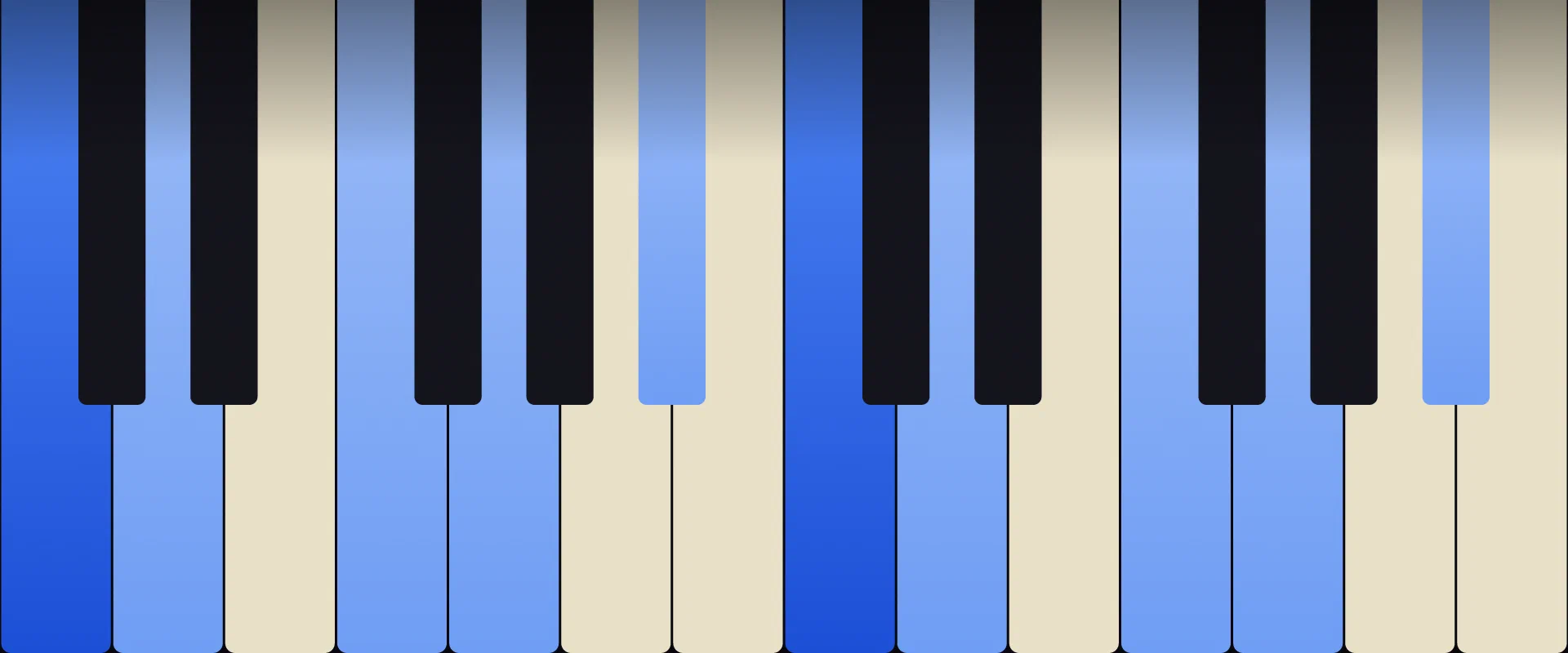
There is no E in this chord. C11 is C, G, B♭, D and F, and the major third that C7, C9 and C13 all insist on is simply absent. That is not an oversight to apologise for. The 11th of C is F, and F stands a semitone above E. Voice the F where an 11th belongs, an octave above the third, and the pair is a minor 9th apart, the one interval between chord tones that arrangers treat as a mistake. So the spelling keeps the 11th and drops the third.
What remains is better than the arithmetic suggests. Lift the C away and the four notes left, G, B♭, D and F, are a G minor 7th chord in root position. Put the C back underneath and none of them moves; only the bass decides whether the chart reads C11 or Gm7. Many arrangers write it a third way, as C9sus4, or as C7sus when the ninth is left to the player. Every one of those names warns the pianist not to hunt for a third.
Try It: C11 in the Chord Finder
Set the root to C and switch the Eleventh toggle on. The chord that appears on the first degree of C mixolydian is this one. Move to C dorian and it survives unchanged, which is the whole point of a chord with no third in it.
The Notes of C11
| Degree | Note | Interval from root | Semitones |
|---|---|---|---|
| 1 (root) | C | Perfect unison | 0 |
| 5 | G | Perfect 5th | 7 |
| ♭7 | B♭ | Minor 7th | 10 |
| 9 | D | Major 9th | 14 |
| 11 | F | Perfect 11th | 17 |
Written out: C, G, B♭, D, F. There is no row for the third, and no row is missing. B♭ is the only accidental and it lands on a black key, so nothing here has to be respelled. The 14 and the 17 are placement instructions rather than interval names: D is a whole tone above the root and F a perfect fourth above it, and both belong an octave higher than that.
Squeeze the five notes into one octave and they read C, D, F, G, B♭, which is the B♭ major pentatonic scale in full. A pentatonic scale holds no semitone, so neither does this chord: its closest two notes stand a whole tone apart. That is why five simultaneous notes sound clean rather than crowded.
How C11 Is Built
Begin with C9: C, E, G, B♭ and D. Stack one more third on the D and you arrive at F, and the moment F appears the E has to leave. Nothing else changes, and the chord keeps its dominant quality because that quality was never carried by the third alone.
Read from the bottom, what is left is a suspension that never resolves. C, F and G are Csus4; add the B♭ and you have C7sus4; add the D and you have C9sus4, which is the same five notes the symbol C11 stands for. One four note chord lives inside it and answers to two names. G, B♭, D and F are Gm7, and the same four notes read from B♭ are B♭6, so either shape placed over a C gives this chord back. Extended Chords and Jazz Harmony covers why the 11th is the one extension that has to displace something to get in.
C11 on the Piano
B♭ is the only black key involved, which makes this one of the friendlier five-note shapes to find. Give the C to the left hand on its own and the right hand is left with G, B♭, D and F, a span of ten semitones that sits under thumb, index, ring finger and little finger without any stretch. Only the index reaches in to a black key.
That right hand is Gm7 in root position, a shape most players already have from working in B♭ major or G minor. Learning C11 at the keyboard is therefore not learning a new grip, it is learning to put a familiar grip over an unfamiliar bass note and to trust that the missing third will not be missed.
Two rearrangements earn their practice time. B♭, D, F, G lifts the ninth to the top and is the brightest rotation. The other moves work to the left hand: hold C and G down there and play a plain B♭ major triad above, B♭, D and F. A chart writes that as B♭/C, and it is the voicing for when the arrangement wants a suspension rather than an extension.
C11 on the Guitar
This is the chord that rewards a guitarist for learning nothing at all. Mute the low E string, lay the index finger flat across the other five at the 3rd fret, and the strings sound C, F, B♭, D and G. That is every note of C11, from one finger, in open position. Let the barre take all six strings instead and 3 3 3 3 3 3 puts a G below the C, which is fine under a held melody note and weak as an arrival.
Higher up the neck the E form costs far more. At the 8th fret the complete chord is 8 10 8 10 8 10: the index barres the 8th while the middle, ring and little fingers each stand on the 10th on the fifth, third and first strings. Nothing is missing there, but the hand does six times the work of the 3rd fret barre for the same five notes.
The standard books carry no open form for this root, but the open strings help more than that implies. D and G are chord tones and both are open strings, so x 1 0 0 1 1 sounds B♭, D, G, C and F, all five notes, with three fingers at the 1st fret. The catch is underneath: with B♭ in the bass the ear hears B♭6/9 rather than C11, which is what the next section is about.
Inversions
| Inversion | Notes | Bass | Symbol |
|---|---|---|---|
| Root position | C G B♭ D F | C | C11 |
| 1st inversion | G B♭ D F C | G | C11/G |
| 2nd inversion | B♭ D F C G | B♭ | C11/B♭ |
| 3rd inversion | D F C G B♭ | D | C11/D |
| 4th inversion | F C G B♭ D | F | C11/F |
Three of these bass notes give a symbol a working musician would actually write. Over C it is C11. Over G the notes read as Gm7 with a C on top, which charts spell Gm7add11. Over B♭ they are B♭, D, F, G and C, which is B♭6/9, one of the standard ways to end a piece in B♭.
So this is not a rare chord needing an introduction. It is a chord most players already finish tunes with, heard from a different bass note. Move a bass line from B♭ up to C under a held right hand and the harmony changes function while no upper voice moves at all. See Chord Inversions and Voice Leading.
Voicings
| Shape | Frets | Result |
|---|---|---|
| C11 | x 3 3 3 3 3 | One finger, all five notes |
| C11/G | 3 3 3 3 3 3 | Full barre, 5th in the bass |
| C11 | x 3 3 3 3 x | Four notes, no 5th |
| C11 | 8 10 8 10 8 10 | E form, all five, hard work |
| C11/B♭ | x 1 0 0 1 1 | Open strings, ♭7 in the bass |
| Csus4 | x 3 3 0 1 1 | The suspension underneath it |
Which Keys Contain C11
- V of F major
- II of B♭ major
- I of C mixolydian
- I of C dorian
- I of C natural minor
- IV of G dorian
Look at rows three, four and five. C mixolydian has an E, C dorian and C natural minor have an E♭, and the chord is at home in all of them because it declines to take a third from any. A chord that names its third has to choose a side; this one never does, which is why it turns up under a soloist about to change key and under a singer whose next note is undecided.
Simpler still, the chord’s own five notes make a scale. B♭ major pentatonic is exactly them, G minor pentatonic is the identical set from another root, and G blues adds one passing note. Play any of the three over this chord and nothing can land wrong.
Where C11 Shows Up
| Progression | Chords | Context |
|---|---|---|
| ii V I in F major | Gm7, C11, Fmaj7 | The V refuses to lead |
| Gospel cadence | C11, C7, F | F falls to E, then it resolves |
| Modal vamp in C dorian | Cm7, C11 | Nothing pulls, by design |
| Written as a slash | Gm7/C, B♭6/C | How it reaches the music stand |
In F major, C is the fifth degree, and C7 is the chord theory expects there: its E is the leading note of the key and its B♭ leans down onto A. C11 keeps the B♭ and throws the leading note away, so the cadence arrives without having been announced. Film and library writers use exactly this when a phrase has to end without sounding like an ending.
The gospel row is worth learning as a physical move. Hold the five notes, then let the F drop a semitone to E. Nothing else changes, the chord is now C7, and the cadence refused a bar ago happens on schedule. Organists do this several times a minute.
The vamp row is where the chord lives most of the time. In C dorian this is the tonic and there is nothing to manage: the bass holds C, the keyboard holds all five notes, and the music moves by melody rather than by harmony. Soul jazz built whole records on that. The last row is about reading rather than harmony, since a rhythm section takes in a slash chord faster than a number.
Related Chords
- C Dominant 9th Chord, the chord this one extends, third still in place
- C Dominant 7th Chord, the four note core before any extension
- C Sus4 Chord, C, F and G, the suspension at the heart of it
- G Minor 7th Chord, the four notes standing above the root
- B♭ Major 6th Chord, the other four note chord living inside it
- C Minor 9th Chord, swap the F for an E♭ and the chord takes sides
Learn More
Practice Chords
Drill chord recognition with a metronome, MIDI support, and score tracking.
Start Practicing