Below the fifth fret this chord does not exist. Not awkward, not a stretch: there is no arrangement of the first four frets that sounds B♭, D♭, F, A♭ and C with B♭ at the bottom. The movable minor 9th shape wants its ♭3 on the fourth string one fret below the root, and with the root at fret 1 that fret is behind the nut.
Nothing arrives free either. The open strings give E, A, D, G and B, and this chord uses none of the five. Its major sibling on this root uses two of them. B♭m9 gets a barre at fret 6.
Try It: B♭m9 in the Chord Finder
Sound the minor triad on B♭, then the 7th, then add C on top.
The Notes of B♭m9
B♭m9 has five notes: B♭, D♭, F, A♭ and C.
| Degree | Note | Interval from B♭ | Semitones |
|---|---|---|---|
| 1 (root) | B♭ | Perfect unison | 0 |
| ♭3 | D♭ | Minor 3rd | 3 |
| 5 | F | Perfect 5th | 7 |
| ♭7 | A♭ | Minor 7th | 10 |
| 9 | C | Major 9th | 14 |
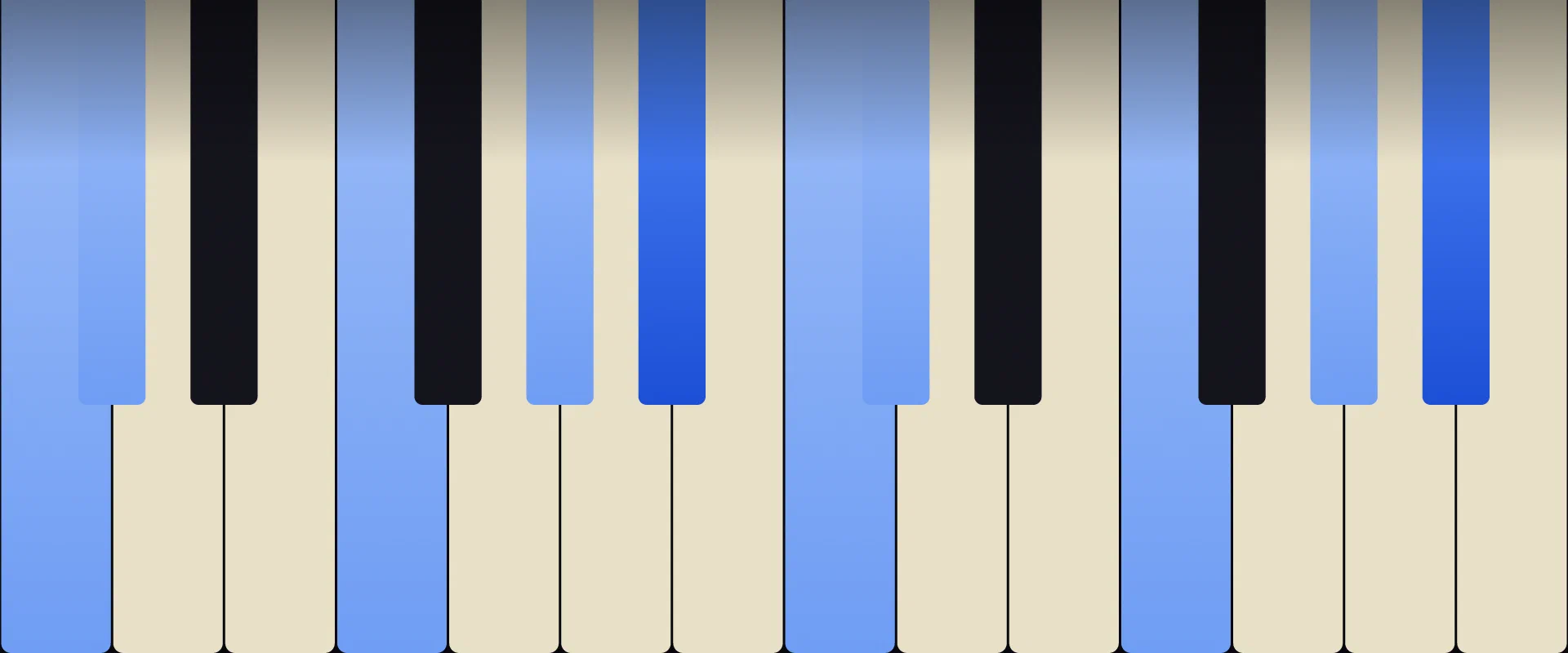
Three black keys, B♭, D♭ and A♭, and two white.
How B♭m9 Is Built
Stack C a major 9th above B♭m7 and you are done. C is the second degree of B♭ minor, so it was in the key already; putting it inside the tonic chord is the only change.
Set it against B♭9 and the distance is one note. That chord is B♭, D, F, A♭ and C; this one flattens the D. A single semitone turns a chord that has to resolve into one that can sit still for eight bars.
Take out the root and D♭, F, A♭ and C is a D♭maj7, the tonic seventh of B♭ minor’s relative major. That identity does most of the work in the voicings below, and Extended Chords: Which Tensions Work explains why rootless shapes hold up at all.
B♭m9 on the Piano
This is a hand position rather than a stretch. Going up, the chord alternates B♭ black, D♭ black, F white, A♭ black, C white, so the fingers that want to be forward on the keys get the black notes and the short ones stay out at the edge.
Split it in two. Left hand takes B♭ and F, a fifth apart. Right hand takes D♭, F, A♭ and C with fingers 1, 2, 3 and 5, thumb on the lower key of the two black group and the middle finger on A♭. That is a D♭maj7, and it is the shape to practise until it needs no thought, because it is the whole chord above the bass.
For one hand, drop F. B♭, D♭, A♭ and C put three black keys under fingers 1, 2 and 4 and leave only the top note white, so the hand sits further into the keyboard than any white key ninth asks for. Pianists tend to find that more comfortable, not less, which is part of why B♭ minor has the repertoire it does: Chopin’s second sonata and the first of the Op. 9 nocturnes both live here.
B♭m9 on the Guitar
The home position is the 6th fret, using the Em9 shape. Play 6 8 6 6 6 8: a full barre at fret 6, ring finger on the fifth string at fret 8 and little finger on the top string at fret 8. All five notes, one doubled 5th.
Why nothing lower works comes down to one string. With the root on the fifth string at fret 1, the only D♭ within reach is on the second string at fret 2, and the only C is on that same string at fret 1. The chord needs both, and one string gives one note. That is also why B♭m7 is so cheap down there and its ninth is impossible: the 7th chord needs only the D♭.
There is one first position curiosity. 4 3 3 3 2 1 does contain all five notes, but its lowest is A♭, so what you have is the third inversion, and it costs all four fingers with the ring finger flattened across three strings.
For comping, cut the barre down. x x 6 6 6 8 gives A♭, D♭, F and C, three strings at fret 6 with the little finger at fret 8, and it is the D♭maj7 from the piano section on four strings. The fifth string shape that failed at fret 1 does exist an octave up, at x 13 11 13 13 13. Guitar Chord Shapes and the CAGED System shows how the two regions connect.
Inversions
| Inversion | Notes | Bass note | Symbol |
|---|---|---|---|
| Root position | B♭ D♭ F A♭ C | B♭ | B♭m9 |
| 1st inversion | D♭ F A♭ C B♭ | D♭ | B♭m9/D♭ |
| 2nd inversion | F A♭ C B♭ D♭ | F | B♭m9/F |
| 3rd inversion | A♭ C B♭ D♭ F | A♭ | B♭m9/A♭ |
| 4th inversion | C B♭ D♭ F A♭ | C | B♭m9/C |
First inversion changes the chord’s allegiance. With D♭ at the bottom the shape is a D♭maj7 and the B♭ above it becomes that chord’s 6th, so a listener hears the relative major rather than the minor tonic. Arrangers use it for exactly that softening.
Second inversion is the walking option: F in the bass alters nothing above it.
Third inversion is where the guitar lands in first position, and the fourth is the interesting one. C at the bottom gives C, D♭, F, A♭ and B♭, a C7sus with a ♭9 and a ♭13, the flamenco sounding chord that falls back to B♭. See Chord Inversions and Voice Leading.
Voicings
D♭ F A♭ C is the rootless chord, and naming it D♭maj7 is the fastest way to remember it under pressure.
B♭ D♭ A♭ C keeps the root and drops F, which is the four note version for a player with no bass underneath. D♭ and A♭ carry the quality, so they stay whatever else goes.
Spacing follows one rule here: C on top and D♭ well below it, since those two are the chord’s only semitone. The pillar above sets out the general principles.
Which Keys Contain B♭m9
- I of B♭ natural minor
- I of B♭ dorian
- II of A♭ major
- VI of D♭ major
- IV of F natural minor
- IV of F harmonic minor
The first two are the reason this chord is so useful as a vamp. B♭ natural minor and B♭ dorian differ by one note, G♭ against G natural, and that note is not in the chord. So the tonic 9th chord will not tell anyone which of the two modes is running. Whatever follows it does.
The pair of F minor entries behave the same way. Raising the 7th degree of F minor to E natural turns natural minor into harmonic minor and leaves this chord untouched, because E is not one of its five notes. The iv is the one place in that key where the harmonic raise costs nothing.
D♭ major is B♭ minor’s relative major, so its VI is the D♭maj7 from the voicings section written out as a scale.
Where B♭m9 Shows Up
Start with the two chord vamp, because it is where the 9th earns its place. Alternate:
B♭m9 | E♭9 | B♭m9 | E♭9
E♭9 is E♭, G, B♭, D♭ and F, so three of its notes are already sounding: B♭, D♭ and F stay, and only two voices need to move. The G natural is the whole point. It is the raised 6th degree of B♭, so the pair of chords announces B♭ dorian rather than B♭ minor. Swap in E♭m7 and the same tonic chord suddenly reads as natural minor without altering a note of it.
As a functional chord it is most often the ii of A♭ major:
B♭m9 | E♭9 | A♭maj7
The same three common tones carry it into the dominant, and A♭ and C then hold over into the tonic, so a whole cadence passes with barely a voice jumping. That is why the 9th gets added to a ii chord more often than to the chord it resolves to.
The third home is the minor blues in F, where this is the iv chord arriving in bar five. Against Fm7 it shares A♭ and C, so the change lands as a lift rather than a move, and the C on top is what keeps a slow F minor blues from sounding funereal.
B♭ minor is a pianist’s key and a guitarist’s detour. Guitarists tend to capo at the first fret and play A minor shapes instead. Knowing the fret 6 barre and the D♭maj7 above the root is most of what it takes to stop transposing away from it.
Related Chords
- B♭ Minor 7th Chord, the four notes underneath, before C arrives.
- B♭ Minor Chord, the triad at the centre of all of it.
- B♭ Dominant 9th Chord, the same five degrees with D natural instead.
- Extended Chords: Which Tensions Work, on rootless voicings and dropped notes.
Learn More
Practice Chords
Drill chord recognition with a metronome, MIDI support, and score tracking.
Start PracticingRelated Articles
A Minor 9th Chord: Notes, Voicings, and How to Play It
Sep 5, 2026 · 9 min
A♭ Minor 9th Chord: Notes, Voicings, and How to Play It
Sep 5, 2026 · 8 min
B Minor 9th Chord: Notes, Voicings, and How to Play It
Sep 5, 2026 · 8 min