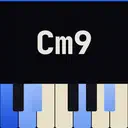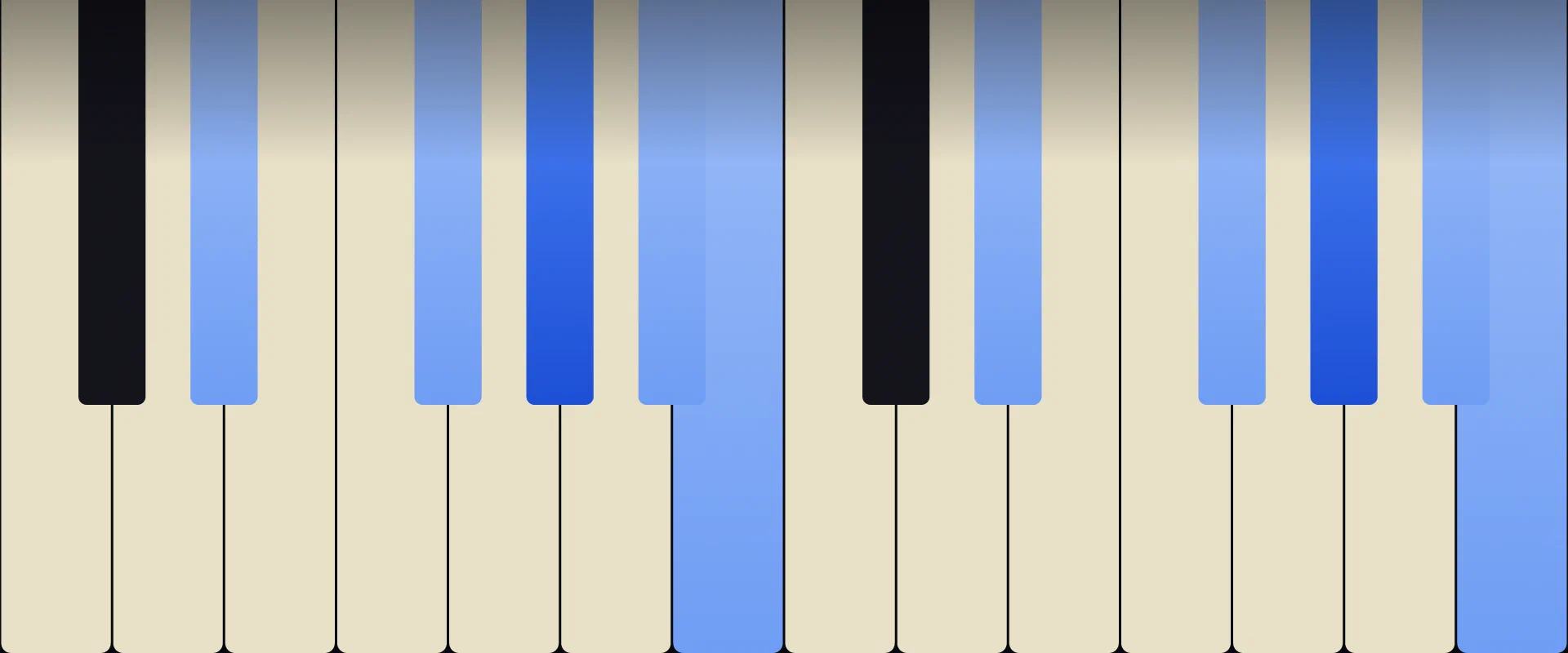
Five notes, five flats, and one of them is played on a white key. A♭m9 is A♭, C♭, E♭, G♭ and B♭, and four of those are ordinary black keys wearing the name you would expect. The odd one is C♭, which sounds on the white key B and sends most readers back to the keyboard to check.
The ninth is not the culprit. B♭ is a black key and a plain flat, so adding it to A♭m7 raises the accidental count without touching the problem. What it raises along with it is the temptation. A player looking at five flats wants to rewrite the one note that looks wrong, and that is the one thing this spelling will not allow.
Try It: A♭m9 in the Chord Finder
The Notes of A♭m9
| Degree | Note | Interval from root |
|---|---|---|
| 1 | A♭ | Perfect unison |
| ♭3 | C♭ | Minor 3rd, 3 semitones |
| 5 | E♭ | Perfect 5th, 7 semitones |
| ♭7 | G♭ | Minor 7th, 10 semitones |
| 9 | B♭ | Major 9th, 14 semitones |
Written low to high in root position: A♭ C♭ E♭ G♭ B♭.
C♭ is played on the white key B. A chord built on a form of A has to take its third from a form of C, and the C three semitones above A♭ is C♭. The A♭ Minor Chord page makes that case in full.
Try to fix it in isolation and watch what happens. Write A♭ B E♭ G♭ B♭ and the chord carries two notes on the letter B, while A♭ up to B reads as an augmented 2nd rather than a minor 3rd, the wrong distance on paper for the sound it makes. Letters in a chord alternate, so the third cannot be renamed unless the root is, and once the root becomes G♯ the rest follow: G♯ B D♯ F♯ A♯.
That is the real choice. One note is uncomfortable and all five have to move to relieve it. The sharp version costs four accidentals instead of five, puts nothing awkward on a white key, and carries a far friendlier key signature: five sharps for G♯ minor against seven flats for A♭ minor. The reference here keeps the flats anyway, because the music that uses this chord is usually already in them.
How A♭m9 Is Built
A♭m7 is A♭ C♭ E♭ G♭ and B♭ sits on top of it, settling nothing about quality that the seventh chord had not already settled. The extended chords guide covers stacking and dropping in general.
Ignore the root and look at what is left. C♭, E♭, G♭ and B♭ are a C♭ major 7th, filed on this site under its sharp name, Bmaj7. The seventh chord hid a plain major triad inside itself; this one hides a major 7th, which is why A♭m9 sounds broad rather than mournful when everything about its name looks severe.
One note separates it from A♭9, which has C where this has C♭. Two separate it from A♭maj9, which has C and G. Root, fifth and ninth are common to all three.
A♭m9 on the Piano
Four black keys and one white, and the fingering follows from that ratio rather than from any rule about ninths. Left hand takes A♭ alone. Right hand takes C♭ E♭ G♭ B♭ with 1, 2, 4 and 5, thumb on the white key, everything else forward on black.
That right hand is the spelling problem made physical. The shape under the fingers is a major 7th chord, and any pianist who has worked in sharp keys knows it as Bmaj7. Here it is C♭maj7, the same four keys, and only the A♭ underneath and the name on the page have changed.
Keep B♭ at the top of that shape. B♭ and C♭ are neighbouring keys, black then white, so voicing the ninth near the third puts two adjacent keys in one handful and the chord turns opaque. Held a major 7th apart, as this grip does naturally, the pair is the reason for playing the chord at all.
If the left hand wants more than the root, give it G♭ rather than E♭: both black, a minor 7th apart, and the wide interval keeps the bottom clear.
A♭m9 on the Guitar
This is the cheapest complete ninth chord on the root. Bar the 4th fret, ring finger on the A string at the 6th, little finger on the top string at the 6th, and 4 6 4 4 4 6 sounds all five notes with the fifth doubled. Two fingers past the barre, where A♭9 needs three and A♭maj9 needs four.
One open string belongs to the chord, the second, which sounds B and is therefore the C♭. The full barre covers it, but a smaller shape lets it ring: 4 x 4 x 0 6, with A♭ on the low E string at the 4th fret, G♭ on the D string at the 4th, the B string open and B♭ on the top string at the 6th, the A and G strings muted by the fingers already down. Root, seventh, third and ninth over two octaves, and the note that makes the spelling awkward is the one the instrument gives away.
At the other end of the neck the chord joins its relatives. x 11 9 11 11 x is A♭m9 on four adjacent strings, root on the A string, no fifth. Raise the D string by a single fret and the third turns major: that is A♭9, the shape funk players use. The frets are cramped at the 11th, and the distance between the two chords is the width of one of them.
Inversions
| Inversion | Notes low to high | Bass note |
|---|---|---|
| Root position | A♭ C♭ E♭ G♭ B♭ | A♭ |
| 1st inversion | C♭ E♭ G♭ B♭ A♭ | C♭ |
| 2nd inversion | E♭ G♭ B♭ A♭ C♭ | E♭ |
| 3rd inversion | G♭ B♭ A♭ C♭ E♭ | G♭ |
| 4th inversion | B♭ A♭ C♭ E♭ G♭ | B♭ |
First inversion is the useful one and it has a second name. C♭ E♭ G♭ B♭ with A♭ above it is C♭maj7 carrying a 6th, so the bass note alone decides whether a listener hears a major chord or a minor one.
Fourth inversion is the one to leave alone. Put B♭ underneath and C♭ becomes a flattened 9th a semitone above the bass, harsher than anything the chord holds in root position.
Voicings
Drop the fifth. A♭, C♭, G♭ and B♭ carry the whole name and E♭ can be left to somebody else, which is what the 11th fret grip already does.
Drop the root as well and the rootless voicing is C♭maj7, the right hand shape described above.
Add D♭ for A♭m11. Swap G♭ for F instead and the chord becomes A♭m6/9, brighter and less settled, carrying the tritone that A♭m6 is built around.
Which Keys Contain A♭m9
- I of A♭ dorian
- IV of E♭ natural minor
- VII of B♭ phrygian
- II of F♯ major
- VI of B major
- IV of E♭ harmonic minor
The first four are one set of seven notes under two names. A♭ dorian, E♭ natural minor and B♭ phrygian are modes of G♭ major, and G♭ major is F♯ major with different letters, so that page spells the chord G♯ B D♯ F♯ A♯ and these ones spell it A♭ C♭ E♭ G♭ B♭. Same sounds throughout. The chord takes five of those seven notes and leaves D♭ and F, its eleventh and its thirteenth.
B major, where the chord is the sixth degree, belongs to the other collection and spells it in sharps too. Strip the root off A♭m9 and what remains, C♭maj7, is that key’s tonic chord written the other way round.
E♭ harmonic minor is the outlier. Raising the seventh degree of E♭ minor swaps D♭ for D, and the chord holds neither, so it survives intact. E♭ melodic minor is missing for a sharper reason: it raises the sixth degree from C♭ to C, and that is this chord’s third.
Where A♭m9 Shows Up
| Progression | In letters | Where it lives |
|---|---|---|
| i9, IV9 | A♭m9, D♭9 | Dorian vamp, neo soul and house |
| IV, iv9, I | A♭maj9, A♭m9, E♭maj7 | The minor fourth turn in E♭ |
| i9, iv9, ♭VImaj7, V7 | E♭m9, A♭m9, C♭maj7, B♭7 | Minor key ballad in E♭ minor |
Row one is the sound of a Rhodes on a loop. D♭9 is D♭ F A♭ C♭ E♭, so three notes carry over and two move, and neither chord is going anywhere. What makes A♭ dorian dorian is its raised sixth degree, F, and F lives in the D♭ chord rather than in the tonic, so the pair has to keep alternating for the mode to register at all.
Row two is a whole song’s worth of feeling in two chords, and on this root it can be seen as well as heard. A♭maj9 and A♭m9 share A♭, E♭ and B♭, all black. Going from one to the other, C steps down to the white key beside it, B, and G steps down on to a black one, G♭. Two fingers move, the frame holds, and the fourth degree of E♭ turns from bright to grieving.
Row three explains the harmonic minor entry above. E♭m9 to A♭m9 is i to iv with the ninth kept on both, and then C♭maj7 arrives, which is A♭m9 with the root removed, so the third chord barely changes the harmony. B♭7 forces the issue: its D natural comes from E♭ harmonic minor and pulls the whole thing home.
Related Chords
- A♭ Minor 7th Chord the four notes underneath, and the C♭ argument
- A♭ Major 9th Chord the same frame with C and G in place of C♭ and G♭
- A♭ Dominant 9th Chord one note away, C against C♭
- A♭ Minor 6th Chord F in place of G♭, and the A♭m6/9 that follows
- B Major 7th Chord the rootless voicing under its sharp name
- A♭ Dorian Scale the mode this chord is the tonic of
Learn More
Practice Chords
Drill chord recognition with a metronome, MIDI support, and score tracking.
Start PracticingRelated Articles
A Minor 9th Chord: Notes, Voicings, and How to Play It
Sep 5, 2026 · 9 min
B Minor 9th Chord: Notes, Voicings, and How to Play It
Sep 5, 2026 · 8 min
B♭ Minor 9th Chord: Notes, Voicings, and How to Play It
Sep 5, 2026 · 8 min