Adding one note to Gm7 costs the chord a key. E♭ major carries G, B♭, D and F on its third degree without complaint, but the note a ninth above that G is A♭ rather than A, so what E♭ major offers there is Gm7♭9, which the extended chords guide rules out over a minor seventh and nobody writes. Three flat keys hold Gm7. Two hold Gm9.
The note doing the deciding is A, and on this root it lands one semitone below the B♭ that makes the chord minor. Those two are the whole difficulty of playing it. Set them side by side in any register and the chord snarls; keep the A above the B♭ and it turns into the sound neo soul keyboard players have leaned on for decades.
Try It: Gm9 in the Chord Finder
The Notes of Gm9
| Degree | Note | Interval from Root | Semitones |
|---|---|---|---|
| 1 (Root) | G | Perfect unison | 0 |
| ♭3 | B♭ | Minor 3rd | 3 |
| 5 | D | Perfect 5th | 7 |
| ♭7 | F | Minor 7th | 10 |
| 9 | A | Major 9th | 14 |
Written Gm9, Gmin9 or G-9. One black key, B♭, and four white ones. The seventh is F natural and the ninth is a plain A, neither of them altered.
How Gm9 Is Built
Gm7 with A placed fourteen semitones above the root. That page finds a B♭ major triad sitting on top of the smaller chord; add the ninth and the triad becomes B♭maj7, since B♭, D, F and A is a major seventh chord in root position. Each tension pushes the same stack one third further up.
Compressed into a single octave the notes read G, A, B♭, D, F. Whole step, semitone, minor 3rd, minor 3rd, whole step. One adjacent pair in the whole chord, and it is the pair described above.
Set it beside the G minor pentatonic, which is G, B♭, C, D and F: five notes on the same root, with C where this chord has A. A rock guitarist in that box and a keyboard player comping Gm9 differ by one pitch, and it is the one that makes the chord sound like jazz.
Gm9 on the Piano
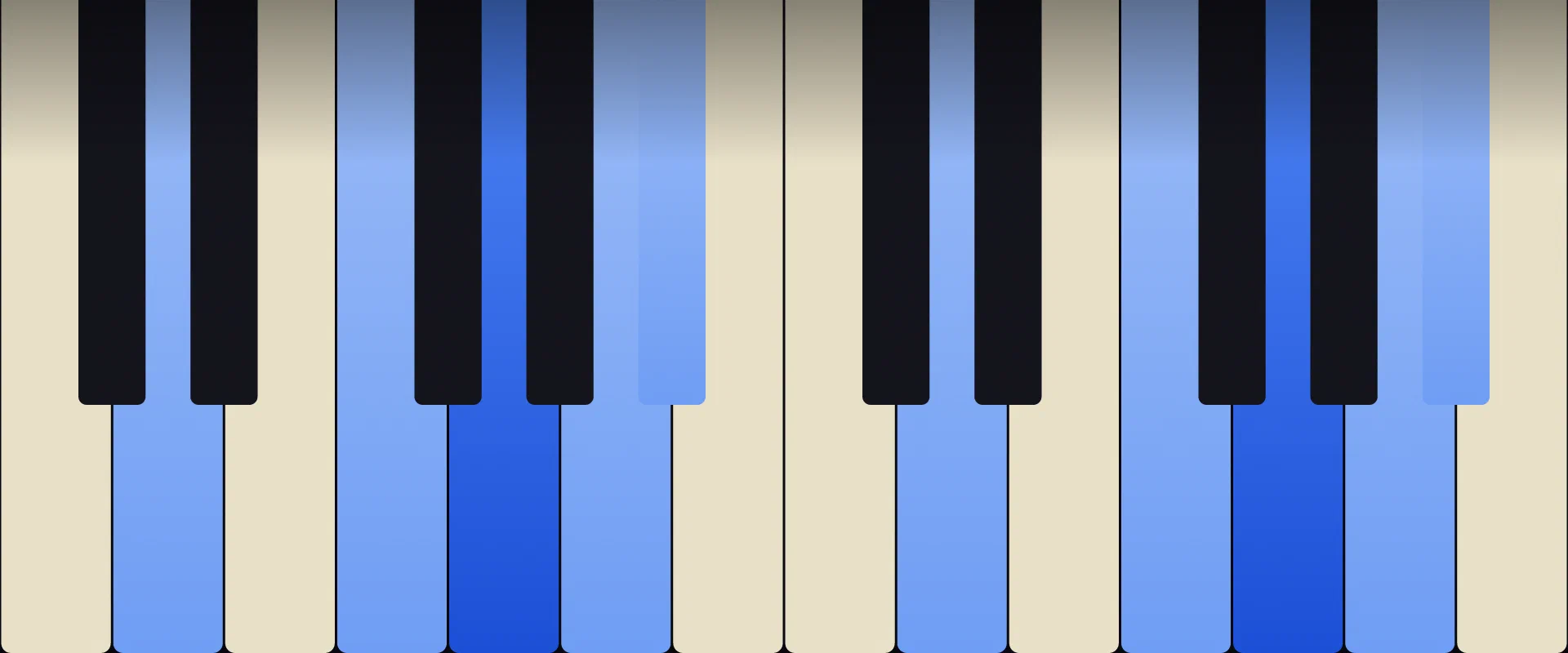
Root position uses all five fingers: 1 on G, 2 on B♭, 3 on D, 4 on F, 5 on A, fourteen semitones with the only black key hard against the thumb. Against the seventh chord, the F steps back from the little finger to the ring finger and the A takes the outside.
Then look at what the hand is covering. A is the white key immediately left of B♭. The two notes that must never touch in this chord are physically touching on the keyboard, which is not true of the ninth over any major chord on this root, where A and B are two white keys apart.
The rule is short: put the A above the B♭, never below. Above by a major 7th the pair is glossy; below by a minor 9th it is the harshest interval the system contains, so the octave you pick does all the work. A left hand of G and F, a minor 7th apart and wide enough for the register, under a right hand of B♭, D and A obeys the rule automatically.
The drill worth the time keeps that A still. Play Gm9, then C13, then Fmaj9, letting the top voice stay on A. It is the ninth of the first chord, the thirteenth of the second and the third of the last, changing function twice without moving.
Gm9 on the Guitar
The standard grip costs one fingertip more than the seventh chord. The Em7 shape barred at the 3rd fret is 3 5 3 3 3 3; move the little finger from the 3rd fret to the 5th on the top string and you have 3 5 3 3 3 5, sounding G, D, F, B♭, D and A. The doubled G that was sitting on top becomes the ninth, so the note the chord is named after ends up as its highest voice. Index barre, ring finger on the 5th string at the 5th fret, little finger on the top string at the 5th, the two outer fingers pulling in opposite directions across a four string barre. Three frets from the nut, on stiff strings, it is a chord to build up to.
The nut has nothing to offer, and the reason is measurable. Only three open strings are chord tones: A, D and G. Take the open A and 3 0 0 3 3 1 does contain all five notes, but that A sounds at A2 while the nearest B♭ is a minor 9th above it, the one interval the chord is arranged to avoid. Complete and unusable at once. The other two open strings offer a fifth and a doubled root, so this is not an open form the books forgot.
| Form | Frets | Notes sounded |
|---|---|---|
| Em7 shape plus ninth, fret 3 | 3 5 3 3 3 5 | G D F B♭ D A |
| Root, seventh, third, ninth | 3 x 3 3 x 5 | G F B♭ A |
| Rootless, top four strings | x x 3 3 3 5 | F B♭ D A |
| Complete at the nut, unusable | 3 0 0 3 3 1 | G A D B♭ D F |
| Am9 shape, fret 10 | x 10 8 10 10 x | G B♭ F A |
Row two is the working voicing. Root on the 6th string, seventh on the 4th, third on the 3rd, ninth on top at the 5th fret, with the 5th and 2nd strings deadened by the fingers already down. Four notes, no fifth, nothing doubled, and it cuts where the full barre only thickens.
Row three is easier still: a small index barre across the 4th, 3rd and 2nd strings at the 3rd fret plus the little finger at the 5th, giving F, B♭, D and A. That is the B♭maj7 identified earlier, so a shape most players already own turns out to be the rootless version of this chord.
High up, x 10 8 10 10 x has one finger per string and the ninth on top again. The frets are narrow there and the index reaches back two from the other three, which suits an archtop better than an acoustic.
Inversions
| Inversion | Notes | Bass | Symbol |
|---|---|---|---|
| Root position | G B♭ D F A | G | Gm9 |
| 1st inversion | B♭ D F A G | B♭ | Gm9/B♭ |
| 2nd inversion | D F A G B♭ | D | Gm9/D |
| 3rd inversion | F A G B♭ D | F | Gm9/F |
| 4th inversion | A G B♭ D F | A | Gm9/A |
The first row of the table is honest and the second is not. B♭, D, F, A and G over a B♭ bass is B♭maj13, a chord with its own name, its own function and nothing minor about it. Writing Gm9/B♭ over a bar tells the bass player the truth and the chord player a lie.
The last row is the interesting one. Read A, G, B♭, D and F upwards from A and the degrees are root, ♭7, ♭9, 11 and ♭13, which is a dominant with a flattened ninth and the flavour A phrygian supplies. Put this chord over an A and you are not in G minor any more.
Voicings
Everything here follows from where the A goes. Above the B♭ it colours the chord, below it ruins it, and that decision matters more than which note you drop, though the answer to that is the usual one and the D goes first.
C is unusually welcome on this root. It sits a whole step above the B♭ rather than grinding against a major third, so Gm11 is available where the equivalent chord on a major triad is not, for the reason the guide gives.
Take the G away and what remains is B♭maj7 in root position. Rootless playing here is not a new shape to learn, it is a familiar chord a minor 3rd up with somebody else naming it.
Which Keys Contain Gm9
- ii of F major
- vi of B♭ major
- i of G natural minor
- I of G dorian
- iv of D natural minor
- iv of D harmonic minor
Five of those six are rotations of two collections, one flat and two. The last is not. D harmonic minor is the only scale here holding Gm9 that is not a mode of F major or B♭ major, and it holds it because raising the seventh degree of D minor touches C and leaves every note of this chord alone.
The ninth also settles a question the seventh chord could not. Gm7 sits equally happily on the tonic of G phrygian, which carries the same four notes. Gm9 does not: phrygian’s second degree is A♭, so it yields the flattened ninth this chord refuses. Sound the A and the phrygian reading is gone.
Where Gm9 Shows Up
| Progression | Chords | Typical use |
|---|---|---|
| ii9, V13, Imaj9 in F | Gm9, C13, Fmaj9 | Jazz standards, with the A never moving |
| i9, IV9 vamp in G dorian | Gm9, C9 | Modal jazz, neo soul and house |
| iv9, V7, i in D minor | Gm9, A7, Dm | Minor cadence, C♯ borrowed above |
| I6, vi9, ii9, V7 in B♭ | B♭6, Gm9, Cm9, F7 | Rhythm changes with the ninths in |
| ♭vii9 in A phrygian | Am, Gm9, Fmaj7 | Descending modal pop and film cues |
| Final chord of a chart in G minor | D7, Gm9 | Bossa nova and soul endings |
Row two is where this chord lives outside jazz. A dorian vamp needs a tonic that never resolves, and the ninth holds attention for eight bars without implying a cadence. House and neo soul producers reach for exactly this shape, usually as the rootless B♭maj7 with a synth bass on G under it.
Row three shows the harmonic minor entry earning its place. Gm9 to A7 to Dm needs C♯ in the middle chord, exactly the note D harmonic minor raises, and the raising happens above this chord rather than inside it. The subdominant keeps its ninth throughout while the dominant does the work.
Row five inverts the usual relationship. In A phrygian this chord is the flattened seventh degree and its A is the tonic of the mode, so the note that names the chord is the note the passage is anchored to. Put that A in the bass and the ninth stops being a colour and becomes a pedal.
Related Chords
- G Minor 7th Chord, the four notes underneath this one
- G Minor Chord, the triad at the bottom of the stack
- G Major 9th Chord, where the same ninth is a whole step from the third
- G Minor 6th Chord, the other way to extend this triad
- B♭ Major 7th Chord, the upper four notes standing alone
- G Half-diminished Chord, what a flattened fifth does to the same shell
- The G Dorian Scale
- The D Harmonic Minor Scale
- Guitar Chord Shapes: The CAGED System
Learn More
Practice Chords
Drill chord recognition with a metronome, MIDI support, and score tracking.
Start PracticingRelated Articles
A Minor 9th Chord: Notes, Voicings, and How to Play It
Sep 5, 2026 · 9 min
A♭ Minor 9th Chord: Notes, Voicings, and How to Play It
Sep 5, 2026 · 8 min
B Minor 9th Chord: Notes, Voicings, and How to Play It
Sep 5, 2026 · 8 min