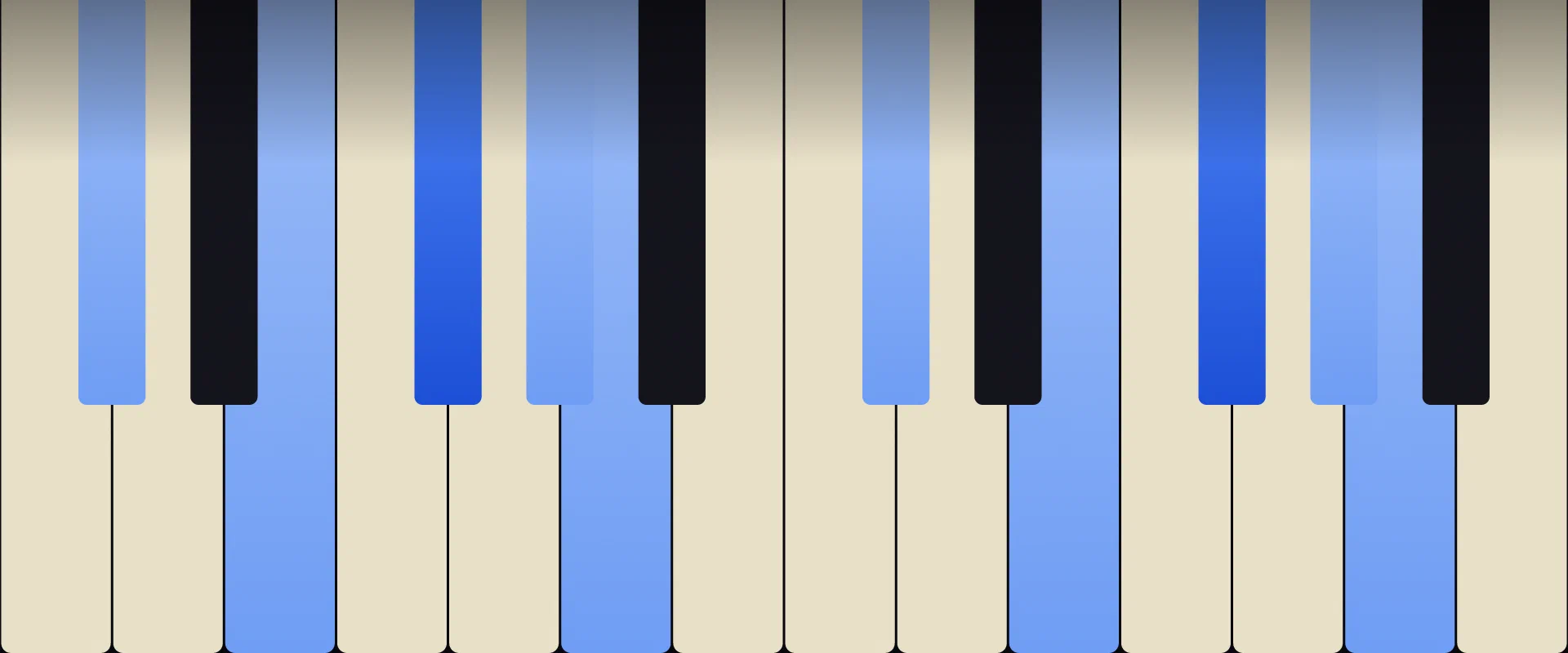
Adding the ninth to F♯m7 costs two keys. D major and B natural minor both hold F♯, A, C♯ and E without complaint, and both put a G natural where this chord wants G♯, so neither of them will take it. What survives the loss is A major and E major, along with their modes, and that is a good trade. Those two signatures carry an enormous amount of what gets written for the guitar, and all five notes of F♯m9 sit inside both of them with nothing borrowed.
The instrument agrees. Take the open F♯m7, 2 0 2 2 2 0, and move the 3rd string back one fret. Nothing else shifts, no finger leaves the neighbourhood, and the ninth is in.
Try It: F♯m9 in the Chord Finder
Sound the F♯ minor triad first, then add E and then G♯, and listen to how little the chord changes character each time.
The Notes of F♯m9
F♯m9 contains five notes.
F♯, A, C♯, E, G♯
| Degree | Note | Interval from root | Semitones |
|---|---|---|---|
| 1 | F♯ | Root | 0 |
| ♭3 | A | Minor 3rd | 3 |
| 5 | C♯ | Perfect 5th | 7 |
| ♭7 | E | Minor 7th | 10 |
| 9 | G♯ | Major 9th | 14 |
Three black keys and two white ones, and the three black keys are F♯, C♯ and G♯: exactly the three sharps of A major. Play in that key and this chord asks for nothing the signature has not already given you.
How F♯m9 Is Built
Put G♯ a whole tone above the octave root of F♯m7. Extended Chords and Jazz Harmony sets out the general rules for stacking a ninth and for dropping notes out of the result.
What is unusual on this root is the name, which has no alternative. Most chords built on the black key between F and G can be written G♭ as easily as F♯, and several of them are, but the minor third above G♭ has to be a form of B, and the pitch you know as A written as a form of B is B♭♭. Nobody prints a double flat to avoid a sharp, so this chord is F♯m9 in every score that contains it, while F♯maj9 on the same root spends most of its life called G♭maj9. One accidental is the entire reason.
Lift the root away and A, C♯, E and G♯ remain, which is Amaj7. That is not a curiosity to file away: it is how the chord gets played on both instruments and how it turns up in progressions, and both follow below.
F♯m9 on the Piano
Two hands make this straightforward and one hand does not. F♯ alone in the left, then A, C♯, E and G♯ in the right under fingers 1, 2, 3 and 5. The right hand is holding Amaj7 and spans eleven semitones, comfortable for most adult hands, and the left hand is doing all the work of deciding what the chord is called.
One arrangement has to be refused: G♯ directly underneath A. They are neighbours on the keyboard, a black key and the white key to its right, and in this chord they belong eleven semitones apart with the fifth and the seventh filling the space between. Side by side they stop sounding like a ninth and start sounding like a wrong note held down.
For a fuller sound, take F♯ and C♯ in the left hand and leave A, E and G♯ to the right. The two white keys then carry the middle of the chord and every black key is either at the very bottom or the very top.
F♯m9 on the Guitar
Two of the six open strings belong to this chord, and they happen to be the two that matter most: the open A string is the minor third and both E strings are the flat seventh. That is why 2 0 2 1 2 0 works. Middle finger on the 6th string at the 2nd fret, index on the 3rd string at the 1st, ring on the 4th at the 2nd, little finger on the 2nd string at the 2nd, and the 5th and 1st strings ring open. Six strings sounding, all five notes present, the root in the bass.
The interesting part is what happens when that shape is made movable. The Em9 form barred at the 2nd fret is 2 4 2 1 2 2, and it has no A anywhere in it: the fretted 5th string gives C♯ instead and the minor third vanishes. The open A string is the only thing rescuing this chord in first position, a piece of luck belonging to F♯ and to no other root on this instrument.
Higher up, x 9 7 9 9 9 gives one of each note on five strings with nothing doubled: index on the 4th string at the 7th fret, middle on the 5th at the 9th, ring flat across the top three at the 9th, where the frets are narrow enough to make that barre easy.
Inversions
| Inversion | Notes | Bass note |
|---|---|---|
| Root position | F♯ A C♯ E G♯ | F♯ |
| 1st inversion | A C♯ E G♯ F♯ | A |
| 2nd inversion | C♯ E G♯ F♯ A | C♯ |
| 3rd inversion | E G♯ F♯ A C♯ | E |
| 4th inversion | G♯ F♯ A C♯ E | G♯ |
The first row deserves a different name. With A underneath, the ear hears an A major chord carrying both its seventh and its sixth, not a minor chord standing on its third. The last row is the one to avoid outright: G♯ at the bottom leaves A a semitone above the lowest note, the exact arrangement the piano section warns against. Chord Inversions and Voice Leading covers how much a bass note decides.
Voicings
C♯ is the note to lose first. F♯, A, E and G♯ still says everything this chord has to say, and on guitar that is x 9 7 9 9 x, the grip above with the top string left out. Cut further and you reach A, E and G♯, which needs a bass player but keeps every scrap of colour. What you cannot do is double G♯ an octave lower, since it lands next to A and the chord collapses into a cluster.
Which Keys Contain F♯m9
| Degree | Key |
|---|---|
| II | E major |
| VI | A major |
| I | F♯ natural minor |
| I | F♯ dorian |
| IV | C♯ harmonic minor |
| III | D lydian |
Two rows call this chord the tonic, and the chord itself cannot tell you which of them you are in. F♯ natural minor and F♯ dorian differ only at the sixth degree, D against D♯, and there is no sixth in F♯m9, so the question is settled by the melody or by whatever chord follows.
The harmonic minor row survives for a similar reason. C♯ harmonic minor raises its seventh to B♯, a note this chord does not contain, so its fourth degree comes out as a plain minor ninth with none of the strangeness the raised seventh causes elsewhere in that scale.
Where F♯m9 Shows Up
Amaj7 to F♯m9 in A major. Not one upper voice moves. The bass drops a major third from A to F♯ and the four notes above it stay exactly where they were, which on guitar means going from x 0 2 1 2 0 to 2 0 2 1 2 0: a single finger arriving on the 6th string. Soul and bossa comping in A rocks between those two for bars at a time, because the harmony is changing and the texture is not.
F♯m9, B9, Emaj7 in E major. The whole cadence lives in first position, 2 0 2 1 2 0 then x 2 1 2 2 x then 0 2 1 1 0 0, and the reason it sounds settled before it arrives is the ninth. G♯ is the note that makes E major major, and here it turns up two chords early, on the 3rd string at the 1st fret, the same fret that separated this chord from F♯m7 at the top of the page. See The ii V I Progression.
F♯m9 held as a groove. One chord, no destination, the sound modern soul and house build a whole track from. Put a B major triad next to it and the mode declares itself as F♯ dorian, since B major carries the D♯ that dorian needs and natural minor does not. Leave the B out and the same five notes sit in F♯ minor instead. The chord is neutral; its neighbours are not.
Related Chords
- F♯ Minor 7th Chord, the chord this one grows out of
- A Major 7th Chord, the four notes sitting above the root
- F♯ Major 9th Chord, the same root and the same ninth, with the third and seventh both raised
- F♯ Minor 6th Chord, D♯ in place of E, the raised sixth that names F♯ dorian
Learn More
- Extended Chords and Jazz Harmony, for what to drop when five notes will not fit
- The A Major Scale, whose three sharps are this chord’s three black keys
- The ii V I Progression, the cadence that puts this chord to work in E
Practice Chords
Drill chord recognition with a metronome, MIDI support, and score tracking.
Start PracticingRelated Articles
A Minor 9th Chord: Notes, Voicings, and How to Play It
Sep 5, 2026 · 9 min
A♭ Minor 9th Chord: Notes, Voicings, and How to Play It
Sep 5, 2026 · 8 min
B Minor 9th Chord: Notes, Voicings, and How to Play It
Sep 5, 2026 · 8 min