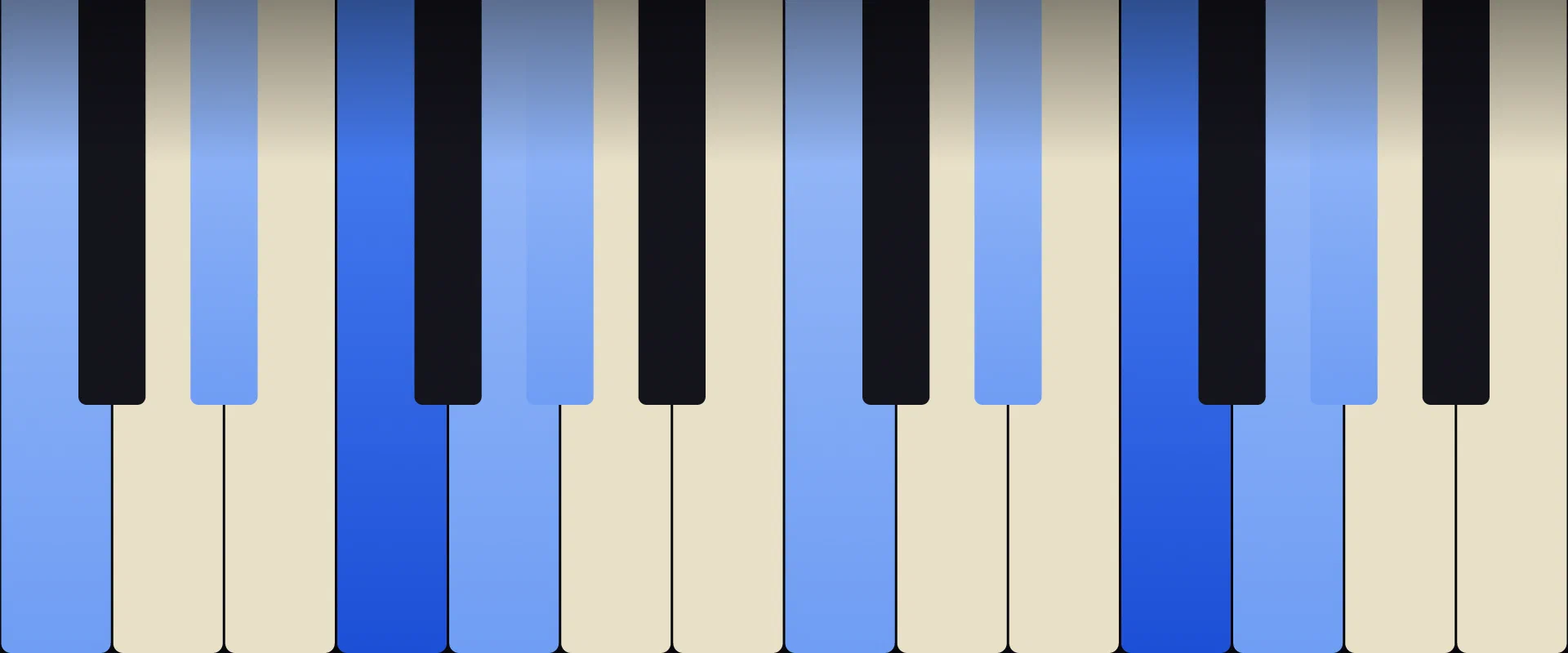
Three white keys and two black ones, and the split is not a coincidence. F, C and G are the root, the 5th and the 9th: two perfect fifths stacked end to end, a frame that declares nothing. Sound only those and nobody can say whether the chord is major or minor, or a seventh chord at all. A♭ and E♭ answer both questions on their own, and they are the notes the hand has to reach in for.
The guitar sorts the same notes the same way and is less generous about it. Exactly one open string belongs to this chord, the 3rd, and it is G, the 9th. Fm7 has none at all, so the note that joins here is also the only note on this root the tuning ever volunteers.
Try It: Fm9 in the Chord Finder
Set F as the root and sound the minor 7th first, then the 9th. Watch where G lands: above the octave, and on a white key, while the two notes that made the chord minor stay behind on black.
The Notes of Fm9
| Degree | Note | Interval from Root | Semitones |
|---|---|---|---|
| 1 (Root) | F | Perfect unison | 0 |
| ♭3 | A♭ | Minor 3rd | 3 |
| 5 | C | Perfect 5th | 7 |
| ♭7 | E♭ | Minor 7th | 10 |
| 9 | G | Major 9th | 14 |
The 9th is a major one even though the chord is minor, and the key signature explains it without any theory at all. F minor flattens B, E, A and D. It leaves G alone. Of the four notes stacked above the root, G is the only one the signature never touches.
How Fm9 Is Built
Add G above Fm7 and alter nothing beneath it. Where the stack runs on from there, and which chord qualities take which extension, is the business of Extended Chords and Jazz Harmony.
Strip the root away and the remaining four notes, A♭, C, E♭ and G, are A♭ major 7th. That is not a curiosity: F minor and A♭ major share a key signature of four flats, so the relative major’s most-used chord and this one are the same handful of notes with the bass making the decision.
One semitone separates it from a wholly different animal. Raise A♭ to A, leave the other four notes where they stand, and the chord is F9. That single black key is doing all the work.
Fm9 on the Piano
This is the rare case where adding a note makes the hand more comfortable rather than less. In Fm7 the little finger has to push in for E♭ on a black key. Here it comes back out to G, and the chord lands in the shape teachers spend months asking for: thumb and little finger on white keys at the front edge, the two black keys under fingers 2 and 4, the hand level.
The cost is width. F up to G is a 9th, a real reach, and low down it sits in the mud. Give F to the left hand and play A♭, C, E♭ and G in the right, which is A♭maj7 and spans a major 7th. Note where the thumb lands: on A♭, a black key, so the hand sits deeper into the keys than the major version of this chord asks for.
The one interval to police is A♭ against G, a semitone apart as pitch classes. Why that particular collision hurts is a rule the extended chords guide states once for every chord. Here it means G stays well above the 3rd, which root position handles for free by putting them eleven semitones apart. A left hand reaching up for G while the right holds A♭ does not.
Keep F and A♭ apart in the bass too: a minor 3rd that low is one thick noise, and F alone carries the chord perfectly well down there.
Fm9 on the Guitar
Start where the chord actually gets played, at the 8th fret: x 8 6 8 8 x, root on the 5th string, then A♭, E♭ and G on the next three, one finger per string and no barre in it. The missing note is C, which this chord can spare, and putting the 1st string down at fret 8 brings it back on top.
Down at the nut the open G string sets a trap. To use it you need E♭ on the 4th string and C on the 2nd, both at fret 1, and the barre that collects them presses the 3rd string at fret 1 as well, where it sounds A♭ and the 9th disappears. The free note and the easy grip cannot both be had.
One shape wins the argument, at the price of the bass note: 4 x 1 0 1 1. Ring finger on the 6th string at fret 4, middle on the 4th at fret 1, index flat across the 2nd and 1st at fret 1, the 3rd string ringing open in the gap and the 5th deadened. Low to high that is A♭, E♭, G, C and F, every note present. With A♭ underneath a listener hears A♭maj7 unless a bass player is on F, which in a band is what happens.
Drop the 6th string and x x 1 0 1 4 is the same notes minus the root, three fingers around the open G, made for comping over a bass.
The barre form is honest work rather than fun. Fm7’s grip at fret 1 leaves the little finger idle, and putting it on the 1st string at fret 3 turns a doubled root into the 9th: 1 3 1 1 1 3, complete and loud, and a three fret spread over the two widest frets on the instrument.
Inversions
| Inversion | Notes | Bass Note | Symbol |
|---|---|---|---|
| Root position | F, A♭, C, E♭, G | F | Fm9 |
| 1st inversion | A♭, C, E♭, G, F | A♭ | Fm9/A♭ |
| 2nd inversion | C, E♭, G, F, A♭ | C | Fm9/C |
| 3rd inversion | E♭, G, F, A♭, C | E♭ | Fm9/E♭ |
| 4th inversion | G, F, A♭, C, E♭ | G | Fm9/G |
First inversion is the row with two careers. With A♭ underneath the ear takes A♭maj7 with F on top, and in E♭ major the reading decides the function: as Fm9 the chord is the ii, as A♭maj7 the IV. Both go to B♭7 next, which is why the ambiguity rarely causes trouble and why the guitar shape above gets away with it.
The last row is the useful one. Read from G there is no 3rd anywhere, only the ♭7, the ♭9, the 11th and the ♭13: a suspended dominant with the darkest available colouring, one chord away from C minor. Gospel keyboard players reach for it constantly and almost never write Fm9/G on the chart.
Voicings
If a note has to go, it is C. Nothing about this chord’s quality or colour is stored in the 5th, and the grip most players use at the 8th fret has already dropped it. Keep E♭ up where it reads as a 7th rather than a smear, and keep G clear of A♭.
| Shape | Frets, low to high | Sounding notes |
|---|---|---|
| Fret 8, no 5th | x 8 6 8 8 x | F, A♭, E♭, G |
| Fret 8, 5th on top | x 8 6 8 8 8 | F, A♭, E♭, G, C |
| Open 3rd string, A♭ underneath | 4 x 1 0 1 1 | A♭, E♭, G, C, F |
| Rootless, over a bass F | x x 1 0 1 4 | E♭, G, C, A♭ |
| Fm7 barre plus little finger | 1 3 1 1 1 3 | F, C, E♭, A♭, C, G |
Which Keys Contain Fm9
- II of E♭ major
- VI of A♭ major
- IV of C natural minor
- IV of C harmonic minor
- I of F natural minor
- I of F dorian
The first line is where the chord earns most of its living, and the note that joins Fm7 is the reason. G is the 3rd degree of E♭ major, so a ii chord dressed this way has the destination key’s defining note already sounding two chords before anyone arrives.
Lines three and four are a pair. As the iv of C minor this chord survives whether the key raises its 7th degree or not, because neither B♭ nor B natural is in it. A minor key can switch between its scales freely and the iv9 never has to be respelled.
Its own tonic is fussier. Lines five and six part company only at the 6th degree, D♭ against D, which the chord does not hold, so it is the tonic of both. But F harmonic minor raises E♭ to E natural and the chord vanishes there, so a tune wanting this sound at home stays natural minor or goes dorian.
Where Fm9 Shows Up
| Progression | Chords | Where it lives |
|---|---|---|
| ii9, V7, Imaj7 | Fm9, B♭7, E♭maj7 | Standards and horn writing in E♭ |
| i9, ♭VI, ♭VII | Fm9, D♭, E♭ | Soul, house and gospel in F minor |
| i, iv9 | Cm, Fm9 | Minor blues and ballads in C |
Row one is the chord’s day job, and the ii V I article has the mechanics. Worth adding here: the 9th costs a horn section nothing, because in E♭ the note is G and any player in the key is already sitting on it.
Row two shows why F minor belongs to keyboard players. Four flats is comfortable under the hand and unpleasant on a guitar neck, and both chords following the tonic share notes with it: D♭ major holds F and A♭, E♭ major holds E♭ and G. Two voices stay put while the bass walks.
Row three is a soloist’s fact more than a harmonic one. C, E♭ and G, the top three notes here, are the tonic triad of C minor, so going from i to iv9 adds F and A♭ underneath and moves nothing above. C minor pentatonic then covers the whole change with only B♭ falling outside the chord, and B♭ lands as a consonant 11th when it does.
Related Chords
- F Minor 7th Chord is the chord underneath, and the barre this one is built on.
- A♭ Major 7th Chord is the four notes above the root, and the reason the first inversion changes its name.
- F Dominant 9th Chord raises the 3rd a semitone and gains a tritone.
- F Minor 6th Chord takes D instead of the 7th and the 9th, and stays inside an octave.
- Chord Inversions and Voice Leading goes further into what an A♭ or a G in the bass does to the name.
Learn More
Extended Chords and Jazz Harmony sets out the stack, the avoid note rule and the voicing principles this page only applies. For the seventh chord underneath, see Seventh Chords: The Complete Guide, and for why the II degree of a major key is minor at all, Diatonic Chords: A Beginner’s Guide. E♭ major and A♭ major sit side by side at three and four flats on the circle of fifths. For every scale containing this chord, see Scales for Piano and Guitar: The Complete Reference Guide.
Practice Chords
Drill chord recognition with a metronome, MIDI support, and score tracking.
Start PracticingRelated Articles
A Minor 9th Chord: Notes, Voicings, and How to Play It
Sep 5, 2026 · 9 min
A♭ Minor 9th Chord: Notes, Voicings, and How to Play It
Sep 5, 2026 · 8 min
B Minor 9th Chord: Notes, Voicings, and How to Play It
Sep 5, 2026 · 8 min