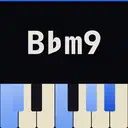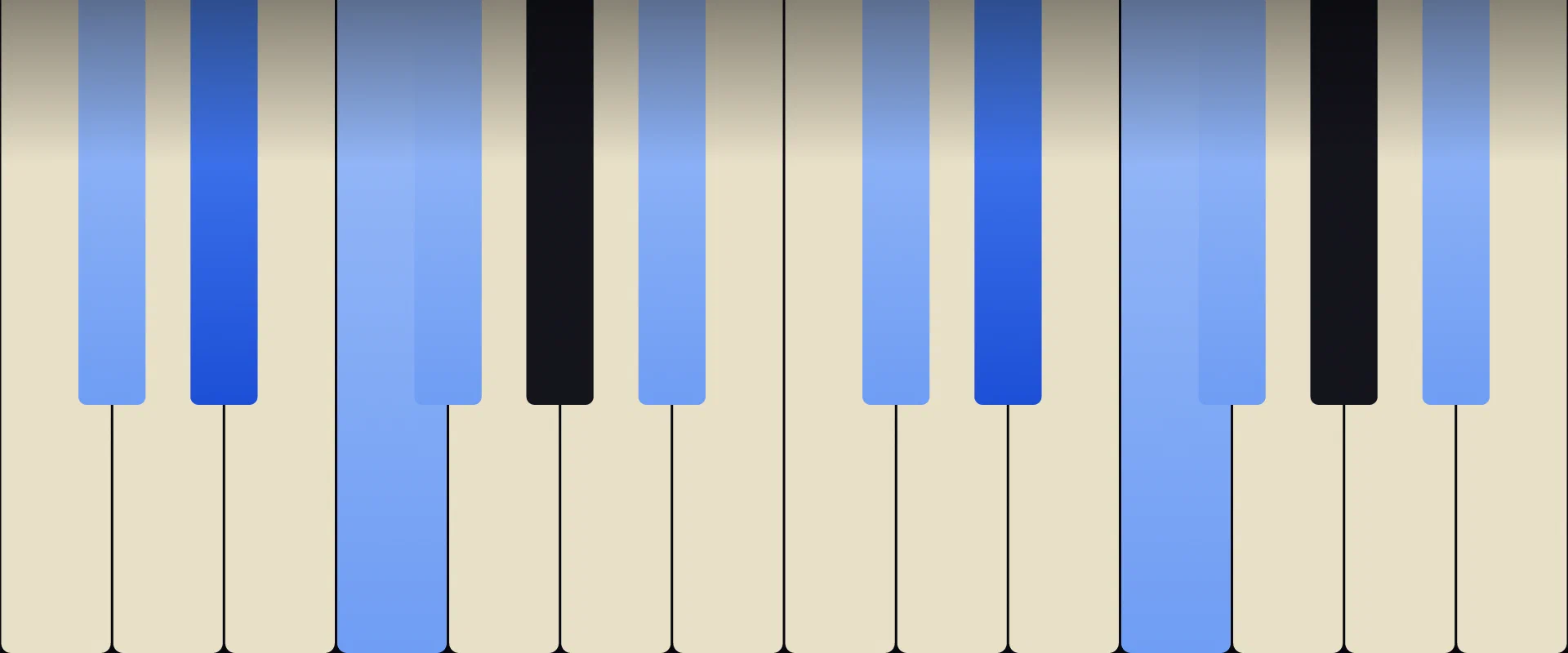
Not one of the six open strings on a guitar belongs to E♭m9. E♭, G♭, B♭, D♭ and F: every note has to be stopped by a finger, in every position. Sit at a piano and the picture turns over. Four of the five are black keys, the hand settles at the back of the keyboard where it hardly needs telling what to do, and exactly one white key, F, has to be reached forward for. Two instruments seldom disagree about a chord this strongly, and both are reacting to the same note.
Try It: E♭m9 in the Chord Finder
The Notes of E♭m9
The chord contains five notes: E♭, G♭, B♭, D♭ and F.
| Degree | Note | Interval from root | Semitones |
|---|---|---|---|
| 1 | E♭ | Root | 0 |
| ♭3 | G♭ | Minor 3rd | 3 |
| 5 | B♭ | Perfect 5th | 7 |
| ♭7 | D♭ | Minor 7th | 10 |
| 9 | F | Major 9th | 14 |
The symbol is E♭m9, and lead sheets also print E♭min9 and E♭-9. The ninth is major even though the chord is minor, which is why the symbol never says so.
How E♭m9 Is Built
Take E♭m7, E♭ G♭ B♭ D♭, and put F above it.
That single note ends something. E♭m7 is the one minor seventh chord of the twelve that fits on the black keys and nothing else, so E♭m9 is the only minor ninth whose lower four notes are all raised, and the ninth is what breaks the run. It has to. A minor third always sits a semitone above the ninth, and no two black keys are a semitone apart, because those five spell E♭ minor pentatonic and a pentatonic scale contains no semitones at all. No minor ninth on any root avoids the white keys. This one gets four of its five and still misses.
Turn it round and a second name appears. Leave out the root and G♭, B♭, D♭ and F is G♭maj7, filed here under its sharp spelling as F♯maj7. E♭m9 is a major seventh chord standing on a bass note a minor third below it, which is most of why a chord written as minor sounds this open.
E♭m9 on the Piano
Find the group of two black keys and work upwards. D♭ is the lower of that pair, E♭ the upper, F the white key immediately past them: the seventh, the root and the ninth, three keys in a row with no gaps. G♭ and B♭ are the outer two of the group of three above.
The easiest way to hold it is to give the left hand the root alone and let the right hand play G♭maj7: G♭, B♭, D♭ and F with 1, 2, 3 and 5. Three raised keys under the first three fingers, the little finger forward on the white one, no thumb on a black key. Once that is in the hand the chord is nearly automatic, which is not true of many five note chords.
Where it goes wrong is the F. Close the voicing up so the ninth sits between the root and the third, a semitone under G♭, and the chord turns from open to gritty in one step. Keep an octave and a whole tone between E♭ and F, minimum, and below middle C drop the ninth altogether.
For a narrower shape that stands up better under a melody, split it the other way: left hand E♭ and B♭, right hand G♭, D♭ and F.
E♭m9 on the Guitar
Nothing here is free, so the only question is which finger goes where. The practical shape is the m9 form at the 6th fret: x 6 4 6 6 x, sounding E♭, G♭, D♭ and F. Index on the 4th string at the 4th fret, middle on the 5th string at the 6th, ring finger flattened across the 3rd and 2nd at the 6th. Root, third, seventh and ninth, no fifth, no barre across the neck.
Near the nut the root has to be surrendered. The cheapest E♭m7 in first position has nowhere to put a ninth, since the F would land on the 1st string at the 13th fret, so what you play there is the chord’s upper half: x x 4 3 2 1, sounding G♭, B♭, D♭ and F. That is the open Fmaj7 grip moved up one fret, a clean diagonal, one finger per string, down where the strings are loosest. Over an E♭ bass it is a full E♭m9.
For a low root, the E form goes up to the 11th fret: 11 13 11 11 x 13, sounding E♭, B♭, D♭, G♭ and F, all five degrees, one each. Index barred at the 11th, ring finger at the 13th on the 5th string, little finger at the 13th on the 1st, 2nd string muted. It is a long reach where the frets have closed up, and the only version of this chord with its root below the staff.
All three grips put F on the highest string that sounds, which is not a coincidence. Lower down, the ninth ends up within a tone or two of the G♭, and on wound strings that pairing sounds like a mistake rather than a colour.
Inversions
| Inversion | Notes | Lowest note |
|---|---|---|
| Root position | E♭ G♭ B♭ D♭ F | E♭ |
| 1st inversion | G♭ B♭ D♭ F E♭ | G♭ |
| 2nd inversion | B♭ D♭ F E♭ G♭ | B♭ |
| 3rd inversion | D♭ F E♭ G♭ B♭ | D♭ |
| 4th inversion | F E♭ G♭ B♭ D♭ | F |
First inversion is barely an inversion. G♭ at the bottom leaves G♭maj7 standing on its own root with an E♭ on top, and the ear takes it as a major chord with a sixth added. Nothing sounds wrong. The chord has changed sides.
Third inversion is the busy one. Read the same five notes from D♭ and you get a root, a ninth, a third, an eleventh and a thirteenth: D♭6/9 with G♭ jammed into it, and a fourth sitting on a third is the collision the extended chords guide spends a section on.
Fourth inversion is better than it looks. With F at the bottom the notes give a seventh, a flat ninth, a fourth and a flat thirteenth and no third at all, which is the chord modal players write as F7sus♭9. Leave your hands where they are, put a bass player on F, and E♭m9 starts leaning towards B♭ minor.
Voicings
Shed the fifth first. E♭, G♭, D♭ and F says everything the chord has to say, and it is exactly what the fret 6 guitar shape gives you.
Spread it rather than stacking it in thirds: E♭ and B♭ low, then G♭, D♭ and F above, so the two notes doing the work, the third and the ninth, sit at opposite ends instead of side by side.
Which Keys Contain E♭m9
- II of D♭ major
- I of E♭ natural minor
- I of E♭ dorian
- IV of B♭ natural minor
- IV of B♭ harmonic minor
- V of A♭ mixolydian
The list has a hole in it. This chord is the tonic of E♭ minor, but only of the natural form and of E♭ dorian: E♭ harmonic and melodic minor both raise the seventh degree to D natural, and the ninth chord on their first degree is not this one. Ask the same question a fourth higher and the answer reverses. B♭ harmonic minor raises its seventh to A natural, a note E♭m9 never uses, so the chord survives the change and stays the fourth degree of both B♭ minors.
Note also that E♭m7 sits inside E♭ minor pentatonic and E♭m9 does not, since that scale has no F. Improvising on the black keys over this chord leaves out the note that names it.
Where E♭m9 Shows Up
E♭m9, A♭13, D♭maj9. The ii V I in D♭ major, and a demonstration of how little has to happen when the chords are this full. F is in all three: the ninth of the first, the thirteenth of the second, the third of the last. One finger stays down through the whole cadence while everything underneath rearranges itself. Play it once with the F moving and once with it held; the held version is the one that sounds like a record.
E♭m9, A♭9. Two chords, eight bars, repeat. This is E♭ dorian rather than E♭ minor, and the second chord is what makes it so: A♭9 contains C natural, the raised sixth degree that separates dorian from the natural minor. A vamp, not a progression, since neither chord is going anywhere.
E♭m9, F7♭9, B♭m. The fourth degree, the dominant and the tonic of B♭ minor. Watch what the ninth becomes. F, the note added to make E♭m9, is the root of the chord that follows, and G♭, its third, becomes that chord’s flat ninth. Two colours turn into two functions without either note moving.
Behind all three is the same reason players pick this root. Six flats look forbidding on a page, and under the hand the chord is four black keys and one finger reaching forward.
Related Chords
Learn More
Practice Chords
Drill chord recognition with a metronome, MIDI support, and score tracking.
Start PracticingRelated Articles
A Minor 9th Chord: Notes, Voicings, and How to Play It
Sep 5, 2026 · 9 min
A♭ Minor 9th Chord: Notes, Voicings, and How to Play It
Sep 5, 2026 · 8 min
B Minor 9th Chord: Notes, Voicings, and How to Play It
Sep 5, 2026 · 8 min