Fifth fret, third fret, second fret, first fret, open. x 5 3 2 1 0 descends one string at a time and lands on the open first string, and what it spells on the way down is D, F, A, C, E. That is the whole of Dm9 in root position, every note sounded once, nothing doubled and nothing omitted. Five note chords hardly ever fall out of a guitar that tidily.
The price is the span: index at the first fret, little finger at the fifth, at the wide end of the neck. Lift that little finger off and the four strings left, x x 3 2 1 0, are an Fmaj7, the first major seventh most guitarists ever learn. Dm9 is that shape with a D underneath it, which is why the chord keeps turning up in music written by people who have never counted a ninth in their lives.
Try It: Dm9 in the Chord Finder
The Notes of Dm9
Dm9 is five notes: D, F, A, C and E.
| Degree | Note | Interval from Root | Semitones |
|---|---|---|---|
| 1 (Root) | D | Perfect unison | 0 |
| ♭3 | F | Minor 3rd | 3 |
| 5 | A | Perfect 5th | 7 |
| ♭7 | C | Minor 7th | 10 |
| 9 | E | Major 9th | 14 |
How Dm9 Is Built
Take Dm7, D F A C, and add an E fourteen semitones above the root. Every note is drawn from D natural minor, so no accidental is borrowed and the symbol needs no qualifier.
Where the E goes matters more than the arithmetic suggests. It is a whole tone above the root, which is unremarkable, but it is also a semitone below the F, and the F is the note that makes this chord minor. Left a ninth up, those two are sixteen semitones apart and the chord sounds open. Fold the E down beside the D and the F sits directly on top of it. The extended chords guide covers the spacing rule this is a case of.
Two neighbours are worth naming. The four notes above the root are Fmaj7 entire. And raising the C to C♯ gives Dm(maj9), a genuinely different animal, which is the reason D harmonic minor does not appear in the list of keys further down.
Dm9 on the Piano
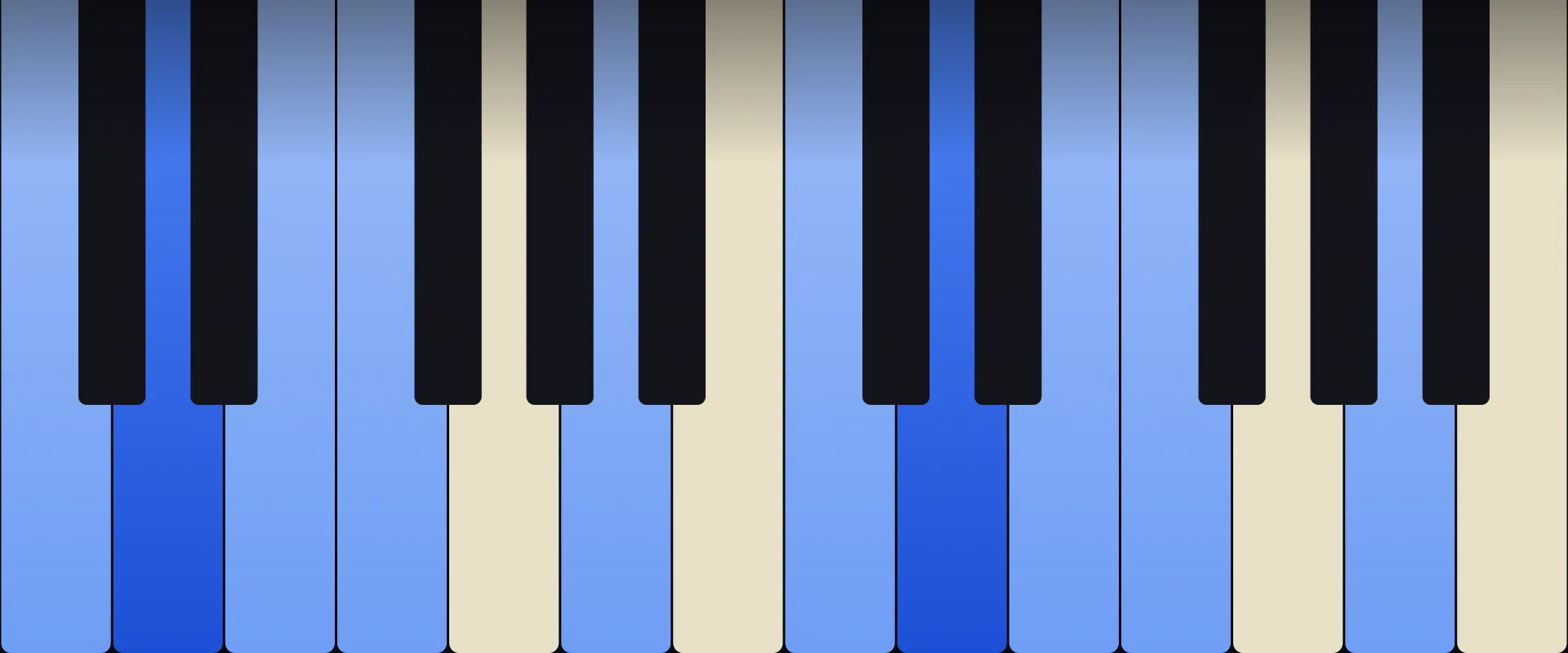
Five notes, five white keys, every second one from D up to E. No accidental to find and no black key to reach over, which sounds like a gift and half of it is. The other half is that the hand gets no landmark. Shift the whole shape one white key upward and out comes E, G, B, D, F, a chord with a flat ninth in it and no relation to this one, and nothing under the fingers will have felt different.
Root position covers a ninth, so split it. Left hand takes D low, right hand takes F, A, C, E with the thumb on F, and that right hand shape is an Fmaj7 most pianists own long before they meet this chord. Notice what sits on top: C up to E is a major third, so the widest bright interval is the highest one, and that is most of why a minor ninth reads as warm rather than sorrowful.
Keep the E away from the bottom. E and F are the only pair here with no key between them, and low down they stop being a colour and start being a beat. Leaner works too: D and C alone in the left hand names the chord, and the A is the first thing to drop.
Dm9 on the Guitar
The open D box, strings four to one below the fifth fret, can produce four of these five notes and never all of them. Which one goes missing is the choice:
| Shape | Notes low to high | What is missing |
|---|---|---|
| x x 0 2 1 1 | D, A, C, F | the 9th |
| x x 0 2 1 0 | D, A, C, E | the ♭3 |
| x x 0 2 5 1 | D, A, E, F | the ♭7 |
| x 5 3 2 1 0 | D, F, A, C, E | nothing |
The second row is the interesting failure. Open the first string on a Dm7 and the chord loses the note that made it minor, so what sounds is not a ninth chord but a chord with no quality at all. The ninth and the third are competing for the same end of the instrument.
The complete grip pays for itself by giving up the open fourth string. The F has to come from that string at the third fret, so the root moves to the fifth string at the fifth fret, the same D at the same pitch. Little finger, ring, middle, index, open.
Up the neck, x 5 3 5 5 x is the compact working version: D, F, C, E, with the fifth dropped and only four strings used. Move the fourth string up one fret and the same grip becomes D9, which is the entire distance between them. Add x 5 3 5 5 5 to put the fifth back on top, or take all six at the tenth fret with 10 12 10 10 10 12, index barred flat across the tenth and the ring and little fingers out at the twelfth, where there is very little room.
Inversions
| Inversion | Bass Note | Notes | Symbol |
|---|---|---|---|
| Root position | D | D, F, A, C, E | Dm9 |
| 1st inversion | F | F, A, C, E, D | Dm9/F |
| 2nd inversion | A | A, C, E, D, F | Dm9/A |
| 3rd inversion | C | C, E, D, F, A | Dm9/C |
| 4th inversion | E | E, D, F, A, C | Dm9/E |
The first inversion barely counts as one. F, A, C, E is a complete Fmaj7 and the D above it reads as an added sixth, so nothing in the sound argues for calling this a D chord at all. Only the bass line decides, which is the relative major and minor relationship at its most literal.
Third inversion is one to pass through rather than sit on, since the C underneath wants to fall to B. In practice a five note chord gets reduced far more often than turned upside down, and what replaces inversion is voice leading.
Voicings
Guitar, complete (x 5 3 2 1 0). All five notes in order, one stretch.
Guitar, rootless (x x 3 2 1 0). Fmaj7 on the top four strings, for playing with a bass.
Guitar, compact (x 5 3 5 5 x). Root, third, seventh and ninth, no fifth, four strings.
Guitar, sixth string root (10 12 10 10 10 12). Full and low, cramped frets.
Piano, split (D low, F A C E above). The working voicing, an Fmaj7 in the right hand.
Piano, shell (D and C in the left hand). Root and seventh, with the E free to be the melody.
Which Keys Contain Dm9
Not one of these five notes carries an accidental, so a great many scales hold this chord intact. Six that earn the space:
- ii of C major
- vi of F major
- i of D natural minor
- i of D dorian
- iv of A natural minor
- iv of A harmonic minor
The last entry is the useful surprise. Harmonic minor is where most extended chords fall apart, because the raised seventh degree contradicts something in the stack. Here it does not: A harmonic minor raises G to G♯, and there is no G in this chord at all, so the fourth degree keeps its ninth in a key that normally refuses them.
Read the same rule the other way and D harmonic minor is excluded, since its seventh degree is C♯ rather than C. Build a ninth chord on the tonic there and you get Dm(maj9), not this.
Where Dm9 Shows Up
The second degree of C major. Count what is absent rather than what is present: this chord holds five of the seven notes of the key, and the two it leaves out are G and B, which are exactly the root and the third of G7. So the ii chord with a ninth on it has already stated most of the key while withholding precisely the dominant’s identity. That is what the ninth costs. Its E is the third of C, so the note the cadence is aiming at is already sounding before the cadence begins, and the arrival lands softer. Whether you want that is a matter of taste, but it is why so much neo soul opens on this chord and never bothers to resolve. The extended chords guide voices the full two, five, one.
The fourth degree in A minor: Dm9, E7, Am. Minor key cadences usually strip the iv chord back to a triad, because anything richer starts arguing with the raised leading note. This one does not argue, and it is holding two of E7’s four notes before that chord arrives: the E, which becomes the dominant’s root, and the D, which is its seventh. The ninth is doing the voice leading rather than the decoration.
The sixth degree in F major. E is F major’s leading note, so putting a ninth on the relative minor’s chord smuggles the sharpest note in the key into the least urgent chord in it. Open a loop on Dm9 and run it to B♭maj7, C7, Fmaj7, and the first chord has already pointed at the last one. It costs the guitarist nothing either, since the Fmaj7 shape is under the hand and all that is needed is a D beneath it.
Related Chords
- D Minor 7th Chord, the four notes this one is built on.
- D Minor Chord, the triad at the bottom of it.
- D Dominant 9th Chord, one fret away and a different function.
- F Major 7th Chord, which is this chord with the root taken away.
- The D Dorian Scale, where this chord is the tonic.
Learn More
Practice Chords
Drill chord recognition with a metronome, MIDI support, and score tracking.
Start PracticingRelated Articles
A Minor 9th Chord: Notes, Voicings, and How to Play It
Sep 5, 2026 · 9 min
A♭ Minor 9th Chord: Notes, Voicings, and How to Play It
Sep 5, 2026 · 8 min
B Minor 9th Chord: Notes, Voicings, and How to Play It
Sep 5, 2026 · 8 min