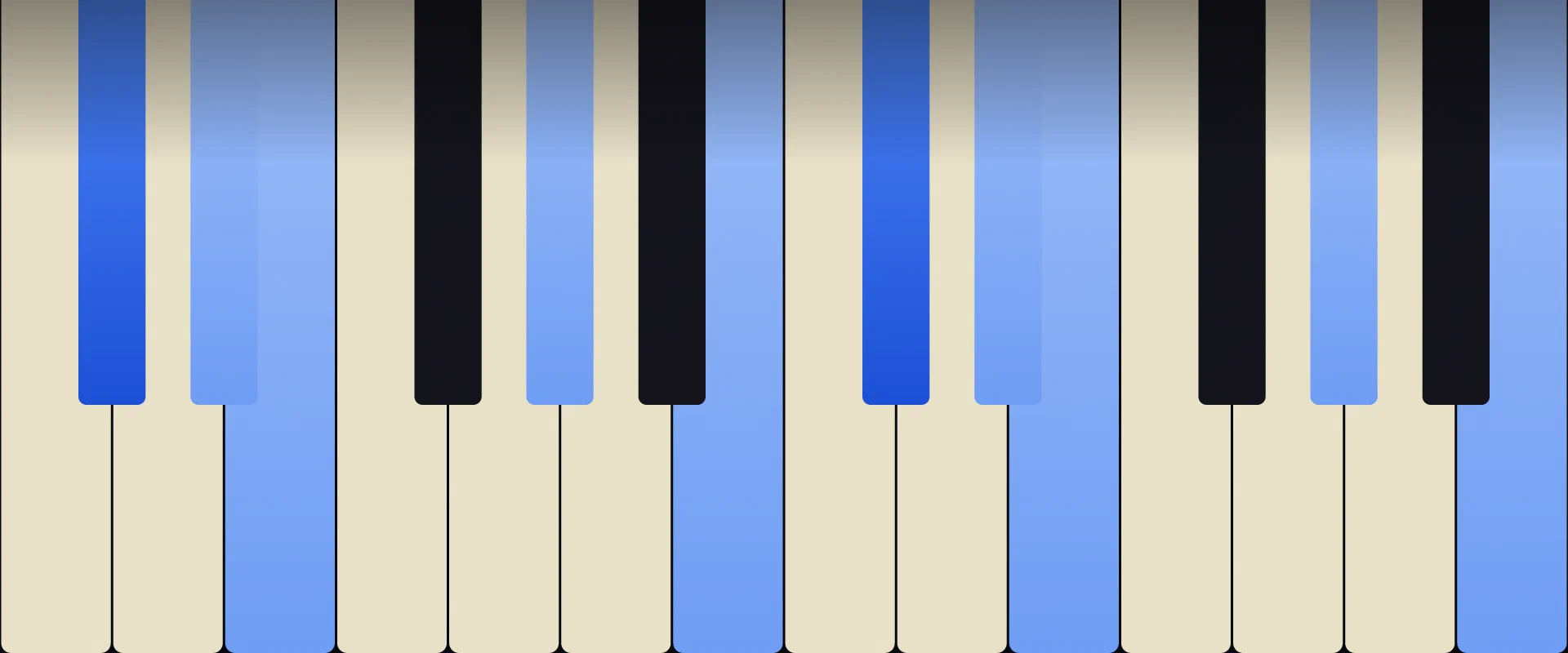
Fifteen scales on this site contain C♯m9 and every one of them writes it C♯, E, G♯, B and D♯. Not one respells a note. That is the opposite of the major ninth on this root, which no scale here prints as written at all. The two chords share the black keys C♯, G♯ and D♯; the minor version asks for E and B instead of two sharps that land on white keys, and in doing so it sits inside the keys guitarists already live in.
Try It: C♯m9 in the Chord Finder
The Notes of C♯m9
| Degree | Note | Interval from root | Semitones |
|---|---|---|---|
| 1 | C♯ | Root | 0 |
| ♭3 | E | Minor 3rd | 3 |
| 5 | G♯ | Perfect 5th | 7 |
| ♭7 | B | Minor 7th | 10 |
| 9 | D♯ | Major 9th | 14 |
Three sharps and two naturals, and all three sharps are in the key signature of C♯ minor. The symbol needs no explanation and no translation, which for a five note chord on this root is unusual.
How C♯m9 Is Built
Add D♯ on top of C♯m7. D♯ is fourteen semitones above the root and E is three, so folded into one octave the ninth lands a semitone below the third: D♯ is the black key E sits against. Voice them a whole tone apart and the chord bites. Voice them a minor ninth apart, D♯ low and E high, and the same two notes sound like air.
The seventh settles which C♯ minor you are in. C♯ harmonic minor raises it to B♯, so its tonic ninth chord is C♯m(maj9), and C♯ melodic minor does the same. Only the natural seventh gives C♯m9, so a piece leaning on its raised leading note cannot rest here. That is why the list below holds natural minor and Dorian and no harmonic minor rooted on C♯.
C♯m9 on the Piano
The five keys alternate colour all the way up: C♯ black, E white, G♯ black, B white, D♯ black. Nothing in the shape doubles back, and that regularity is why it falls so easily under a hand that has not learned it.
Give C♯ to the left hand alone and play E, G♯, B and D♯ in the right. Those four are Emaj7 in root position, so plenty of pop charts write the whole thing Emaj7/C♯ and mean this exactly. Fingering 1 on E, 2 on G♯, 3 on B, 5 on D♯ keeps the hand relaxed across eleven semitones.
Three triads live inside these five notes and all three are diatonic to C♯ minor: C♯ minor at the bottom, E major in the middle, G♯ minor at the top. Any of them over a C♯ bass gives part of the chord, which is how a keyboard player gets a whole arrangement out of one harmony.
Keep D♯ high. Directly above C♯ in the left hand it fights the root; above B it becomes the brightest thing in the chord.
C♯m9 on the Guitar
The open strings help this chord and none of its neighbours. C♯maj9 and C♯add9 contain no open string at all, and C♯9 contains only the B, which its usual grip has to fret anyway. Here both E and B are chord tones, ringing on three of the six strings, and the two notes needed beyond them, G♯ and D♯, sit one fret above the open G and D.
That produces a voicing the chord books miss: x 4 1 1 0 0. Index flat across the fourth and third strings at the 1st fret, ring finger on the fifth at the 4th. Two fingers, all five notes, low to high C♯, D♯, G♯, B, E. Look where the ninth and third end up: D♯ near the bottom and E at the top, thirteen semitones apart, exactly the spacing recommended above and arrived at by accident of tuning.
Set it beside the half open C♯m7 grip on the minor seventh page, x 4 2 1 0 0. One finger slides back a fret, E on the fourth string becomes D♯, and a seventh chord becomes a ninth.
For a movable version, use x 4 2 4 4 4: middle finger on the fifth string at the 4th fret, index back to the fourth at the 2nd, ring finger flattened over the top three at the 4th. It sounds C♯, E, B, D♯, G♯, one fret from the C♯9 grip at the same position, the third being all that moves.
Higher up, 9 11 9 9 9 11 gives six strings from the 9th fret: barre, ring finger on the fifth string at the 11th, little finger on the top string at the 11th for D♯. The second string has no ninth anywhere near that position, so the top string must carry it, and losing the little finger loses the ninth.
Inversions
| Inversion | Notes | Lowest note |
|---|---|---|
| Root position | C♯ E G♯ B D♯ | C♯ |
| 1st inversion | E G♯ B D♯ C♯ | E |
| 2nd inversion | G♯ B D♯ C♯ E | G♯ |
| 3rd inversion | B D♯ C♯ E G♯ | B |
| 4th inversion | D♯ C♯ E G♯ B | D♯ |
First inversion is not really an inversion in use. With E underneath, the four notes above it spell Emaj7 with a sixth added, and the ear follows the bass. This is the risk of the open shapes: any stray low E takes the chord away.
Third inversion is the one to keep. Over B the chord reads as a B major triad with no fifth and with C♯ and E added, so it hangs on the dominant of E major and can fall to either E or B. Fourth inversion, with D♯ underneath, sounds unfinished in a way that is occasionally exactly right at the end of a phrase.
Voicings
Four notes are plenty: C♯, E, B and D♯. The fifth goes first, as the extended chords guide explains, and G♯ is the least missed of the five because the open strings already give this chord its width on guitar.
Drop the root too and E, G♯, B and D♯ stand alone as an E major seventh, which is why bass and keyboard so often disagree about what to call it.
Spread for two hands: C♯ well below, then B, E and G♯ with D♯ on top. Seventh at the bottom of the right hand, third above it, ninth crowning.
Which Keys Contain C♯m9
- vi of E major
- ii of B major
- i of C♯ natural minor
- iv of G♯ natural minor
- iv of G♯ harmonic minor
- i of C♯ dorian
The harmonic minor entry is the surprise. G♯ harmonic minor raises its seventh to F𝄪, a double sharp played on the key called G, and no letter name would do instead. None of the five notes here touches that degree, so the minor fourth chord takes a ninth without any contact with the raised leading note.
Note what is missing from the list. A major contains C♯m7 as its third degree, but it has D natural where this chord wants D♯, so it does not hold C♯m9 at all. Raise that one degree, turning A major into A lydian, and the chord appears. One accidental decides it.
E major and B major are the practical entries. On the guitar those are home keys, and this is the sixth and the second degree of them.
Where C♯m9 Shows Up
| Progression | Chords | Turns up in |
|---|---|---|
| i9 ♭VI ♭III in C♯ minor | C♯m9, A, E | Alt rock, R&B ballads |
| vi9 IV I in E major | C♯m9, A, E | Guitar pop, singer-songwriter |
| iv9 V i in G♯ minor | C♯m9, D♯7, G♯m | Minor key soul, film |
| i9 IV7 loop in C♯ Dorian | C♯m9, F♯7 | House, neo soul, two chord vamps |
| ii9 V13 Imaj9 in B major | C♯m9, F♯13, Bmaj9 | Jazz in sharp keys |
Row three is where the harmonic minor point pays off. D♯7 is D♯, F𝄪, A♯ and C♯, and that double sharp sounds as G, so the dominant shares only C♯ and D♯ with the chord before it and three voices have to move. It is a hard, bright cadence, and putting a ninth on the iv chord widens the contrast rather than smoothing it.
Rows one and two hold identical chords doing opposite jobs, which is the useful thing about this root. C♯ minor is the relative minor of E major, so a band in E and a band in C♯ minor both arrive here, one hearing a passing colour and the other hearing home. Neither has to leave the first four frets.
Row four turns on the chord next to it. C♯ Dorian raises the sixth degree to A♯, which makes its fourth chord F♯7, a dominant seventh rather than a minor one. C♯m9 contains no sixth of its own, so it fits either mode without argument, and the F♯7 beside it is what announces Dorian. The two share C♯ and E, so the loop moves three voices and turns over without ever settling.
Related Chords
- C♯ Minor 7th Chord, the four note chord underneath, one fret away in the open position
- C♯ Minor Chord, the triad at the centre of it, with the barre positions worked out
- C♯ Major 9th Chord, the same three black keys with two very different white ones
- C♯ Minor 6th Chord, the same triad decorated from below the seventh instead of above it
- E Major 7th Chord, these five notes minus the root
- Chord Inversions and Voice Leading
Learn More
- Extended Chords and Jazz Harmony, for guide tones, rootless voicings and which tensions each chord quality will take
- Seventh Chords: The Complete Guide
- The ii, V, I Progression
- Guitar Chord Shapes: The CAGED System
- The Circle of Fifths Explained
- C♯ Natural Minor Scale, the key this chord is the tonic of
Practice Chords
Drill chord recognition with a metronome, MIDI support, and score tracking.
Start PracticingRelated Articles
A Minor 9th Chord: Notes, Voicings, and How to Play It
Sep 5, 2026 · 9 min
A♭ Minor 9th Chord: Notes, Voicings, and How to Play It
Sep 5, 2026 · 8 min
B Minor 9th Chord: Notes, Voicings, and How to Play It
Sep 5, 2026 · 8 min