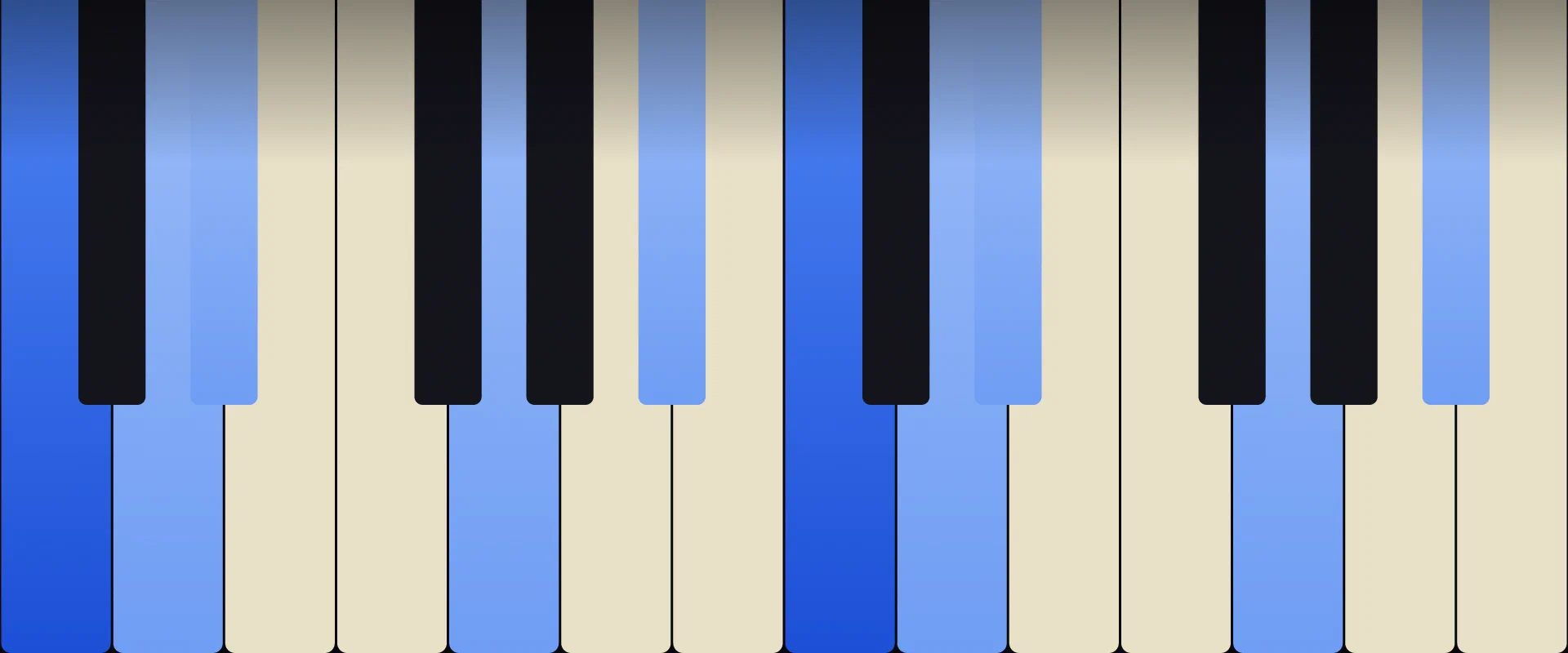
The ninth in this chord has a neighbour that the ninth in a major chord does not. D sits a whole tone above the root, as ninths always do, but the note immediately above it is E♭, one semitone away, and that relationship decides how the chord gets played. Set the D anywhere near the E♭ and the two grind; lift it an octave, above the B♭, and the same five notes are one of the warmest things on a keyboard. Almost everything below follows from that semitone. The notes are C, E♭, G, B♭ and D, two black keys and three white, and the white ones are a stack of fifths: C, G, D.
Try It: Cm9 in the Chord Finder
Set the root to C, switch the Ninth toggle on and look at the first degree of Phrygian. The ninth arriving there is D♭ rather than D, a different chord entirely.
The Notes of Cm9
| Degree | Note | Interval from root | Semitones |
|---|---|---|---|
| 1 (root) | C | Perfect unison | 0 |
| ♭3 | E♭ | Minor 3rd | 3 |
| 5 | G | Perfect 5th | 7 |
| ♭7 | B♭ | Minor 7th | 10 |
| 9 | D | Major 9th | 14 |
Written out: C, E♭, G, B♭, D. Both accidentals are flats and both land on black keys, so nothing here is spelled awkwardly. The ninth is major even though the chord is minor: the flats belong to the third and the seventh, and the ninth takes no alteration at all.
How Cm9 Is Built
Start from Cm7 and add a third on top, B♭ up to D. Now take the root away. What is left, E♭, G, B♭ and D, is E♭maj7 in root position, so the whole upper half of this chord is a major seventh chord on the flattened third. Add F and the pattern holds: the chord becomes Cm11 and the notes above the root become E♭maj9.
That is how the chord is fingered, not just how it is analysed. A pianist with a bass player in the room plays E♭maj7 and calls it Cm9, and a guitarist on the top four strings does the same. Extended Chords and Jazz Harmony covers which notes get dropped, and why a minor seventh chord takes a natural ninth without any argument.
Cm9 on the Piano
Two hands, always. C up to D is fourteen semitones with three notes inside that span, so one hand leaves no fingers over. Left hand on C, right hand on E♭, G, B♭ and D. That right hand is the Cm7 right hand slid up a third: C, E♭, G, B♭ spans ten semitones and E♭, G, B♭, D spans eleven, so the hand keeps its width and moves rather than opens.
Then obey the semitone. D belongs above the B♭, where the interval below it is a major third and the note reads as pure colour. Put the D under the E♭ instead and the two are a semitone apart, or a minor 9th apart if an octave separates them, which is the harshest interval available. A major ninth chord is forgiving here, its third standing a whole tone off the ninth. This one is not.
For solo playing, split it differently: left hand takes C and G as an open fifth, right hand takes E♭, B♭ and D and drops its own G as redundant.
Cm9 on the Guitar
No chord book prints an open Cm9, and the open strings show why. Only two of the six, D and G, hold chord tones, so C, E♭ and B♭ all have to be fretted before the ninth is even considered. What can be done is x 3 0 3 4 3, keeping the open D string as the ninth: index barred across the top three strings at the 3rd fret, ring finger on the second string at the 4th, middle finger on the fifth string, and the fourth string left alone.
The real answer is the 8th fret, and it is generous. Cm7 there is the E form barre, 8 10 8 8 8 8. Move the little finger onto the first string at the 10th fret and you have 8 10 8 8 8 10: C, G, B♭, E♭, G and D, all five notes present and the ninth on top where it belongs. One finger, nothing sacrificed.
The A form at the 3rd fret is the awkward one. x 3 1 3 3 3 sounds C, E♭, B♭, D and G: ring finger flat across the top three strings at the 3rd fret, middle finger on the fifth string beside it, index reaching back to the fourth string at the 1st fret. That reach is longer here than anywhere else the shape goes, since frets are widest by the nut and strings stiffest, so the grip is at its hardest on exactly this root. Drop the top string for x 3 1 3 3 x and the fifth goes, which costs nothing and makes it usable at speed.
Inversions
| Inversion | Notes | Bass | Symbol |
|---|---|---|---|
| Root position | C E♭ G B♭ D | C | Cm9 |
| 1st inversion | E♭ G B♭ D C | E♭ | Cm9/E♭ |
| 2nd inversion | G B♭ D C E♭ | G | Cm9/G |
| 3rd inversion | B♭ D C E♭ G | B♭ | Cm9/B♭ |
| 4th inversion | D C E♭ G B♭ | D | Cm9/D |
The first inversion has a name of its own. E♭, G, B♭, D with a C above them is an E♭maj7 with its sixth added, printed on a chart as E♭maj13, so two players reading the two different symbols are disagreeing only about which note is the root.
The bottom row needs care. It is the only arrangement forcing the D below the E♭, and low down it sounds broken. Read upwards from that D, though, and the notes spell a suspended chord with a flattened ninth, the Phrygian sound, which is why flamenco influenced writing reaches for it on purpose. Everywhere else, avoid it. See Chord Inversions and Voice Leading for how bass motion like this is handled.
Voicings
| Shape | Frets | Result |
|---|---|---|
| Cm9 | 8 10 8 8 8 10 | E form barre, all five notes |
| Cm9 | x 3 1 3 3 3 | A form, index back at the 1st fret |
| Cm9 | x 3 1 3 3 x | The same without the 5th |
| Cm9 | x 3 0 3 4 3 | Open D string as the 9th |
| Cm9 | x x 1 3 3 3 | Rootless: an E♭maj7 grip |
| Cm7 | 8 10 8 8 8 8 | The barre it grows from |
Play the rootless row over a bass C and the chord is Cm9; play it over a bass E♭ and it is E♭maj7.
Which Keys Contain Cm9
- degree 1 (I) of C dorian
- degree 1 (I) of C natural minor
- degree 2 (II) of B♭ major
- degree 6 (VI) of E♭ major
- degree 4 (IV) of G harmonic minor
- degree 3 (III) of A♭ lydian
The first two rows are where the ninth turns into information. C Dorian and C natural minor differ in one degree, the sixth: A in the first, A♭ in the second. The chord contains neither, so it is the tonic of both and a soloist can recolour a vamp without contradicting the harmony. C Phrygian was on that list too while the chord was still Cm7, and the ninth removes it, since the second degree there is D♭. One added note cut the choice of modes from three to two.
The chord holds no F♯, so it survives the raised seventh of G harmonic minor untouched and works as the minor iv in a cadence heading for G. A♭ lydian is the other outlier: put an A♭ under these five notes and the D becomes a ♯11, giving A♭maj9♯11, that scale as a single chord.
Where Cm9 Shows Up
| Progression | Chords | Context |
|---|---|---|
| i vamp (C dorian) | Cm9, F13sus4 | Same notes, bass moves |
| i VI (C minor) | Cm9, A♭maj9 | One note changes |
| I vi ii V (E♭ major) | E♭maj7, Cm9, Fm7, B♭7 | Ballads and soul |
| ii V I (B♭ major) | Cm9, F13, B♭maj9 | The chord’s day job |
The first row is not a figure of speech. Put an F under C, E♭, G, B♭ and D and the same five notes read as F13sus4: F is the root, G the ninth, B♭ the fourth, C the fifth, E♭ the seventh and D the thirteenth, with no third anywhere to spoil it. Hold the chord, move the bass a fourth, and the harmony has changed while the hands have not. A great deal of modal jazz and house piano runs on that.
The second row is nearly as economical. A♭maj9 is A♭, C, E♭, G and B♭, so four notes are already down and only the D leaves. A i to VI move in C minor becomes one voice stepping down a whole tone while an A♭ arrives underneath, which is why film and soul writing sits on those two chords for bars at a time without sounding static.
The last two rows are the chord in working clothes, and the cadence mechanics there belong to Cm7, which does the job with four notes. What the ninth adds is comping weight: a pianist reads Cm9 and plays E♭maj7 in the right hand, a guitarist adds one finger to a barre already under the hand, and the chord arrives with more body and no more effort. That is why neo soul, gospel and deep house treat it as the default minor chord rather than as an extension of anything.
Related Chords
- C Minor 7th Chord, the four notes underneath the ninth
- E♭ Major 7th Chord, what the top four notes spell on their own
- C Minor Chord, the triad at the bottom of the stack
- C Minor 6th Chord, A in place of B♭, a tonic that stays put
- C Dominant 9th Chord, the same ninth over a major third
- C Major 9th Chord, where the ninth has no semitone above it
- Extended Chords and Jazz Harmony for what else a minor seventh chord will take
Learn More
Practice Chords
Drill chord recognition with a metronome, MIDI support, and score tracking.
Start PracticingRelated Articles
A Minor 9th Chord: Notes, Voicings, and How to Play It
Sep 5, 2026 · 9 min
A♭ Minor 9th Chord: Notes, Voicings, and How to Play It
Sep 5, 2026 · 8 min
B Minor 9th Chord: Notes, Voicings, and How to Play It
Sep 5, 2026 · 8 min