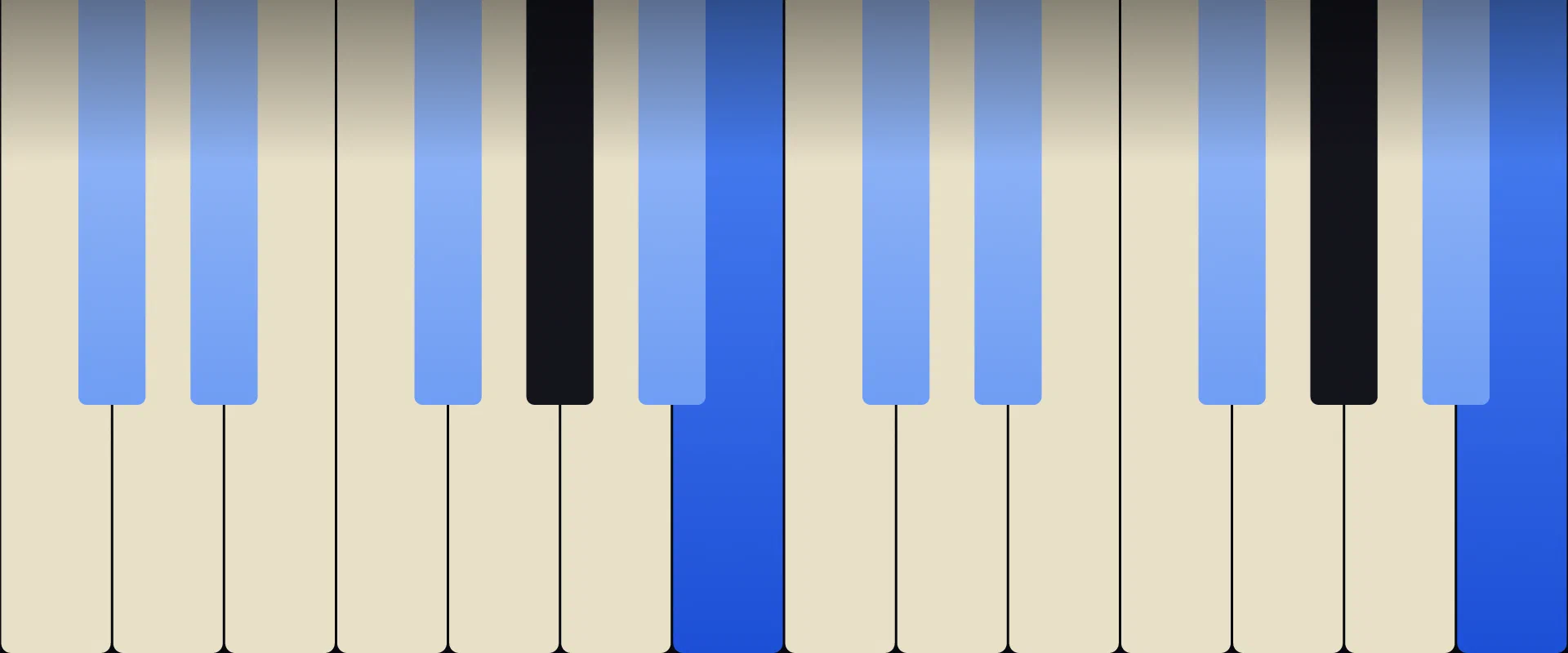
Take your hand off the white keys, play every black key except G♯, and put a single B underneath. That is this chord. Bmaj9 is B, D♯, F♯, A♯ and C♯, and the root is the only one of the five sitting at the front of the keyboard.
The guitar starts from the opposite impression and arrives somewhere friendly. Bmaj7 on this root has no open form and its working grip is an index barre at the second fret with three fingers crowded in behind it. Add the ninth and the barre goes away. x2132x asks for four separate fingers inside frets 1 to 3 and nothing else, so the bigger chord is the easier one to hold.
Try It: Bmaj9 in the Chord Finder
The Notes of Bmaj9
| Degree | Note | Interval from Root | Semitones |
|---|---|---|---|
| 1 (Root) | B | Perfect unison | 0 |
| 3 | D♯ | Major 3rd | 4 |
| 5 | F♯ | Perfect 5th | 7 |
| 7 | A♯ | Major 7th | 11 |
| 9 | C♯ | Major 9th | 14 |
Four sharps and one natural, which puts this chord at the crowded end of the circle of fifths. It is diatonic to B major, five sharps, and to F♯ major, six, and to no other major key. Why the seventh must be spelled A♯ rather than B♭ is an argument the Bmaj7 page settles in full.
How Bmaj9 Is Built
Stack C♯ on the major seventh and stop. No tritone appears anywhere in the five notes, so the chord keeps its settled quality and simply gains a top voice.
Read the upper four notes alone and they are D♯, F♯, A♯ and C♯, a D♯ minor seventh in root position. Bmaj9 is that chord with a B placed beneath it. The site files those four sounds under their flat names, as the E♭ minor 7th chord.
One semitone separates this chord from B9: lower A♯ to A, a tritone opens between third and seventh, and a chord with nowhere it needs to go acquires a destination. Take the seventh away instead and you have Badd9, a difference the extended chords guide covers properly.
Bmaj9 on the Piano
Four black keys and one white, and the white one is the root, sitting below the group rather than among it. Left hand takes B alone. Right hand takes D♯, F♯, A♯ and C♯ with 1, 2, 3 and 5, and every finger of that hand presses at the same depth. The shape has no forward and back in it at all, so the chord can be found without looking down.
The black keys arrive as a pair, C♯ and D♯, and a group of three, F♯, G♯ and A♯. This chord takes both members of the pair and the outer two of the group, straddling G♯ in the middle. Feel for that gap under the second and third fingers and the hand knows where it is before a note sounds.
G♯ is no danger either. Add it and the chord becomes a thirteenth on B, so all five black keys sit over this harmony with nothing that needs careful handling. A pianist can improvise on the black keys alone above a low B and never leave the chord, which no other root offers.
The caution is at the bottom, not the top. A♯ and B are neighbouring keys, so an extra low B added under an otherwise complete voicing turns the whole thing opaque.
Bmaj9 on the Guitar
x2132x, string by string: middle finger on the fifth string at fret 2 for the root B, index on the fourth at fret 1 for D♯, little finger on the third at fret 3 for A♯, ring finger on the second at fret 2 for C♯. The first string takes no part and is damped by the underside of the ring finger. Low to high it sounds B, D♯, A♯, C♯.
What is missing is F♯, the first thing to go from a five note chord, and here it goes for a physical reason rather than a musical one. F♯ sits on the first string at fret 2, so x21322 is a complete Bmaj9, and holding it takes five fingers unless the ring finger lies flat across the top two strings while the little finger arches over it to fret 3. Most hands decline.
Set the grip beside Badd9 and the entire difference is the third string. That chord has no seventh to put there and leaves the string silent. This one must sound A♯ at fret 3, and the finger that goes there is the one Badd9 had spare for the top string.
Higher up, take the E shape major seventh at the seventh fret, 798877, and move the first string from fret 7 to fret 9: B becomes C♯. The fifth string then drops out, since frets 8 and 9 have three fingers between them and the index is still holding the barre. 7x8879 remains, sounding B, A♯, D♯, F♯ and C♯ with nothing absent.
Inversions
| Inversion | Notes | Bass Note |
|---|---|---|
| Root position | B D♯ F♯ A♯ C♯ | B |
| 1st inversion | D♯ F♯ A♯ C♯ B | D♯ |
| 2nd inversion | F♯ A♯ C♯ B D♯ | F♯ |
| 3rd inversion | A♯ C♯ B D♯ F♯ | A♯ |
| 4th inversion | C♯ B D♯ F♯ A♯ | C♯ |
Five notes almost never appear in the order the table gives them, so the real question is which one the bass takes, and two of the rows rename the chord. With D♯ underneath, the top four are a D♯ minor seventh and B rides above them as a sixth degree, so a bass moving to the third turns a bright major chord into something that reads minor. With C♯ underneath, the five notes are root, seventh, ninth, eleventh and thirteenth on C♯: the dominant eleventh of F♯ major. The second of the two keys that hold this chord is one bass note away.
Voicings
Drop the root and xx1322 leaves D♯, A♯, C♯ and F♯ across the top four strings, third, seventh, ninth and fifth, waiting for a bass to supply B. Why rootless voicings work is the pillar’s business; what is local is that the shape still fits inside frets 1 to 3.
At the keyboard, split the chord as B and F♯ in the left hand with D♯, A♯ and C♯ in the right. D♯ and A♯ are the two notes that make the chord what it is, and both are raised keys, so that right hand states the identity and the colour together without ever coming forward.
Spacing decides the rest. In x2132x the third is at the bottom of the voicing and the ninth ten semitones above it, which is why a version with no fifth in it still sounds full rather than thin.
Which Keys Contain Bmaj9
- degree 1 (I) of B major
- degree 4 (IV) of F♯ major
- degree 1 (I) of B lydian
- degree 3 (III) of G♯ natural minor
- degree 7 (VII) of C♯ dorian
- degree 6 (VI) of E♭ natural minor
Six entries, two parent scales. G♯ natural minor and C♯ Dorian are B major read from other starting notes, and B Lydian is F♯ major read from its fourth degree, so this chord lives at five and six sharps and nowhere milder.
The last entry looks like an exception and is not. E♭ natural minor writes these five sounds as C♭, E♭, G♭, B♭ and D♭: identical pitches, every letter different, because a key with six flats cannot admit a note called B. C♭maj9 and Bmaj9 are one chord seen from opposite ends of the circle.
Where Bmaj9 Shows Up
| Progression | Numerals | Chords |
|---|---|---|
| Tonic vamp in B | Imaj9, IV | Bmaj9, E |
| Relative minor turn | i9, ♭IIImaj9 | G♯m9, Bmaj9 |
| Descent in F♯ | IVmaj9, iii7, ii7 | Bmaj9, A♯m7, G♯m7 |
| Phrygian ♭II | i, ♭IImaj9 | B♭m, C♭maj9 |
The first row is the practical one, and it works because both shapes are cheap. x2132x moving to the open E major at 022100 covers a tonic and a subdominant in five sharps with no barre anywhere, which is not what such a key signature usually promises. Singers ask for B major far more often than guitarists offer it.
Row two is four shared notes. G♯m9 is G♯, B, D♯, F♯ and A♯, so the move to Bmaj9 changes one voice only, G♯ rising to C♯, and the relative major and minor of a five sharp key become a single finger apart. Slow gospel and neo soul writing lives on that pair.
The third row is a keyboard idiom rather than a guitar one, since F♯ major is not a key the fretboard volunteers for. Watch the middle chord as it goes past: A♯m7 contains E♯, which is the white key called F, so the plainest looking chord in the descent is the one that forces the strangest name.
Row four moves the same five sounds into flat territory. In B♭ Phrygian the chord a semitone above the tonic is C♭ major, and its ninth, D♭, is already the third of the tonic chord, so the ♭II gives the full Spanish colour without dragging the ear anywhere new. The chart will say C♭maj9 while your hands play exactly what is described at the top of this page.
Related Chords
- B Major 7th Chord
- B Add9 Chord
- B Dominant 9th Chord
- B Major Chord
- B Major Scale
- Guitar Chord Shapes: The CAGED System
Learn More
Practice Chords
Drill chord recognition with a metronome, MIDI support, and score tracking.
Start PracticingRelated Articles

A Major 9th Chord: Notes, Voicings, and How to Play It
Sep 4, 2026 · 9 min
A♭ Major 9th Chord: Notes, Voicings, and How to Play It
Sep 4, 2026 · 8 min
B♭ Major 9th Chord: Notes, Voicings, and How to Play It
Sep 4, 2026 · 8 min