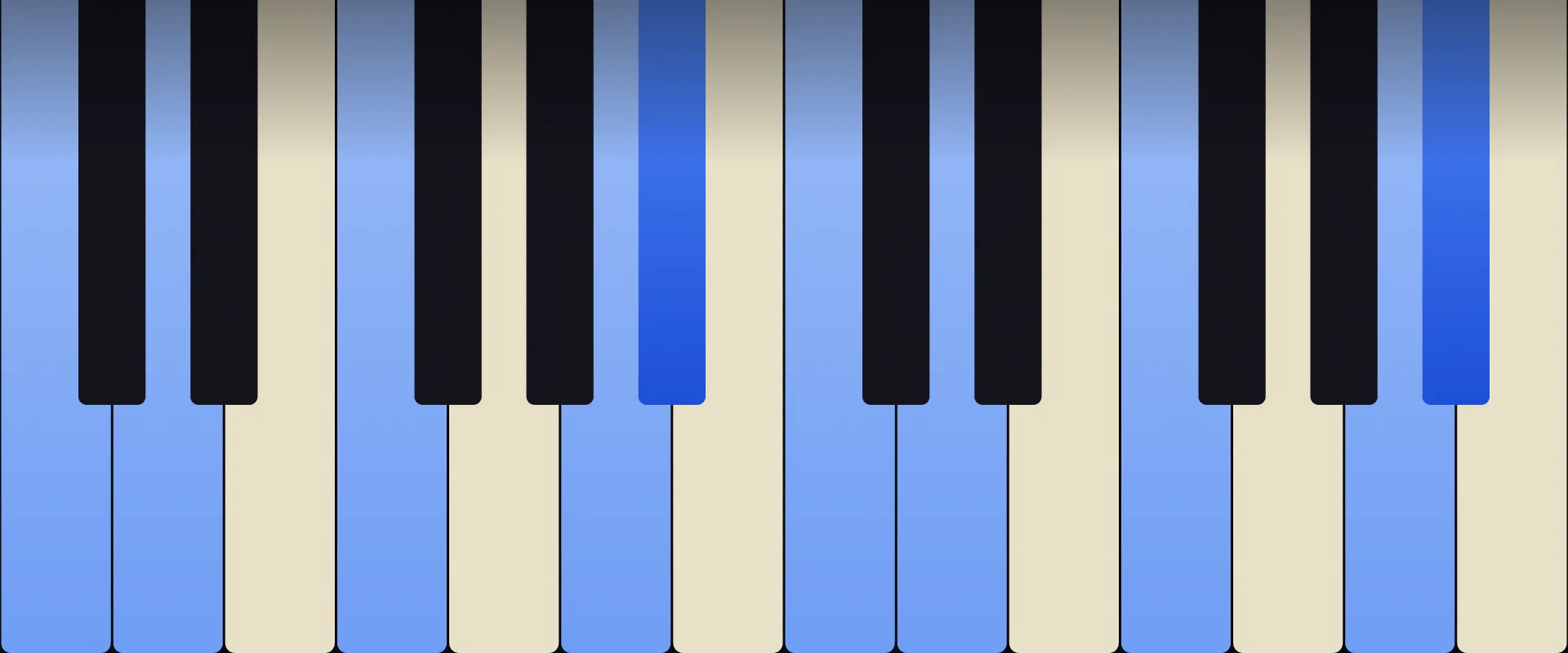
Five roots in this set are black keys, and only one of them carries a major 9th with nothing but white notes above it. B♭maj9 is that one: D, F, A and C sit on the naturals, and the single black key in the chord is the B♭ underneath them.
That matters because those four white notes are a chord in their own right, D F A C, a D minor 7th. Once a bass player or a left hand has the B♭, the whole of B♭maj9 above it is a shape almost everybody already owns, on either instrument.
Try It: B♭maj9 in the Chord Finder
Play B♭ alone, then add D, F, A and C above it and listen to how little the bottom note has to do.
The Notes of B♭maj9
B♭maj9 has five notes: B♭, D, F, A and C.
| Degree | Note | Interval from B♭ | Semitones |
|---|---|---|---|
| 1 (root) | B♭ | Perfect unison | 0 |
| 3 | D | Major 3rd | 4 |
| 5 | F | Perfect 5th | 7 |
| 7 | A | Major 7th | 11 |
| 9 | C | Major 9th | 14 |
One black key, four white ones.
How B♭maj9 Is Built
Take B♭maj7 and put C a major 9th above the root. Nothing below it changes, so every argument about the A natural in that chord still applies here, with one more note leaning over it.
The near neighbours differ from this chord by a single semitone each, which is worth knowing because the fingerings barely move. B♭add9 is the same B♭, D, F and C with no A at all. B♭9 keeps the A but flattens it, and the chord stops being a tonic and starts pulling towards E♭.
The scale that produces it is B♭ major, B♭ C D E♭ F G A, taken in thirds. The degrees skipped are E♭ and G, and E♭ is the one that cannot be added over the D. Extended Chords: Which Tensions Work sets out that rule across all chord qualities.
B♭maj9 on the Piano
The left hand makes the only trip to a black key. Put B♭ and F in it, a fifth apart, and the right hand never leaves the naturals: D, F, A and C under fingers 1, 2, 3 and 5, a minor 7th across, the plainest grip in the chord.
That is the version to learn first, because it puts the two notes that need distance at opposite ends. A and B♭ are a semitone apart, and the maj7 page explains what that rub is doing here. Voiced this way they are a minor 9th apart instead, which is exactly where the ear stops hearing a clash and starts hearing colour.
Squeezing all five into one hand means dropping F and reaching B♭ up to C, which most hands manage once and few manage at tempo. Inside D F A C there is also an F major triad: put that on top and C becomes the highest note, the brightest reading available.
B♭maj9 on the Guitar
The first fret, which is where B♭ chords usually go to suffer, holds the best voicing of this one. Play x 1 0 2 1 1. The middle finger takes B♭ on the fifth string, the fourth string stays open for D, the ring finger takes A on the third string at fret 2, and the index covers C and F on the top two strings at fret 1. Five notes, five degrees, nothing doubled, and no barre.
Search the whole neck below the fifth fret and that grip is the only one that sounds all five notes with B♭ at the bottom. Everything else either drops a degree or puts a different note in the bass.
Compare it with the dominant ninth on this root, which needs one finger. There the third string carried A♭ at fret 1, inside the reach of the same index finger doing everything else. The major 7th sits at fret 2 on that string, one fret out, and that single fret is the whole difference between a one finger chord and a three finger one.
Drop the root and you get x x 0 2 1 1, which is the open D minor 7th shape from a beginner’s first month. Over a B♭ bass it is a complete B♭maj9, which is the cheapest rootless voicing on the instrument.
Further up, the Emaj9 shape barred at fret 6 is 6 8 7 7 6 8 and holds everything, but wants a barre plus three fingers over two frets. x x 7 7 6 8 is the practical version, A, D, F and C, the same rootless four notes an octave above the open ones. Ignore the A shape maj9 moved to fret 1: it needs frets 1 and 7 at once. Guitar Chord Shapes and the CAGED System maps the positions between.
Inversions
| Inversion | Notes | Bass note | Symbol |
|---|---|---|---|
| Root position | B♭ D F A C | B♭ | B♭maj9 |
| 1st inversion | D F A C B♭ | D | B♭maj9/D |
| 2nd inversion | F A C B♭ D | F | B♭maj9/F |
| 3rd inversion | A C B♭ D F | A | B♭maj9/A |
| 4th inversion | C B♭ D F A | C | B♭maj9/C |
First inversion is the one that argues back. With D underneath, the four white notes are a D minor 7th in root position and the B♭ reads as a colour added on top rather than the thing the chord is named after.
Third inversion is the tense row, because A in the bass puts the semitone the wrong way round and stretches it into a minor 9th under everything else.
Fourth inversion is the useful one and it gets a different name. C, B♭, D, F and A is a C13sus4, the sus dominant of F major, which is why B♭/C appears on so many charts. Chord Inversions and Voice Leading covers the mechanics.
Voicings
D F A C is the rootless chord and the one to default to, all four notes white and all four degrees distinct.
B♭ D A C keeps the root and drops the 5th, which is the four part voicing for anyone carrying their own bottom end. D and A are the pair that fix the quality, so neither can go.
In the low register keep D at least a tenth above B♭, for the reason the pillar above gives.
Which Keys Contain B♭maj9
- I of B♭ major
- IV of F major
- I of B♭ lydian
- V of E♭ lydian
- VI of D natural minor
- III of G natural minor
The first and third entries produce identical notes. What separates B♭ lydian from B♭ major is E natural against E♭, and neither is a chord tone, so the tonic 9th chord cannot tell you which of the two you are in. The difference only surfaces if you carry on stacking to the 11th.
The E♭ lydian entry is neater than it looks. The note that makes that mode lydian is its A natural, and here that same A is the major 7th of the chord built on its fifth degree.
G natural minor is B♭ major’s relative minor, so its III is this chord doing tonic work from inside another key.
Where B♭maj9 Shows Up
Its most frequent job is as the IV chord of F major, and F is a key guitars and voices both like. Move from Fmaj7, F A C E, to B♭maj9 and three notes stay put: F, A and C are in both chords. Only E falls to D, and B♭ arrives underneath. Vamping I to IV in F therefore changes almost nothing while sounding like it changes a great deal, which is the whole engine of a certain kind of soul and gospel writing.
The same five notes serve the other side of that key too. Put C in the bass and B♭maj9 becomes the C13sus4 that precedes a resolution to F, so one grip covers both the chord before the cadence and the chord after it. Guitarists get this free: hold x x 0 2 1 1 and let the bass move from B♭ to C.
As a tonic it closes a cadence in its own key:
Cm7 | F7 | B♭maj9
F7 is F, A, C and E♭. Three of those four are already in the target chord, so the resolution is one voice moving a semitone, E♭ down to D. On the guitar that is the 1st fret ninth chord becoming the 1st fret major ninth, one finger shifting one fret.
Two flats normally sends a guitarist reaching for a capo. This chord is the argument for staying put.
Related Chords
- B♭ Major 7th Chord, the four notes underneath, before C arrives.
- B♭ Add9 Chord, the same C with the A removed.
- B♭ Dominant 9th Chord, one semitone away, and pulling somewhere.
- D Minor 7th Chord, the four white notes that sit above the root.
- Extended Chords: Which Tensions Work, on rootless voicings and what gets dropped.
Learn More
Practice Chords
Drill chord recognition with a metronome, MIDI support, and score tracking.
Start PracticingRelated Articles

A Major 9th Chord: Notes, Voicings, and How to Play It
Sep 4, 2026 · 9 min
A♭ Major 9th Chord: Notes, Voicings, and How to Play It
Sep 4, 2026 · 8 min
B Major 9th Chord: Notes, Voicings, and How to Play It
Sep 4, 2026 · 8 min