Four of a guitar’s six open strings sound notes this chord wants, and between them they amount to three: A, B and E. Sound only those and you have Asus2, which declares nothing about major or minor. The two notes standard tuning will not supply are C♯ and G♯, the third and the major 7th, exactly the pair that decides what the chord is. The instrument gives away the skeleton and charges for the meaning, and everything awkward about Amaj9 near the nut follows from that.
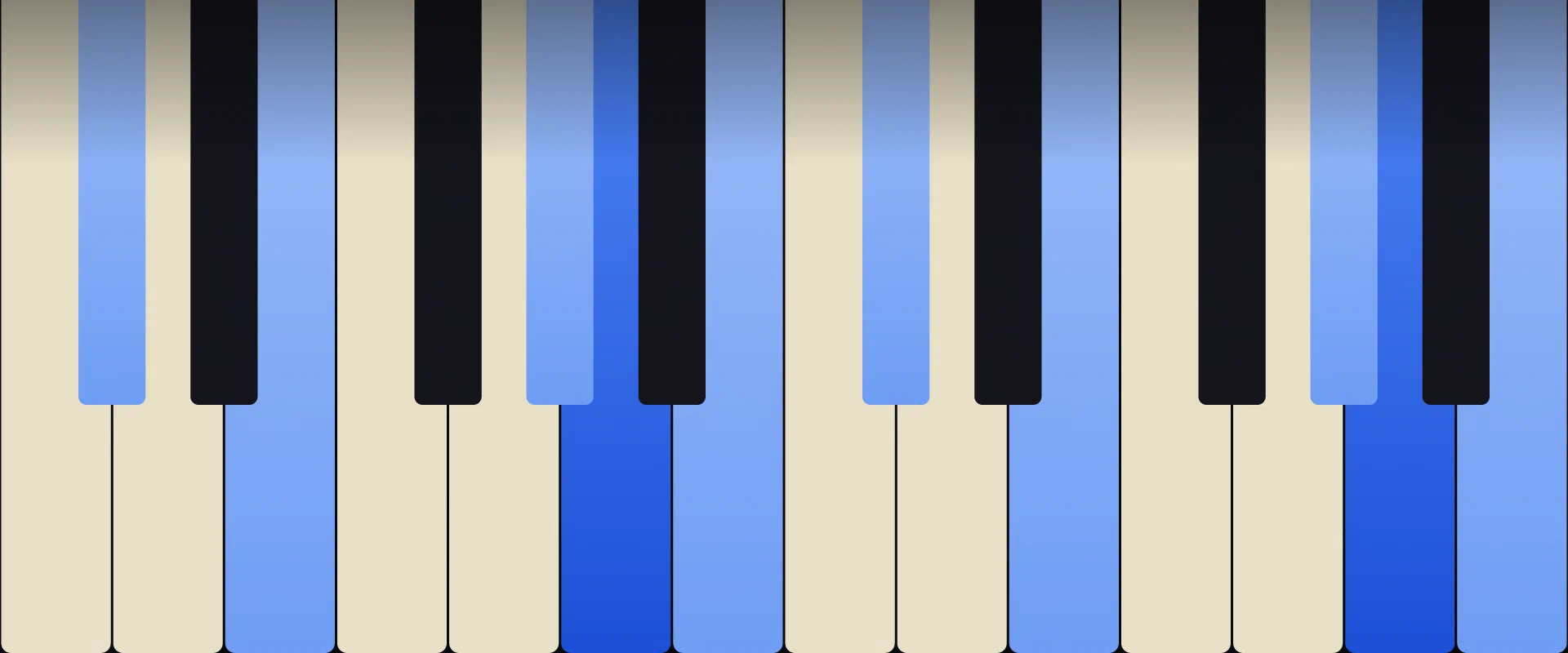
Try It: Amaj9 in the Chord Finder
Sound Amaj7, then set a B above it. Listen for the G♯ losing its place at the top of the chord.
The Notes of Amaj9
| Degree | Note | Interval from root | Semitones |
|---|---|---|---|
| 1 (root) | A | Perfect unison | 0 |
| 3 | C♯ | Major 3rd | 4 |
| 5 | E | Perfect 5th | 7 |
| 7 | G♯ | Major 7th | 11 |
| 9 | B | Major 9th | 14 |
Written out: A, C♯, E, G♯, B. Three white keys, two black, and the split falls along a useful line. Both accidentals carry quality: C♯ makes the chord major, G♯ makes it a major seventh rather than a dominant. The white keys are the frame, and on their own they are Asus2.
How Amaj9 Is Built
Take Amaj7, which is A, C♯, E and G♯, and put a B a whole tone above the root, an octave up. Nothing is removed and nothing is altered.
What changes is which note finishes the chord. In Amaj7 the G♯ is the highest voice and leans a semitone under the root, which is why that chord never quite settles. Cover it with a B and the leading note becomes an inner voice. The friction is still there, but it is no longer the last thing the ear hears.
Drop the G♯ to G and the chord is A9, with a tritone in it and somewhere to go. Take the G♯ out and A, C♯, E and B is Aadd9, a distinction the guide to extended chords settles in full.
Take the Root Away and It Is C♯m7
The four notes above the bass, C♯, E, G♯ and B, are a C♯ minor 7th in root position, so a pianist holding C♯m7 and a bass player on A produce this chord between them without either of them playing it. Put F♯ under those same four notes instead and you have F♯m11 complete, root, ♭3rd, 5th, ♭7th, 9th and 11th.
Amaj9 on the Piano
The root has to leave the hand. A up to B is fourteen semitones, three more than Amaj7 asks for, which is the difference between a chord one hand can close around and a chord it cannot. A2 goes to the left, and C♯4, E4, G♯4 and B4 to the right, a span of ten semitones under 1, 2, 3 and 5.
That right hand shape is C♯ minor 7th, so a player who owns that chord owns this one and only has to remember the floor. The thumb does land on a raised key, which sets the wrist deep into the keyboard; rolling the notes to E, G♯, B, C♯ puts it back on white.
Then hold those four still and change the bass. A underneath gives Amaj9, F♯ gives the F♯m11 above, and D gives a lydian D chord, the C♯ its major 7th and the G♯ its ♯11. One hand position, three chords, one moving note.
Amaj9 on the Guitar
Watch the open strings get spent one at a time. Open Amaj7 is x 0 2 1 2 0, sounding A2, E3, G♯3, C♯4 and E4. The B is free on the open second string, except that string is holding the C♯, as the Aadd9 page works out in detail. So the B moves to the third string at the 4th fret, which evicts the G♯ to the first string at the 4th fret, which was the open top E.
What is left is x 0 2 4 2 4: A2, E3, B3, C♯4, G♯4, all five notes, and one open string where the A major shape had three. It is the Aadd9 grip with the top string raised a major third, from open to the 4th fret.
The trap is in the middle of the grip. The C♯ sits on the second string at the 2nd fret with both of its neighbours held two frets ahead, so both of those fingers have to arch clear of it. Barre the 2nd fret across the fourth to second strings with the index, then take the third string at the 4th with the ring finger and the first string at the 4th with the little one. Any lean and the C♯ becomes a D♯.
Most players never get that far, because x 0 2 1 0 0 is two fingers and sounds lovely. It is Amaj7 with the C♯ swapped for the open B, leaving A, E, G♯ and B: an E major triad over an open A bass, the dominant of the key sitting on its own tonic. With no third in it, it commits to nothing until a singer or a bass line supplies the C♯.
Up the neck the Emaj9 shape at the 5th fret, 5 x 6 6 5 7, restores everything: root in the bass, all five notes, fifth string damped because the barre would put a D there. Drop the root and x x 6 6 5 7 is the comping grip, four adjacent strings carrying the 7th, 3rd, 5th and 9th.
Inversions
| Inversion | Notes | Bass | Symbol |
|---|---|---|---|
| Root position | A C♯ E G♯ B | A | Amaj9 |
| 1st inversion | C♯ E G♯ B A | C♯ | Amaj9/C♯ |
| 2nd inversion | E G♯ B A C♯ | E | Amaj9/E |
| 3rd inversion | G♯ B A C♯ E | G♯ | Amaj9/G♯ |
| 4th inversion | B A C♯ E G♯ | B | Amaj9/B |
The first inversion barely answers to the name. With C♯ lowest the chord is a complete C♯m7 carrying an A a minor 6th above the bass, and the ear takes it as C♯ minor with something added rather than an A chord at all.
The third inversion has teeth, since it puts the G♯ directly under the root, and it belongs in a bass line rather than at a cadence. Used that way it is the best thing in the chord: hold C♯, E, G♯ and B and walk A, G♯, F♯ underneath, the last of those being the F♯m11 again. With B lowest, A becomes a flattened 7th and the chord is what charts print as A/B.
Voicings
| Voicing | How to play it |
|---|---|
| Open Amaj9 | x 0 2 4 2 4, all five notes, one open string left |
| Two fingers, no third | x 0 2 1 0 0, an E major triad over the open A |
| Barre at the 5th fret | 5 x 6 6 5 7, the Emaj9 shape moved up |
| Comping grip | x x 6 6 5 7, top four strings, 7th, 3rd, 5th and 9th |
| Piano, split | A2 in the left hand, C♯4, E4, G♯4 and B4 in the right |
| Piano, thumb on white | A2 in the left hand, E4, G♯4, B4 and C♯5 in the right |
| Over a moving bass | Hold C♯, E, G♯ and B and play A, then F♯, then D |
Which Keys Contain Amaj9
- degree 1 (I) of A major
- degree 4 (IV) of E major
- degree 6 (VI) of C♯ natural minor
- degree 3 (III) of F♯ dorian
- degree 7 (VII) of B dorian
- degree 4 (IV) of E mixolydian
Five notes fix six of the seven degrees of any scale that holds this chord. A, B, C♯, E and G♯ are the 1st, 2nd, 3rd, 5th and 7th, the 6th comes out as F♯ either way, and the only open question left is the 4th, D or D♯. Amaj7 leaves two degrees undecided; the B closes one of them.
That last choice sorts the list into two collections. A major, B dorian and E mixolydian take D. E major, C♯ minor and F♯ dorian take D♯. For a soloist it is barely a choice, since D sits a semitone above the C♯ and behaves as the avoid note rule says it will. Most players take the D♯ and play lydian whatever the key signature says.
Where Amaj9 Shows Up
| Progression | In this key | Chords |
|---|---|---|
| ii7, V7, Imaj9 | A major | Bm7, E7, Amaj9 |
| i7, VImaj9, i7 | C♯ minor | C♯m7, Amaj9, C♯m7 |
| Falling bass | A major | Amaj9, Amaj9/G♯, F♯m11 |
| Final chord | A major | E7, Amaj9 |
The cadence in the first row resolves with one voice moving. E7 is E, G♯, B and D, and three of those four are already in Amaj9, so only the D goes anywhere, dropping a semitone to C♯. The G♯ that a textbook calls the leading note does not resolve at all: it stays put as the major 7th of the tonic chord, which is why the arrival settles rather than lands.
C♯ minor gets the chord almost for free. The tonic seventh of that key is C♯m7, and the whole of it lives inside Amaj9, so a keyboard player holds one voicing while the bass steps down a minor 3rd to A and the harmony changes name without anybody moving a finger. Loops in this key are built that way because nothing has to be re-voiced.
As a last chord it does a job Amaj7 cannot. Ending on Amaj7 leaves the G♯ pressed against the root as the final sound; ending on Amaj9 buries it under the B, and the piece stops rather than hovers. That the tonic chord of this particular key also takes three open strings is why soul ballads and bossa arrangements written for guitar keep landing here.
Related Chords
- A Major 7th Chord the four notes underneath it
- A Add9 Chord the same B with no seventh below it
- A Dominant 9th Chord the G♯ pulled down to G
- C♯ Minor 7th Chord what is left when the root goes
- E Major Chord the triad inside the two finger open form
- Guitar Chord Shapes: The CAGED System
Learn More
Practice Chords
Drill chord recognition with a metronome, MIDI support, and score tracking.
Start PracticingRelated Articles
A♭ Major 9th Chord: Notes, Voicings, and How to Play It
Sep 4, 2026 · 8 min
B Major 9th Chord: Notes, Voicings, and How to Play It
Sep 4, 2026 · 8 min
B♭ Major 9th Chord: Notes, Voicings, and How to Play It
Sep 4, 2026 · 8 min