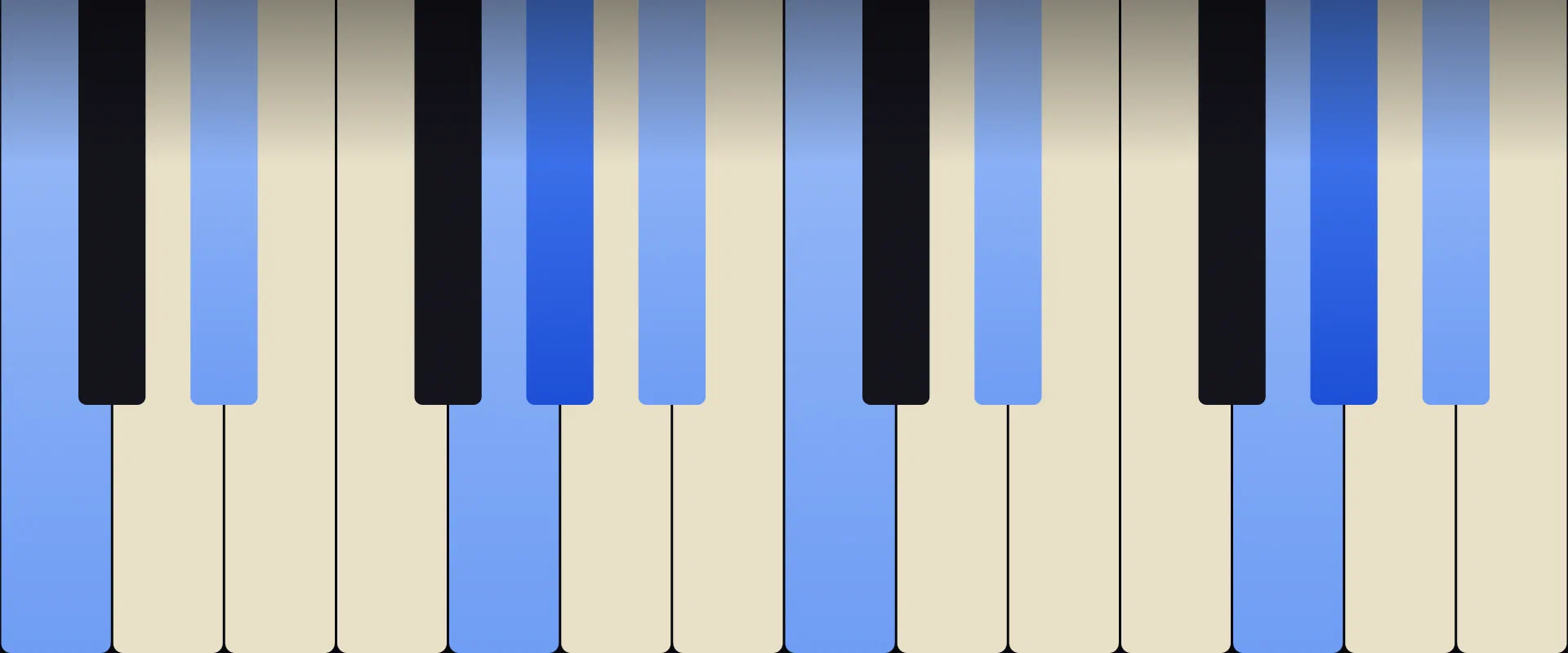
Two of these five notes are white keys, and they are the two that name the chord. C is the third, G is the major 7th, and that pair rules out every other chord these notes could belong to. A♭, E♭ and B♭ take the black keys and build the frame: root, fifth, ninth, a stack of two perfect fifths that says nothing at all about quality.
Of the twelve roots covered here, only one other splits a major 9th that cleanly, and it is C♯, where the two white keys have to be written E♯ and B♯. On A♭ they are a plain C and a plain G with nothing attached to either. A chord that needs three flats to write turns out to have no awkward letters in it anywhere.
Try It: A♭maj9 in the Chord Finder
The Notes of A♭maj9
| Degree | Note | Interval from root |
|---|---|---|
| 1 | A♭ | Perfect unison |
| 3 | C | Major 3rd, 4 semitones |
| 5 | E♭ | Perfect 5th, 7 semitones |
| 7 | G | Major 7th, 11 semitones |
| 9 | B♭ | Major 9th, 14 semitones |
Written low to high in root position: A♭ C E♭ G B♭.
How A♭maj9 Is Built
A♭maj7 is A♭ C E♭ G. B♭ goes above it and nothing is displaced, so every judgement the seventh chord made survives. What the ninth adds is height rather than argument, and the extended chords guide covers the general case of stacking one degree on another.
The three ninth chords on this root sit in a chain one note apart. Lower G to G♭ and A♭maj9 becomes A♭9, a dominant with somewhere to go. Lower C to C♭ as well and you arrive at A♭m9. Root, fifth and ninth never move through any of that, which is another way of saying the black keys are common property and the white ones do all the deciding.
Take the seventh away instead of moving it and you have A♭add9.
A♭maj9 on the Piano
Hold A♭, E♭ and B♭ in the left hand and you have committed to nothing. Those three black keys are the shared frame of all three ninth chords on this root, and a listener hearing them alone cannot tell which one is coming. Then the right hand plays C and G, two white keys a fifth apart, and the chord is settled in one gesture. No other quality on A♭ lets the deciding notes land on white keys together.
In practice the ninth travels with the right hand rather than the left. Thumb on C, 4 on G, 5 on B♭ gives a span of ten semitones with two whites and one black under the fingers, and it puts B♭ at the top, which is where a ninth is worth having. The left hand keeps A♭ and E♭, or just A♭ if somebody else is covering the bottom.
The arrangement to avoid is B♭ sitting immediately under C, a whole tone apart with the white key B between them, low in the left hand. That is the spacing problem the extended chords guide sets out in full, and on this root it is easy to fall into, because B♭ is a comfortable key for the left hand to reach and C is right beside it.
A♭maj9 on the Guitar
One chord tone is free on this instrument, the open G string sounding the major 7th, and adding B♭ makes it harder to keep, since everything else then has to be found within a fret or two of the nut.
It can be done if the root goes to the bass player. Play x 1 1 0 1 x: B♭ on the A string at the 1st fret, E♭ on the D string at the 1st, the G string open, C on the B string at the 1st. Index across the two lower strings, middle finger on the B string, nothing above the first fret, and the result is the ninth, fifth, seventh and third of A♭maj9 with no A♭ anywhere in it. Guitarists who know that grip as a Cm7 have already met this chord without being told.
With the root included, the working shape is at the 4th fret: 4 x 5 5 4 6. A♭ on the low E string, the A string muted, G and C on the D and G strings, E♭ on the B string and B♭ on top. Index barres the 4th fret, middle and ring take the 5th, the little finger reaches the 6th. Barring all six strings for 4 6 5 5 4 6 adds a doubled fifth and a fight, and most players drop it.
Higher up, four adjacent strings at the 11th fret carry the entire family. A♭maj9 is x 11 10 12 11 x. Move the G string down one fret to 11 and the seventh flattens: that is A♭9. Take the D string down one fret as well, to 9, and the third flattens too, which is A♭m9. The frets are narrow up there and the grip is small, so the distance between a tonic and a dominant is one fingertip.
Inversions
| Inversion | Notes low to high | Bass note |
|---|---|---|
| Root position | A♭ C E♭ G B♭ | A♭ |
| 1st inversion | C E♭ G B♭ A♭ | C |
| 2nd inversion | E♭ G B♭ A♭ C | E♭ |
| 3rd inversion | G B♭ A♭ C E♭ | G |
| 4th inversion | B♭ A♭ C E♭ G | B♭ |
Third inversion is gentler here than it is on the seventh chord. A♭maj7 in third inversion puts A♭ directly above the G in the bass and grinds; add the ninth and B♭ sits between them, so G B♭ A♭ spreads the same semitone over a minor 3rd and a whole tone. The chord survives a bass note that would otherwise ruin it.
Fourth inversion changes the name. Read B♭ A♭ C E♭ G upwards and B♭ has a minor 7th, a 9th, an 11th and a 13th above it with no third anywhere: B♭13sus4, the chord charts write as A♭/B♭. Keyboard players use it as the dominant of E♭ without moving a finger in the right hand.
First inversion is the quiet workhorse. With C at the bottom the lower four notes make a C minor 7th and A♭ rides above them, so a passage can cross between the two names without the bass moving.
Voicings
Drop the fifth. A♭, C, G and B♭ are root, third, seventh and ninth, and E♭ is the note nobody misses, which is exactly what the 11th fret grip does.
Drop the root as well and what remains is Cm7, C E♭ G B♭, a rootless voicing that hands the bass player the only note it is missing.
Swap G for F and the chord becomes A♭6/9, which A♭6 covers: same brightness, no major 7th, and a much easier chord to end on. Keep G and add F above B♭ instead and it is A♭maj13. What must not go in is D♭, the eleventh, which lands a semitone above the C and cancels it.
Which Keys Contain A♭maj9
- I of A♭ major
- IV of E♭ major
- VI of C natural minor
- I of A♭ lydian
- V of D♭ lydian
- II of G phrygian
The two lydian entries are worth taking together. A♭ lydian and D♭ lydian are different collections, D against D♭, and this chord belongs to both because it contains neither note. As the fifth degree of D♭ lydian it occupies the position a dominant would normally hold while carrying a major 7th, so it cannot cadence, which is the whole reason lydian writing sounds becalmed.
G phrygian is the sharpest entry. There the chord sits a semitone above the tonic, and its ninth, B♭, is the third of the G minor triad underneath. The flattened second arrives already holding a note the tonic owns, so it slides back down without ever sounding foreign.
Where A♭maj9 Shows Up
| Progression | In letters | Where it lives |
|---|---|---|
| ii7, V7, Imaj9 | B♭m7, E♭7, A♭maj9 | Turnaround into A♭, jazz and soul |
| IVmaj9, V, iii7, vi7 | A♭maj9, B♭, Gm7, Cm7 | City pop and R&B in E♭ |
| Imaj9, II7 | A♭maj9, B♭7 | Lydian vamp, film and television cues |
Row one arrives with almost nothing moving. E♭7 is E♭ G B♭ D♭, and three of those four notes are in the target chord already, so a pianist holding E♭ G B♭ in the right hand can leave it exactly where it is while the bass drops to A♭ and the D♭ falls a semitone to C. The chord that felt like a dominant a moment ago has become the fifth, seventh and ninth of the tonic.
Row two is the reason this chord turns up on so many records that never mention jazz. In E♭, the fourth degree opens the phrase, and by the time the progression reaches Cm7 it has landed on the four notes that were sitting inside A♭maj9 from the start. The tune goes somewhere, the harmony circles back to its own contents.
Row three needs the chord to stay put. B♭7 carries D natural, the raised fourth of A♭ lydian, and rocking between the two chords states the mode without either of them resolving. Scoring for picture leans on this because it suspends time without sounding unstable, and A♭ suits the keyboard instruments that usually play it.
Related Chords
- A♭ Major 7th Chord the four notes underneath this one the same frame with both white keys lowered
- A♭ Dominant 9th Chord one note away, and the chord that travels
- A♭ Add9 Chord the ninth with no seventh under it
- C Minor 7th Chord the rootless voicing, under its own name
- A♭ Lydian Scale the mode behind row three
Learn More
Practice Chords
Drill chord recognition with a metronome, MIDI support, and score tracking.
Start PracticingRelated Articles

A Major 9th Chord: Notes, Voicings, and How to Play It
Sep 4, 2026 · 9 min
B Major 9th Chord: Notes, Voicings, and How to Play It
Sep 4, 2026 · 8 min
B♭ Major 9th Chord: Notes, Voicings, and How to Play It
Sep 4, 2026 · 8 min