No chord book prints an open Gmaj9. Take the open Gmaj7, 3 2 0 0 0 2, stop the 3rd string at the 2nd fret, and the whole chord is under your hand: G, B, D, F♯ and A, one finger from a grip most players already own. The omission is a habit, not a verdict.
That 3rd string is where this root keeps its ninth. The plain triad, G6, G7, Gmaj7, Gsus2 and Gsus4 all leave it open, ringing as a bare G, the third G in the chord and the note it can most afford to lose. Gadd9 was the first to fret it. This is the second, at the same fret for the same reason: inside the first four frets, the only A that sounds a genuine ninth above the bass G is there.
Try It: Gmaj9 in the Chord Finder
The Notes of Gmaj9
| Degree | Note | Interval from Root | Semitones |
|---|---|---|---|
| 1 (Root) | G | Perfect unison | 0 |
| 3 | B | Major 3rd | 4 |
| 5 | D | Perfect 5th | 7 |
| 7 | F♯ | Major 7th | 11 |
| 9 | A | Major 9th | 14 |
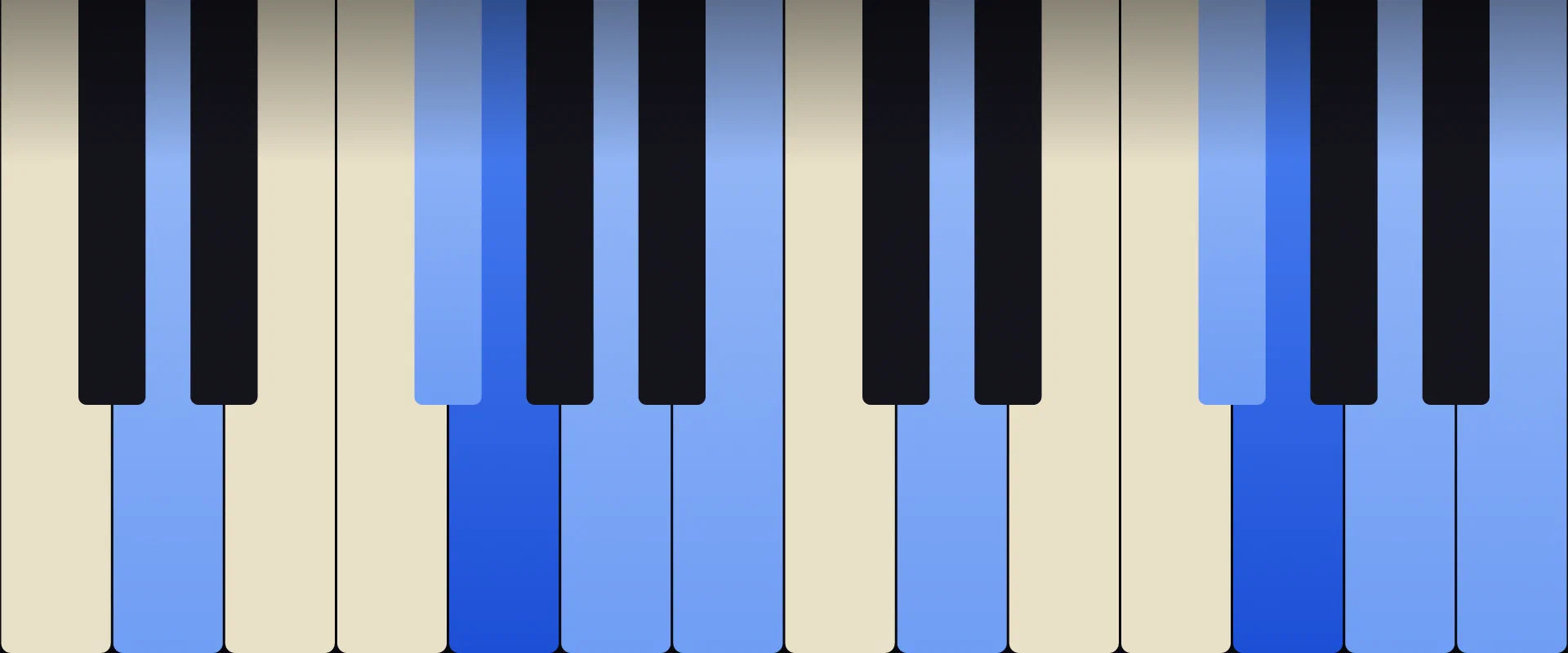
Written Gmaj9, GM9 or GΔ9. Four white keys and one black, and the black one is the F♯ the key signature of G major supplies anyway.
How Gmaj9 Is Built
Gmaj7 with A placed fourteen semitones above the root. That page has already noticed that the upper four notes spell Bm7. Take the upper three instead and D, F♯ and A is a plain D major triad, so the tonic ninth of the key of G contains the key’s own dominant triad, sitting on top and behaving nothing like a dominant.
Squeeze all five into one octave and they read G, A, B, D, F♯. Whole step, whole step, minor 3rd, major 3rd, then a semitone back to the top. One semitone in the whole chord, the same F♯ against G that the major seventh already had, so the ninth introduces no new friction at all.
Gmaj9 on the Piano
One black key in five, and it is fourth from the bottom. Root position takes all five fingers: 1 on G, 2 on B, 3 on D, 4 on F♯, 5 on A, fourteen semitones from thumb to little finger.
The ninth improves the hand rather than complicating it. In Gmaj7 the F♯ falls to the little finger, the weakest one, out at the end of the stretch and set back into the keyboard while the thumb stays at the front edge. Add the A and that job passes to finger 5 on a white key, the black key moves inward to the ring finger, and 3 and 5 sit either side of it on D and A. Wider, and much easier to sound evenly.
One spacing rule carries over, the one Gmaj7 already sets out: F♯ and G must not be neighbours. Nothing the ninth brings can go wrong, since A is a whole step from both of the notes flanking it. Give G to the left hand alone, B, D, F♯ and A to the right, and the ninth arrives on top of its own accord.
Then practise it standing still. Hold those four notes in the right hand and play nothing but bass notes with the left. Over G the chord is Gmaj9. Move down to D and the same four become D6, the tonic of the neighbouring key, with the right hand motionless. That is the IV to I of D major played by a hand doing nothing at all.
Gmaj9 on the Guitar
The open form is 3 2 0 2 0 2, sounding G, B, D, A, B and F♯ from the bottom. Middle finger on the 6th string at the 3rd fret, index on the 5th at the 2nd, ring on the 3rd string at the 2nd, little finger on the top string at the 2nd. Three fingers at one fret with an open string between each pair, so all three have to arch clear, and the 4th and 2nd strings tell you at once whether they have. Damp the 5th string instead and 3 x 0 2 0 2 keeps all five notes for two fingers, since the B the index was holding only doubled the open 2nd string.
Notice where the A lands. It sounds at A3, a ninth above the bass, yet it sits below the open B, so the guitar buries the colour note in the middle and leaves the major seventh on top. That reverses the usual advice about keeping the brightest note highest, and it is why the open form sounds settled rather than showy.
| Form | Frets | Notes sounded |
|---|---|---|
| Open, all five notes | 3 2 0 2 0 2 | G B D A B F♯ |
| Open, three fingers | 3 x 0 2 0 2 | G D A B F♯ |
| Rootless at the nut | x x 0 2 0 2 | D A B F♯ |
| E shape, barred at 3 | 3 x 4 4 3 5 | G F♯ B D A |
| A shape, fret 10 | x 10 9 11 10 x | G B F♯ A |
The barre at the 3rd fret hides a trap. Index across the fret, middle and ring on the 4th and 3rd strings at the 4th, little finger on the top string at the 5th, and every note is right except one: the barre is also holding the 5th string down at C, the natural 11th above a major 3rd, the one note this chord must never contain. The finger that makes the shape possible frets the note that ruins it. Chord charts print an x on that string and rarely say why.
High up, x 10 9 11 10 x gives one note per string, no fifth, and the ninth on top. Set it against the funk grip on G9, which is x 10 9 10 10 x: the 3rd string climbs a single fret and the chord stops being a dominant. That string decides this chord twice, once at the nut and once at the 10th fret.
Inversions
| Inversion | Notes | Bass | Symbol |
|---|---|---|---|
| Root position | G B D F♯ A | G | Gmaj9 |
| 1st inversion | B D F♯ A G | B | Gmaj9/B |
| 2nd inversion | D F♯ A G B | D | Gmaj9/D |
| 3rd inversion | F♯ A G B D | F♯ | Gmaj9/F♯ |
| 4th inversion | A G B D F♯ | A | Gmaj9/A |
Turning the chord over never removes the F♯ against G. It only decides whether that pair sounds as a major 7th, a minor 9th or a bare semitone, and root position is the one arrangement that guarantees the first of the three. Hence the habit of players who happily invert a triad on this root and leave the ninth chord alone.
The last row is not really this chord. With A underneath everything the ear takes A as the root and hears a suspended dominant, the reading pop charts want when they approach D major without a leading tone.
Voicings
Drop the D first, as always: the order in which notes leave puts the fifth at the front of the queue, and G, B, F♯ and A says everything the symbol promised. Do not double the A either.
Better is to keep all five in one hand and move the bass under them. Over G they are Gmaj9. Over E they are Em11 in full, every note of that stack present and nothing omitted. Over C they supply the fifth, major seventh, ninth, sharp eleventh and thirteenth of Cmaj13♯11, which is everything C lydian offers except its own third. One shape, three chords, and the last of them explains why C lydian appears in the list below.
Which Keys Contain Gmaj9
- I of G major
- IV of D major
- III of E natural minor
- VI of B natural minor
- V of C lydian
- VII of A dorian
Two key signatures cover the lot. Every scale here containing Gmaj9 is a rotation of G major, with one sharp, or of D major, with two, so C lydian and A dorian above are not extra keys but the same seven notes read from other starting points.
Adding the ninth costs one scale, and the loss is instructive. B harmonic minor carries G, B, D and F♯ on its sixth degree quite happily, then raises its own seventh degree to A♯. The ninth it offers is therefore A♯, so that scale gives Gmaj7 and refuses Gmaj9, which is why the cadence in the fourth row below has to borrow a note.
Where Gmaj9 Shows Up
| Progression | Chords | Typical use |
|---|---|---|
| ii7, V7, Imaj9 in G | Am7, D7, Gmaj9 | Jazz standards landing in G |
| Imaj9, IVmaj9 in D | Dmaj9, Gmaj9 | Bossa nova and neo soul vamps |
| i9, ♭IIImaj9 in E minor | Em9, Gmaj9 | Folk rock and modal pop |
| VI, V7, i in B minor | Gmaj9, F♯7, Bm | Minor cadences with a lush sixth |
| ♭VII over a static A | Am7, Gmaj9 | Dorian vamps in film and television |
| Final chord of a chart in G | D7, Gmaj9 | Endings that arrive without settling |
Row two is almost free on a guitar. Dmaj9 as x 5 4 6 5 x and Gmaj9 as x 10 9 11 10 x are one shape five frets apart, and the two chords share three notes, since D, F♯ and A is the root, third and fifth of one and the fifth, seventh and ninth of the other.
Row four is where the previous section pays off. F♯7 needs A♯, the very note that stopped B harmonic minor producing this chord, so the cadence works by reaching for a scale the sixth degree cannot live in.
Row three barely moves at all. Em9 is E, G, B, D and F♯, so four of the five notes are shared and the change amounts to trading the E for an A. On a guitar it costs two fingers: open Em9 is 0 2 0 0 0 2 and this chord is 3 2 0 2 0 2, with the 5th, 4th, 2nd and 1st strings identical in both. Only the bass string and the 3rd move, and the 3rd string is doing what it has done throughout.
Related Chords
- G Major 7th Chord, the four notes underneath this one
- G Add9 Chord, the same ninth with no seventh below it
- G Dominant 9th Chord, F natural in place of the F♯
- G Major 6th Chord, the other way to colour this triad
- B Minor 7th Chord, the upper four notes on their own
- The G Major Scale
- The C Lydian Scale
- Guitar Chord Shapes: The CAGED System
Learn More
Practice Chords
Drill chord recognition with a metronome, MIDI support, and score tracking.
Start PracticingRelated Articles
A Major 9th Chord: Notes, Voicings, and How to Play It
Sep 4, 2026 · 9 min
A♭ Major 9th Chord: Notes, Voicings, and How to Play It
Sep 4, 2026 · 8 min
B Major 9th Chord: Notes, Voicings, and How to Play It
Sep 4, 2026 · 8 min