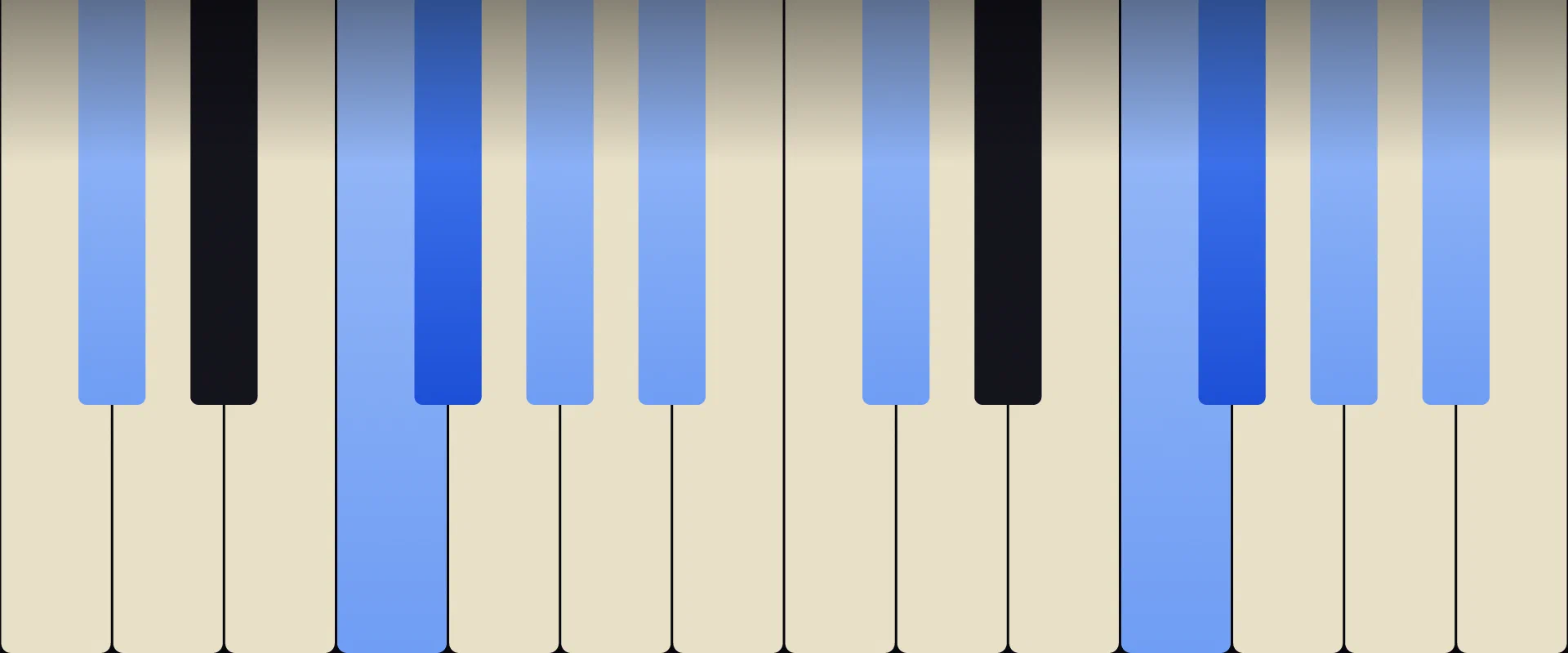
Fourteen scales on this site contain these five sounds and eleven of them call the chord G♭maj9. The three that spell it with sharps are F♯ major, B lydian and C♯ mixolydian, and those are the same seven notes rotated, so the sharp name has precisely one key signature to live in and it is the one with six sharps in it. That is the working life of this chord in one sentence: ordinary under the hands, rare on the page, and usually met wearing its other name.
The seventh is E♯, which is played on the white key F. That looks like an error and is not, and the F♯maj7 page works through why the alphabet leaves no other option. Everything below assumes it and moves on.
Try It: F♯maj9 in the Chord Finder
The Notes of F♯maj9
F♯maj9 contains five notes.
F♯, A♯, C♯, E♯, G♯
| Degree | Note | Interval from root | Semitones |
|---|---|---|---|
| 1 | F♯ | Root | 0 |
| 3 | A♯ | Major 3rd | 4 |
| 5 | C♯ | Perfect 5th | 7 |
| 7 | E♯ | Major 7th | 11 |
| 9 | G♯ | Major 9th | 14 |
Four black keys and one white one, and the white one is the key immediately to the left of the root, touching it. The ninth, G♯, is the next black key but one above. Both of the notes that turn a triad into this chord are therefore right next to the root, one below and one above, which is exactly where a hand does not want them.
How F♯maj9 Is Built
Set G♯ above F♯maj7 and stop. Extended Chords and Jazz Harmony has the general rules for the stack and for what gets left out of it.
The addition is free, which is not true of every ninth. Every key listed on the F♯maj7 page holds this chord as well: wherever that major seventh is diatonic, G♯ is already in the signature under one name or the other. Compare F♯m9 on this same root, where the ninth throws the chord out of two keys it used to belong to.
Take the root off and A♯, C♯, E♯ and G♯ is a complete A♯ minor seventh. Written the flat way that is B♭m7, a shape every pianist owns, and the whole of F♯maj9 is that chord with a bass note a major third underneath it.
F♯maj9 on the Piano
Split it and the reading problem disappears. F♯ in the left hand, then A♯, C♯, E♯ and G♯ in the right under fingers 1, 2, 3 and 5, a span of ten semitones. Black, black, white, black going up, with the third finger taking the only unraised key in the chord.
That white key is easier to reach than its notation suggests. F is one of only two white keys with no black key to its left, so its upper portion is wide and open and the third finger can take E♯ deep between the black keys without the hand coming forward. A chord that reads as five accidentals is played without a single change of level.
What the hand must not do is put E♯ and F♯ in the same octave at the bottom. Adjacent keys low in the register cancel each other out rather than rubbing productively. Keep the major seventh in the right hand, above the third, where the ninth can sit over it.
F♯maj9 on the Guitar
Every open string on the instrument is exactly one fret from a note of this chord, and not one of them is in it. E, A, G and the top E all sit a semitone below a chord tone, D and B a semitone above. Nothing rings for free, and everything is close.
The grip worth learning is x x 4 3 6 4 on the top four strings: middle finger on the 4th string at fret 4 for F♯, index on the 3rd at fret 3 for A♯, little finger on the 2nd at fret 6 for E♯, ring on the 1st at fret 4 for G♯. Root, third, seventh, ninth in order, one per string, no fifth and no doubling. The reach out to the 6th fret on the 2nd string is the only awkward part, and it is unavoidable: the 2nd string is tuned a major third above the 3rd rather than a fourth, which pushes every note on it three frets further along.
Move the identical sequence down one string set and the fret pattern changes completely. x 9 8 10 9 x puts the same four notes on strings five to two, and adding the 1st string at fret 9 for C♯ completes the chord at the cost of a little finger stretching over its neighbours.
The full six-string barre at the 2nd fret is 2 4 3 3 2 4, and it asks for two barres in one hand: index across the 2nd fret, middle flattened over the 4th and 3rd strings at fret 3, ring and little finger on the 5th and 1st at fret 4. Playable, and few people choose it.
Inversions
| Inversion | Notes | Bass note |
|---|---|---|
| Root position | F♯ A♯ C♯ E♯ G♯ | F♯ |
| 1st inversion | A♯ C♯ E♯ G♯ F♯ | A♯ |
| 2nd inversion | C♯ E♯ G♯ F♯ A♯ | C♯ |
| 3rd inversion | E♯ G♯ F♯ A♯ C♯ | E♯ |
| 4th inversion | G♯ F♯ A♯ C♯ E♯ | G♯ |
Second inversion is the row with a second life. C♯, E♯ and G♯ is a C♯ major triad, and the F♯ and A♯ above it become a fourth and a sixth, so the chord reads as C♯ with those two colours added and no seventh anywhere: the gentlest dominant available in F♯ major, leaning homewards with no tritone to force the issue. First inversion is simply A♯ minor seventh with F♯ hanging above it. Chord Inversions and Voice Leading covers what the bass decides.
Voicings
C♯ goes first, which is what the four-string guitar grip above has already done for you. For a wide sound put F♯ low, A♯ well above it, then E♯ and G♯ close together at the top. The two notes to keep when the arrangement is crowded are A♯ and E♯, since dropping either turns this into a different chord type altogether.
Which Keys Contain F♯maj9
The bottom three write the chord G♭, B♭, D♭, F and A♭. Same five sounds, and not one of the five letters survives the translation, which is why a musician can know this chord thoroughly and still fail to recognise it written the other way.
The two rows marked I are the useful pair. F♯ major and G♭ lydian both treat this chord as home, and the two scales differ by exactly one degree, the fourth: B in the first, C natural in the second. The chord contains neither, so it sits in both without adjustment and the melody above it chooses the mode.
Where F♯maj9 Shows Up
C♯9 to F♯maj9. The V and the I of F♯ major, and the note that binds them is the white key F. E♯ is the third of C♯9, the leading note that makes the dominant lean, and it is also the seventh of this chord, so the sharpest note in the cadence never moves. The arrival is a settling rather than a landing. Guitarists can run it as x 4 3 4 4 x into x x 4 3 6 4 without the hand leaving the 3rd and 4th frets.
G♭maj9 with C natural in the melody. The tonic sound of G♭ lydian, where the raised fourth floats above a chord that does not contain it. Film and library writing reaches for this when a scene needs to open out rather than resolve, and that C natural is the one note dividing G♭ lydian from ordinary F♯ major, so the whole colour of the cue hangs on it.
B♭m7 to G♭maj9 in B♭ minor. The upper four notes are identical, B♭, D♭, F and A♭, so the bass alone changes the chord, walking down a major third from the tonic to the flat sixth. This is the commonest place the chord actually turns up, and it is a long way in notation from the six-sharp key at the top of this page.
Very few writers choose F♯ major. This chord mostly arrives as somebody else’s fourth degree, or as the bright chord in a flat minor key, or at the end of a modulation that has run out of sharps, which is why both of its names stay in circulation and neither wins.
Related Chords
- F♯ Major 7th Chord, the chord underneath this one, and the full account of the E♯
- F♯ Add9 Chord, the same ninth with no seventh under it, and no white key at all
- F♯ Dominant 9th Chord, E natural in place of E♯, one semitone and a completely different job the same ninth over a minor seventh, and a chord with only one possible name
Learn More
- Extended Chords and Jazz Harmony, for guide tones and which note to drop first
- Seventh Chords: The Complete Guide, for the four note chord this one is built on
- The F♯ Major Scale, the only key signature that spells this chord with sharps
Practice Chords
Drill chord recognition with a metronome, MIDI support, and score tracking.
Start PracticingRelated Articles

A Major 9th Chord: Notes, Voicings, and How to Play It
Sep 4, 2026 · 9 min
A♭ Major 9th Chord: Notes, Voicings, and How to Play It
Sep 4, 2026 · 8 min
B Major 9th Chord: Notes, Voicings, and How to Play It
Sep 4, 2026 · 8 min