Plenty of guitarists are one finger away from this chord and have never been told. The grip people learn instead of barring F is x x 3 2 1 0, which is Fmaj7. Take the middle finger off the 3rd string, let the open 5th ring as well, and the result is x 0 3 0 1 0: F, A, C, E and G, a complete five note chord held down by two fingers.
Only F and C have to be found by a finger. A, E and G are open strings, which means both of the notes carrying this chord past the plain triad were sounding before anyone touched the neck.
The bill is the bass. Open A is the lowest thing in the grip, so on its own the chord arrives in first inversion with the 6th string silent.
Try It: Fmaj9 in the Chord Finder
Set F as the root and switch on the ninth chords. Compare it against the seventh: the note that joins is G, and it lands a whole tone above the octave rather than anywhere inside the chord.
The Notes of Fmaj9
| Degree | Note | Interval from Root | Semitones |
|---|---|---|---|
| 1 (Root) | F | Perfect unison | 0 |
| 3 | A | Major 3rd | 4 |
| 5 | C | Perfect 5th | 7 |
| 7 | E | Major 7th | 11 |
| 9 | G | Major 9th | 14 |
Fourteen semitones from F up to G, so root position no longer fits inside an octave. Read the notes as a stack of thirds, F to A to C to E to G, and the next third above would be B♭: the 11th, the first black key, and the point at which the chord stops being white. Where the stack goes after that belongs to Extended Chords and Jazz Harmony.
How Fmaj9 Is Built
Put G on top of Fmaj7 and change nothing underneath. All four original notes stay, in order, which is why the two chords substitute for each other so freely.
Two near neighbours differ by exactly one note. Fadd9 has the same G and no E at all. F9 keeps the G and drops E to E♭, which is enough to turn a chord that sits still into one that leans towards B♭.
Look at the four notes above the root and they are a chord in their own right: A, C, E and G is A minor 7th. Every rootless voicing of Fmaj9 is therefore an Am7 grip with somebody else supplying the F, and the pillar sets out when that trade is worth making.
Fmaj9 on the Piano
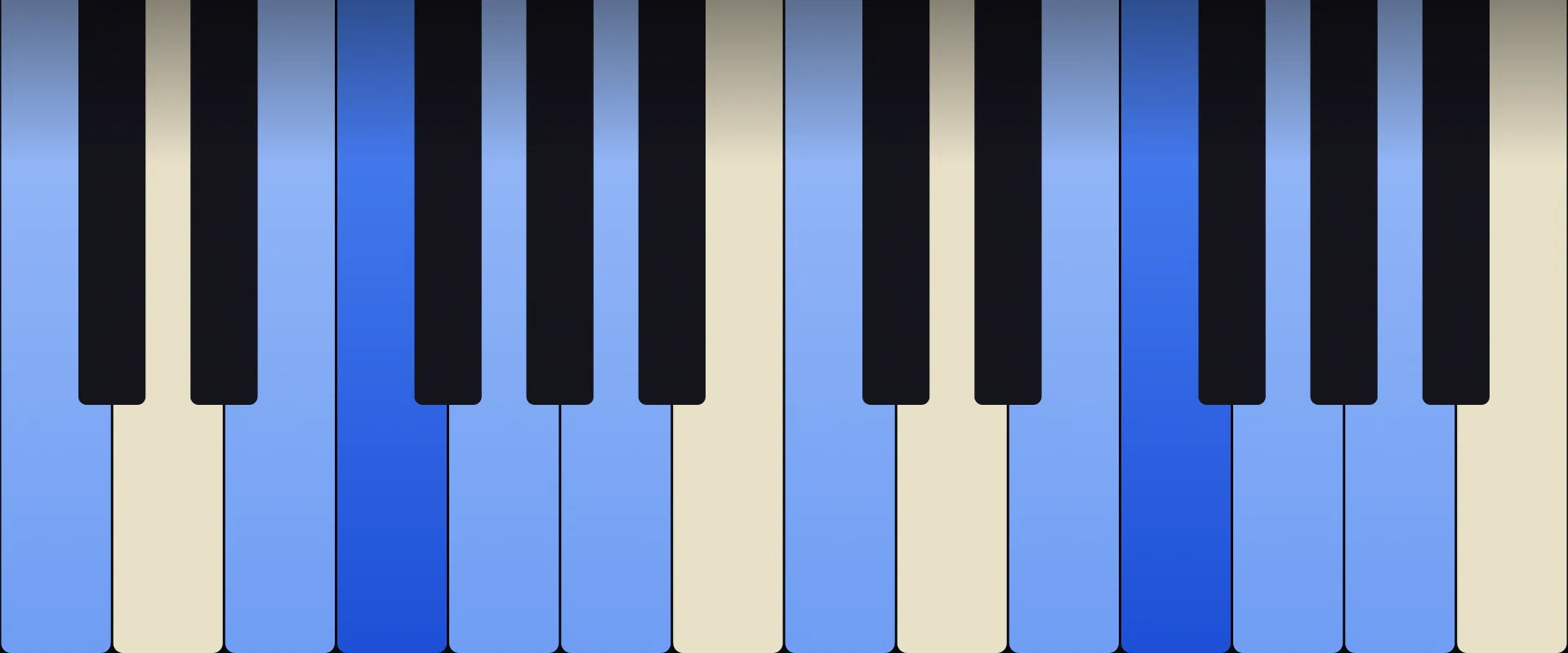
Five notes and not an accidental among them. F is the easiest root on the keyboard to find without looking, since it is the white key immediately to the left of the group of three black keys, and from there the chord is every other white key going up.
Root position puts one finger on each third: thumb on F, index on A, middle on C, ring on E, little finger on G. A medium hand can hold that 9th, but low down the five notes crowd into the muddiest part of the keyboard.
Split it instead. F alone in the left hand, A, C, E and G in the right with fingers 1, 2, 3 and 5, and the reach shrinks to a minor 7th. That right hand is Am7, so a pianist who owns one chord owns this one.
The version worth learning after that keeps F and C in the left hand and gives the right only E, G and A. Three notes inside a perfect 4th, nothing to stretch for, and the 7th sits at the bottom of the right hand where it does the most work.
One arrangement is always wrong. E must never go below F. A semitone between the bottom two voices is the only way to make five white keys sound like a mistake, and root position avoids it automatically by placing them eleven semitones apart.
Fmaj9 on the Guitar
The two finger shape at the top of this page, x 0 3 0 1 0, is the one to start from: ring finger on the 4th string at fret 3, index on the 2nd at fret 1, three strings ringing open between and around them. Its only fault is the A underneath.
Fixing that costs one more finger and no stretch. Play 1 0 2 0 1 0: index on the 6th string at fret 1, middle on the 4th at fret 2, little finger on the 2nd at fret 1, and the index standing on its tip so the open 5th keeps sounding beside it. Low to high that is F, A, E, G, C, E, everything present with the root underneath.
Do not simply let the 6th string ring on the two finger shape. Open E under the chord puts the major 7th a semitone below the root, and the result is a phrygian sounding thing in E rather than a sloppy Fmaj9.
Up the neck, x 8 7 9 8 x is the grip that gets used: one finger per string, no barre, sounding F, A, E and G. The 5th is the note dropped and nobody misses it. This is F9 at the same fret with the 3rd string moved up one, so the two chords are a single semitone apart under the hand as well as on paper. Add the 1st string at fret 8 and C returns on top.
The barre at fret 1 is the awkward route. The E shape version, 1 x 2 2 1 3, is complete, but the 5th string sits under the index sounding B♭ and has to be skipped rather than strummed, which makes it a picking voicing or nothing.
Inversions
| Inversion | Notes | Bass Note | Symbol |
|---|---|---|---|
| Root position | F, A, C, E, G | F | Fmaj9 |
| 1st inversion | A, C, E, G, F | A | Fmaj9/A |
| 2nd inversion | C, E, G, F, A | C | Fmaj9/C |
| 3rd inversion | E, G, F, A, C | E | Fmaj9/E |
| 4th inversion | G, F, A, C, E | G | Fmaj9/G |
The first inversion is where most guitarists meet the chord, since it is what x 0 3 0 1 0 produces. Read it from the bottom and it is Am7 with F laid on top, which is exactly why the row after it in a pop chart is so often A minor.
The third inversion is the row to distrust. E in the bass with F immediately above it is the collision the piano section warns about, and no amount of spacing higher up repairs it.
The last row changes category rather than spelling. Over a G bass those five notes are a dominant with no 3rd, the 13sus that stands in for G7 in C major, and the Fadd9 page takes up what a bass note can do to a name.
Voicings
Drop the 5th before anything else. C says nothing here about either the quality or the colour, and losing it opens room between the remaining notes. Keep E above middle C, keep G at the top, and the chord behaves.
| Shape | Frets, low to high | Sounding notes |
|---|---|---|
| Two fingers, three strings open | x 0 3 0 1 0 | A, F, G, C, E |
| Root restored underneath | 1 0 2 0 1 0 | F, A, E, G, C, E |
| Fret 8, no 5th | x 8 7 9 8 x | F, A, E, G |
| Fret 8, 5th on top | x 8 7 9 8 8 | F, A, E, G, C |
| E shape at fret 1, 5th skipped | 1 x 2 2 1 3 | F, E, A, C, G |
Which Keys Contain Fmaj9
- IV of C major
- I of F major
- VI of A natural minor
- III of D dorian
- VII of G mixolydian
- V of B♭ lydian
Read the list for what is missing and B♭ major is the answer. F is that key’s dominant and Fadd9 serves there happily, but B♭ major holds E♭ where this chord holds E. A major key offers a major 9th on its tonic and its subdominant and nowhere else, so nothing here ever asks the chord to resolve.
The last line is the exception that proves it. F is still the 5th degree of B♭ lydian, and what stops it behaving like a dominant is E natural, the raised 4th the mode is named for. An error in B♭ major is the whole point one mode over.
G mixolydian is the other outlier worth having. There F is the ♭VII, and the note this chord adds, G, is the key centre itself.
Where Fmaj9 Shows Up
| Progression | Chords | Where it lives |
|---|---|---|
| Imaj9, vi7, ii7, V7 | Fmaj9, Dm7, Gm7, C7 | Ballads and standards in F |
| i7, VImaj9 | Am7, Fmaj9 | Minor key loops in A minor |
| I, IVmaj9 over a held bass | C, Fmaj9/C | Gospel and soul in C |
The second row is the cheapest change in the set. Am7 is A, C, E and G, which is this chord with the F removed, so a band moving from one to the other puts a single new note underneath and holds everything above it dead still. Loops built that way never sound like they have gone anywhere, which is the effect they are after.
Row one explains why F attracts this chord. One flat suits horns, five white keys suit the pianist reading behind them, and an arranger who wants the tonic bar warm rather than final writes the 9th in without anyone querying it. Plain F major would close the tune two choruses early.
Row three is the gospel move: hold C in the bass, push the upper voices out to F, A, C, E and G, let them fall back. Nothing modulates and the bass never lifts, so the whole lift is the 9th arriving on top.
Related Chords
- F Major 7th Chord is the four notes underneath, and the shape this one is built from.
- F Add9 Chord takes the same 9th and leaves the 7th out.
- F Dominant 9th Chord lowers E to E♭ and gains a tritone.
- A Minor 7th Chord is the four notes above the root, and every rootless voicing here.
- Chord Inversions and Voice Leading covers what putting C or G underneath does.
Learn More
Extended Chords and Jazz Harmony carries the stack past the 9th and sets out which notes get dropped when. For why the tonic and the subdominant are the two degrees taking a major 7th and a 9th together, see Diatonic Chords: A Beginner’s Guide, and for the chord underneath this one, Seventh Chords: The Complete Guide. F sits one step anticlockwise from C on the circle of fifths, the shortest account of why it serves two keys at once. For every scale containing it, see Scales for Piano and Guitar: The Complete Reference Guide.
Practice Chords
Drill chord recognition with a metronome, MIDI support, and score tracking.
Start PracticingRelated Articles

A Major 9th Chord: Notes, Voicings, and How to Play It
Sep 4, 2026 · 9 min
A♭ Major 9th Chord: Notes, Voicings, and How to Play It
Sep 4, 2026 · 8 min
B Major 9th Chord: Notes, Voicings, and How to Play It
Sep 4, 2026 · 8 min